UVA’s Common Ground
How Newcomb Hall evolved from ‘Darden’s Folly’ to a home base for generations of students
Matt Riley
It was 1949, and Colgate Darden (Col 1922) expressed plenty of worry in his first annual report as UVA’s president. He wasn’t concerned about the university’s ability to prepare young men for their careers as much as something that he considered “far more substantial and lasting”—cultivating what then College Dean Ivey Lewis called, in an attached report, “trained intelligence and disciplined minds.”
Standing in the way of that goal was the dominance of fraternities, Darden wrote. Though they represented only one-third of the student body, he warned, they created a “barren and petty society in which social advancement is more sought after than solid academic achievement, and in which talent finds itself overshadowed and in danger of being inundated by mediocrity.”
He prescribed one primary remedy: a student activities building that would provide a space where every student, regardless of “membership in any organization,” could “profit to the fullest by his stay here.”
The building was part of Darden’s grander plan to democratize UVA, which also included enrolling more public school students, according to Encyclopedia Virginia, a project of Virginia’s state humanities council. And he was successful on a variety of fronts, including the construction of a dedicated student union.
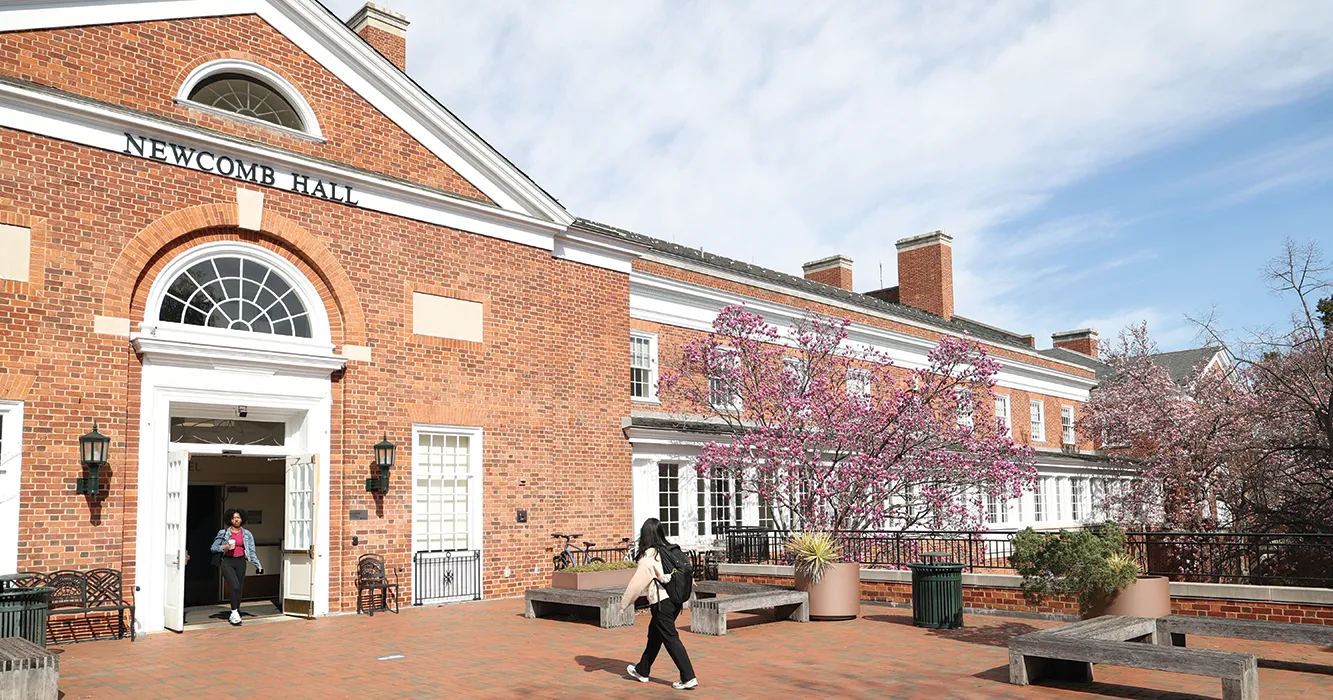
That building—Newcomb Hall—opened its doors in 1958. It included a new dining hall, replacing one inside Garrett Hall, along with new space for student activities and events For 68 years, Newcomb has meant different things to different students. For some, it has provided simply a place to grab food between classes. But for others—particularly those seeking alternatives to Greek life or spaces to gather on Grounds—Newcomb has fulfilled Darden’s vision precisely.
From its opening, Newcomb became woven into the daily rhythm of student life. Diverse groups—from international students in the building’s first weeks to Black students forming their own Greek organizations in the 1970s—found space here when options were scarce. Student leaders strategized in its offices. Student workers bonded during shifts. Between classes, students popped in for study sessions or events. And these small daily moments added up, becoming central to their college experience.
The Push for a Student Union
Long before Newcomb Hall opened, Madison Hall, built in 1905 as the first university-based YMCA in the country, provided some spaces for students to meet. Student publications and other groups had their offices in the building, which also hosted concerts, lectures, pep rallies and dances.
According to Virginius Dabney (Col 1920, Grad 1921) in his book Mr. Jefferson’s University, a group called the Student Union had operated before World War I and was revived in 1933 on the redecorated lower floor of Madison Hall. It ran a used book exchange and social spaces for activities like ping-pong and badminton.
A decade later, in 1943, the Dry Dock, a lounge and soda fountain with a nickelodeon and pinball machines, opened in Madison Hall’s basement and was “pronounced a howling success,” Dabney wrote. “It was said to be the first thing remotely describable as a student union that the university had ever had.”
By the time the Dry Dock opened, discussions about the construction of a dedicated student activities building were already a decade old and becoming more than talk. At a 1945 Charlottesville Rotary Club meeting, Lucius Moffatt, a Romanic languages professor, promoted plans for a “student union” building that would be “comparable to the best in this country,” he told the crowd, according to a Daily Progress article.
As Virginia’s governor from 1942 to 1946, Darden had championed the project. By his 1949 report as UVA’s president, the need felt urgent. During the 1947-48 academic year, reports surfaced of what was characterized as a general “whooping up”—unchaperoned girls and women being “entertained at all hours” in Lawn and Range rooms, and “drinking of alcoholic liquors.”
With Darden’s support, Student Council leaders stepped up with measures to improve student behavior, including a plan to open first-floor suites in dorms as temporary lounges for mixed parties, supervised by chaperones from the Charlottesville community.
Still, a student activities building—the best solution, as Darden saw it—remained unfunded. State lawmakers balked at approving construction funds amid budget pressures that included rising inflation and a shortage of building materials because of military needs. The first $500,000 for the project, then estimated to cost about $1.5 million, finally came in March 1950. But it was a short-lived win; by November, construction on the student union and other projects on Grounds was deferred indefinitely.
It would be several years before momentum returned. In 1954, shortly after the death of UVA’s second president, John Lloyd Newcomb (Engr 1903), Darden named the planned building in his honor. While president, Newcomb also had been an early proponent for a student activities building at UVA.
Students were invited to offer thoughts on the design. And Porter Butts, a nationally recognized student union expert from the University of Wisconsin, was called in as a consultant. Butts would consult on the design of more than 100 student union buildings during his career.
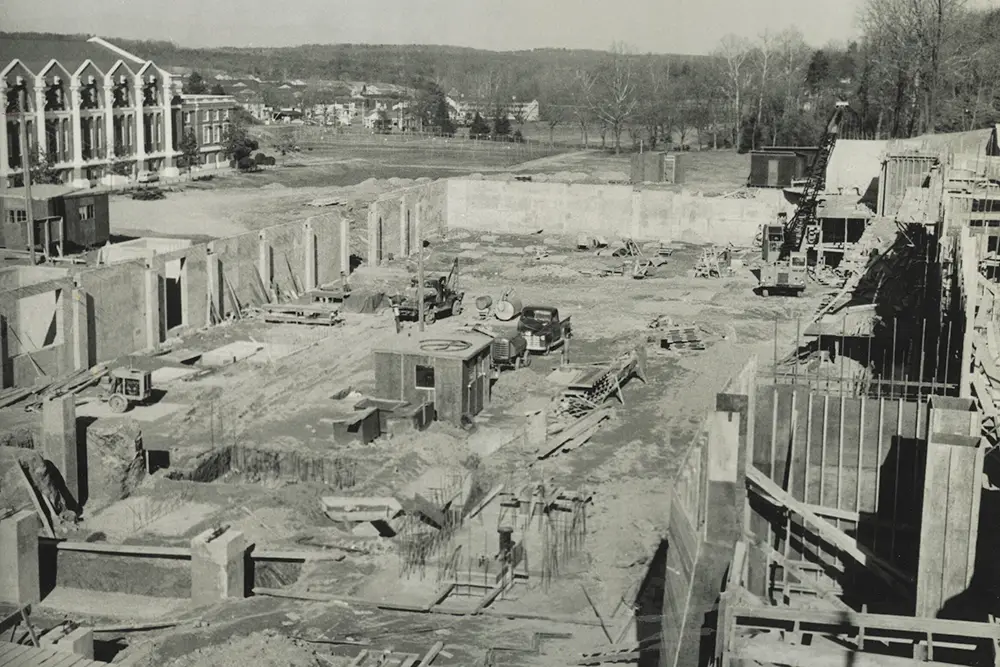
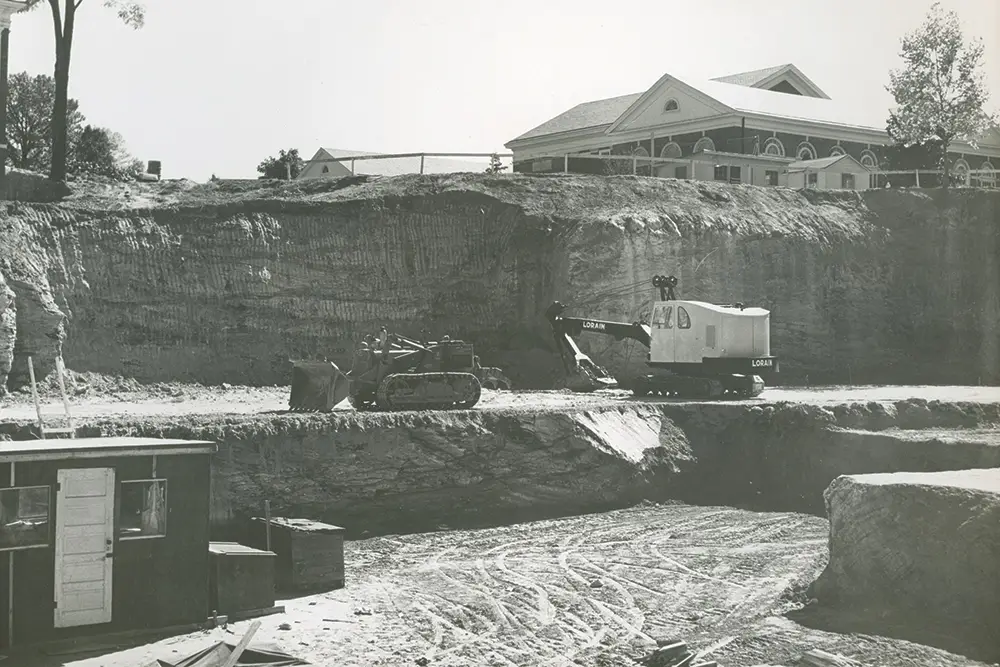
Construction ultimately began in the summer of 1956, timed to start after June finals in the education school because the excavation would be so loud. When Newcomb Hall opened at the start of the 1958-59 academic year, it received statewide coverage and was described as “ultra-modern.” The total cost came in at $2.5 million.
When Darden retired in 1959, he considered the building a crowning achievement—though plenty had derided the project before and after it opened. Through the years, amid worries that it was an attempt to quash Greek life or an effort to turn an elite “gentleman’s university” into nothing more than another big state university, it was derided as “Darden’s Folly.”
Some students nicknamed it “The Palace,” making fun of its well-appointed rooms, The Daily Progress reported. But they also were filling up the spaces.
“Many students have remarked that they don’t know how we’ve gotten along without it,” then-Student Union President Kendrick Dure (Col class of ’59, Law class of ’65) was quoted as saying in a Roanoke Times article when the building opened.
Within weeks, the building was drawing crowds for events. In October, the International Students Club held a dance to mark United Nations Day, featuring a dance performance by Reiko Kamata (Grad class of ’59), then a graduate student in foreign affairs from Japan, and singing from Welsh students.
Notable speakers came. In November 1958, future U.S. Attorney General Robert F. Kennedy (Law class of ’51), then chief counsel for a Senate committee that investigated labor racketeering, drew 500 to the new building to discuss labor corruption. The event was a Kennedy family affair: Robert had led UVA’s Student Legal Forum during law school, and his brother, Ted Kennedy (Law class of ’59), the future U.S. senator, held the same position at the time and introduced him.
Still, student life was strongly centered around the fraternity system that Darden had critiqued. And by the time Newcomb Hall opened, students had managed without it for so long that the community didn’t quite know what to make of it, remembers Beverley Crump (Col class of ’63, Law class of ’68), who was involved in the University Union and PK German while an undergrad and served on Student Council while in law school.
“University-wide events were already being handled without a student union,” Crump says. “Newcomb was a new idea and a new function. It provided a great space for a cafeteria, and I think that was well-used. It provided offices for the student organizations. It wasn’t the center of student life.”
Changes to the Building
Through the decades, the building evolved, along with the students who relied on it.
The building’s basic layout has remained fairly consistent since it opened. The main dining hall is on the second floor; the Ballroom, which has hosted dances like the Restoration and Colonnade balls, is on the third floor; and offices for student groups such as Student Council and the Honor and Judiciary committees are on the fourth floor. The Cavalier Daily, once on the fifth floor, moved to a renovated basement space in 1992 due to stricter fire codes.
“For a substantial fraction of the university’s existence,” the paper’s editorial board wrote, “the fifth floor of Newcomb Hall has been the Grand Central Station of information on Grounds. … Now we are ready to launch a new era of late nights and tight friendships closer to sea level.”
The building has also undergone several major renovations. In 1981, UVA added 15,000 square feet, creating a multiuse meeting room and expanding the university’s bookstore there. Thirteen years later the bookstore moved out of Newcomb, relocating to a new building and parking garage next door.
In 1995, UVA launched a two-year project to add 6,200 square feet to Newcomb, according to Corks & Curls. The project forced about two dozen student groups, including Student Council, the Honor and Judiciary committees, and the Cavalier Daily, to temporarily relocate.
The most recent transformation came in 2013, when UVA completed a three-year renovation. That project expanded seating in the dining hall and Pavilion XI, nicknamed “The Pav”; added 16,500 square feet to the building; and renovated 85,000 square feet of the existing space. For several months during the renovation, a temporary dining hall, dubbed “N2,” was set up in front of Peabody Hall.
Beer and Bowling
The building’s amenities told their own story, shaped by shifting student interests and state drinking laws.
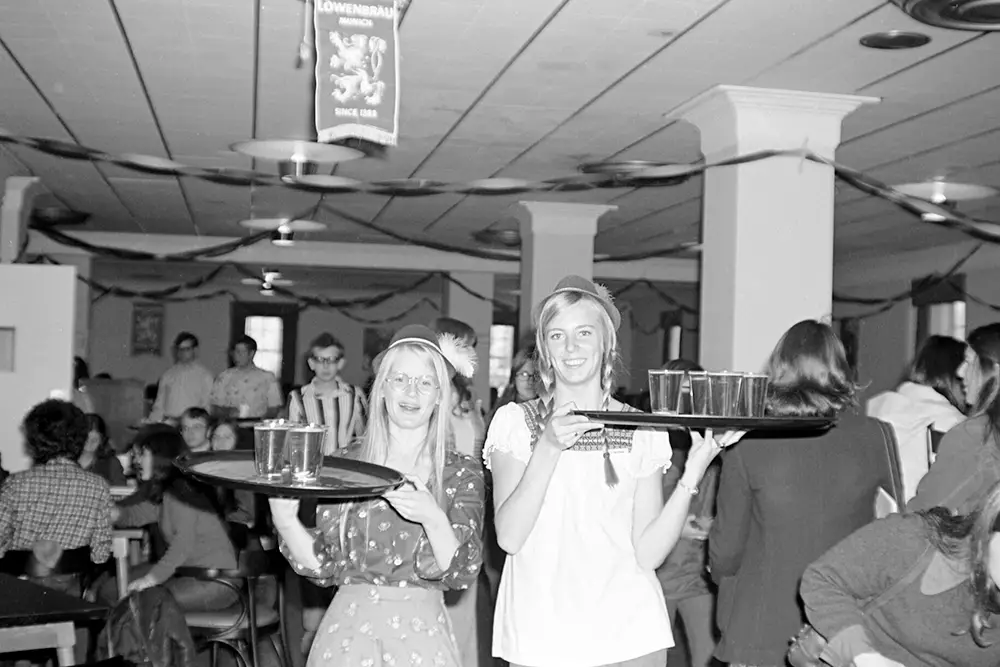
In the 1970s, when the legal drinking age was still 18, a student beer hall opened on the first floor of Pavilion XI and became a popular hangout with bands and beer. Clara “Kiki” Steele Eden (Col class of ’80, Med class of ’88) remembers disappearing into the dark space as she entered to dance. “It had lots of music,” she says. “It was an alternative place to go, and I enjoyed that.”
But serving beer on a college campus proved more difficult as the drinking age changed to 21 in the 1980s. By 1985, plans were in the works to convert the night spot into a “daytime student hangout,” according to the Cavalier Daily. Beer taps moved to a back room, and the serving area was converted into a coffee bar and new home for Newcomb’s then-popular Sweet Shop, which sold pastries.
In 1986, UVA had to crack down on ongoing underage drinking in the space, according to the Cavalier Daily. To prevent students from serving underage friends, pitchers of draft beer were no longer sold, and bottles of beer could be purchased only one at a time. By 1990, plans were in the works to end beer sales altogether. The reason: too few customers.
Other amenities also faded with time. Newcomb Hall Lanes, a bowling alley included in the original design, closed in 1968 because of the sport’s “lack of popularity,” the Cavalier Daily reported. And long before streaming services, small listening rooms with record players and a library of records once took up spaces across from the Ballroom, remembers Yolanda Burrell Taylor (Col class of ’76). “They were small rooms, but a few people could gather and listen or just talk.”
Communities Within
Much of life in Newcomb has played out behind closed doors and in quiet corners—in the offices where student leaders strategized, the meeting rooms where groups gathered, and the communal spaces where students studied or connected over curly fries.
Sometimes the building’s simplest features have brought students together. The ride board, where students posted requests for lifts home, became an unexpected matchmaker, forging a few romances. Before TVs in dorm rooms and smartphones, Newcomb’s televisions drew crowds that gathered to witness Jack Ruby shoot Lee Harvey Oswald in 1963, the moon landing in 1969, and the O.J. Simpson verdict in 1995.
And then there were the routines—shifts working in the dining hall or movie theater, hourslong student governance meetings, and visits to the bank and bookstore.
“In the ’80s, everything was in Newcomb Hall,” says Debra Haas (Col class of ’85), who served as co-chair of University Union. Newcomb felt so much like home base to Haas that she’d leave her belongings on a window seat near the Union office where she studied. She was there so often that friends looking for her knew to check the spot.
Leon Chen (Col class of ’07) and his sister Vicky Chen (Engr class of ’08) spent countless hours as projectionists in Newcomb’s movie theater with a tight-knit community of co-workers. They spliced reels together, adjusted focus and framing, and played at least one prank on an unsuspecting audience. Ahead of a screening for the 2006 Samuel L. Jackson vehicle Snakes on a Plane, Leon played a trailer—for the same movie.
“I was in the theater for one of those, and the people watching it were really hyped up to watch the movie,” Vicky says. “So when they saw the trailer, they were cheering.”
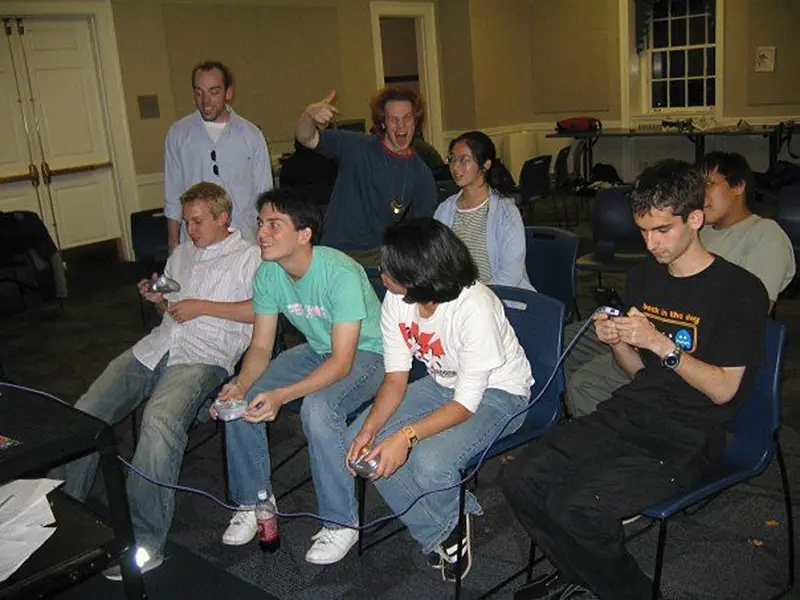
Both siblings were also members of UVA’s Gamers Club, which held events in Newcomb. After club meetings, attendees would often head to Newcomb to eat dinner together, Vicky remembers. “For me, a lot of my college memories are over there.”
Eden remembers the camaraderie with other student workers who, like her, had to work to stay in school. They toiled in Newcomb’s basement dish room, loading stacks of dishes into a giant dishwasher. “It was hot as can be down there and messy,” she says. Later, while working in the bookstore, Eden once sold basketball star Ralph Sampson (Col class of ’83) a single pencil. “I was starstruck,” she says.
Eden had not known Newcomb’s origin story. But in her mind, Darden’s effort to provide an alternative to Greek life succeeded. “That served that purpose for me,” she says.
A ‘Center for Entertainment’
As president, Darden’s vision of an expanded student body meant opening UVA’s doors to a broader range of white men. He supported “separate but equal” schools and barred Gregory Hayes Swanson (Law class of ’53), UVA’s first Black student, from living on Grounds. He named Newcomb Hall after a supporter of eugenics, a pseudoscience based on false claims of Black genetic inferiority. So it’s likely Darden never imagined that the building he long championed would become a vital hub for Black students seeking community and belonging.
In the 1970s, as more Black students entered UVA, Newcomb Hall became essential infrastructure for building community at the predominantly white university. Taylor was a charter member of UVA’s chapter of Delta Sigma Theta, the school’s first Black sorority, formed in 1973. She remembers holding step shows in Newcomb’s Ballroom (as well as in the Chemistry Building) and meetings in its conference rooms. Without a house of their own, Newcomb helped serve that purpose. “We did not have deep pockets,” she says.
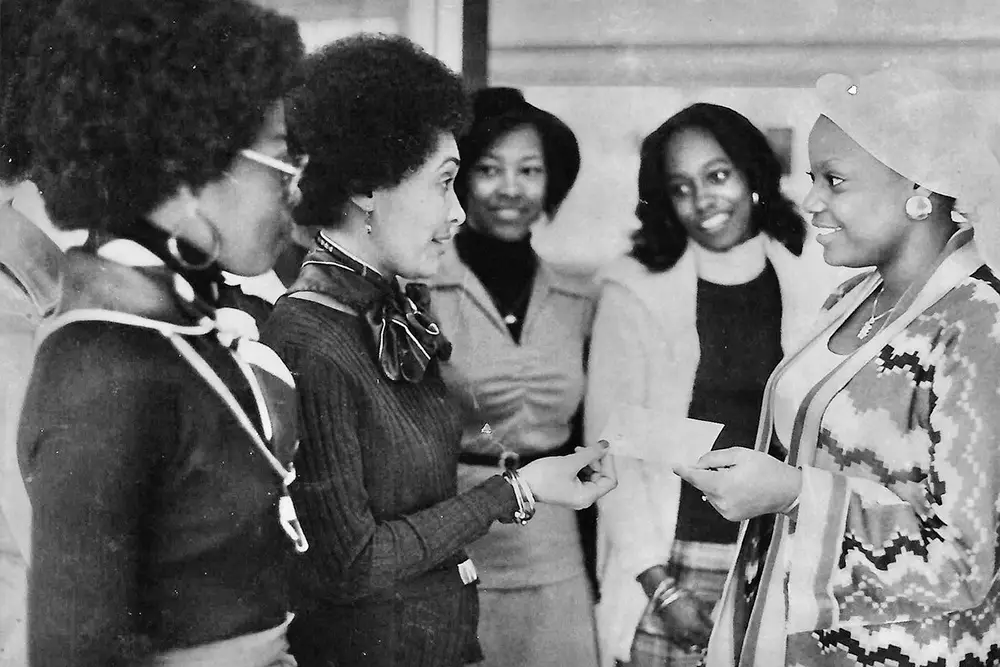
By the late 1980s, the building had become the center of Black student life. Tahnee Jackson Whitlock (Col class of ’92) remembers meeting up at noon with other Black students at the Black Bus Stop, the UTS stop in front of Monroe Hall, to walk over to Newcomb for lunch, and spending countless hours there between classes.
“I don’t know if those are the people [Darden] wanted up there, but it was mission accomplished on the goal of having alternative social opportunities for people,” Whitlock says.
Throughout her time at UVA, Whitlock was an active member of the Black Student Alliance, whose offices were also on the fourth floor. That’s where she spent most of her time when she wasn’t in class or studying.
“It was caffeine-fueled, and you were always on a mission in that office,” says Whitlock, who helped organize a march against apartheid in South Africa.
The office was a hub for Black students and leaders, and home to the group’s Pride Magazine. The alliance’s monthly meetings and parties packed the Ballroom, and they regularly drew crowds for film festivals, symposiums and cultural events.
“It was another home for us, and it wasn’t just us,” Whitlock says. The office was steps away from other major student groups, including Student Council, the Honor and Judiciary committees, and University Union. That proximity created a cohesive community of diverse student leaders who discussed issues and made plans together, Whitlock says.
“It made for a really good opportunity for every single one of those organizations to collaborate,” she says. “A lot of us became part of the Lawn, so it just solidified that experience.”
For Marjorie Boursiquot (Engr class of ’96), Newcomb Hall was central to her social experience at UVA. She remembers singing “Bridge Over Troubled Water,” during Harambe, an annual peer adviser celebration, and watching dance troupes perform during CultureFest. At DJ parties in the Ballroom, the crowd would go wild when A Tribe Called Quest came on. While other parties centered on drinking with music, Newcomb’s parties were focused on the music and dancing themselves, she says.
Newcomb offered something else crucial: a place to gather safely, without the tensions or risks Black students sometimes faced in predominantly white spaces and neighborhoods.
“It definitely was the center of entertainment for us,” Boursiquot says. “And it was just a safe, easy place to go. Even if you were going to do something afterwards, you would go to the Newcomb party first.”
Decades of Student Life
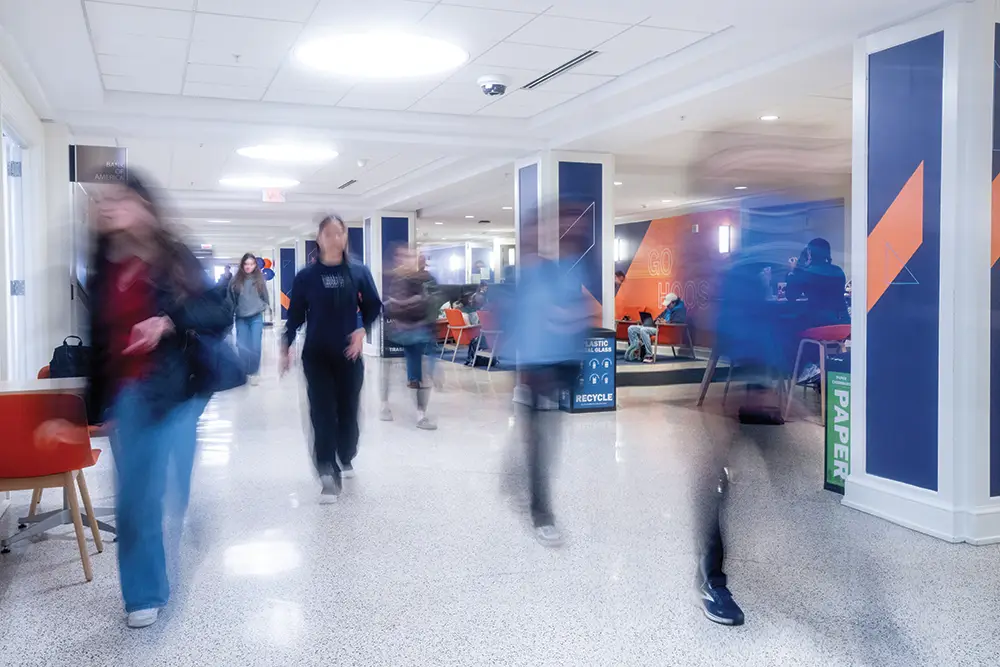
Nearly 70 years after it opened, Newcomb’s cycle continues. New generations of students create the same rhythms that defined the experience for those who came before.
“The area is very busy,” says Angeline Ngo (Col class of ’27), vice chair of programming for the University Programs Council. “It’s not often that you go into Newcomb Hall and there’s not something going on, even on weekends.”
Spaces are sometimes booked months in advance, and the University Programs Council regularly plans events that draw hundreds of students. Its Newcomb Hall Crawl, an event for first-years at the beginning of the fall semester, brings out 1,000 students to learn more about what the building has to offer, says chair Bhavya Suggula (Col class of ’26).
Sure, many students spend far more of their free time on the Corner than in The Pav. But for a big part of the student population, Suggula says, Newcomb lives up to Darden’s original vision: a place for students to gather, regardless of their affiliations.
“I one thousand percent think so,” Suggula adds. She’s also chair of UVA’s Pan Asian Council, which organizes big cultural events and shows in the building.
“Newcomb Ballroom, especially, everyone’s fighting to death for,” she says. “It’s really hard accommodating everyone who wants to use it, but … people want this big space to be able to showcase their community and what they stand for. And I think that’s really meaningful.”