Protecting memories in Alzheimer’s patients
Memories are one of the most important bonds we share with the people we care about. So it is particularly heartbreaking that late-stage Alzheimer’s disease steals the ability to remember not only the stories but the people themselves.
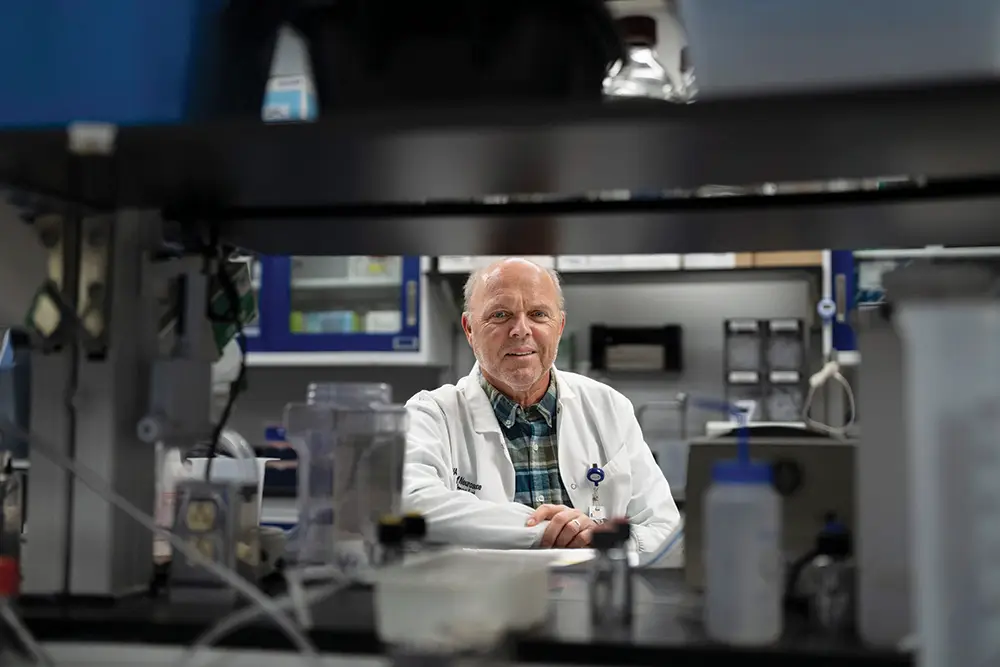
Social-recognition memory is “a very discrete form of memory, a very important one and one that is unequivocally lost in late stages of Alzheimer’s disease,” explains Harald Sontheimer, professor and chair of neuroscience in UVA’s School of Medicine. “When you talk to people who care for persons with Alzheimer’s disease, it is very difficult once you realize your loved one no longer recognizes you.”
Now, however, research from Sontheimer’s team, published in Alzheimer’s & Dementia: The Journal of the Alzheimer’s Association, has found that protecting a gel-like sugary protein substance that surrounds specialized neurons in the brain’s hippocampus may help maintain and preserve these important social memories.
Other researchers, Sontheimer notes, have found that damage—such as through injury—to a particular region of the hippocampus leads to a similar loss of this kind of memory. Sontheimer and his team compared healthy mice to those genetically modified to mimic the brain changes and symptoms of Alzheimer’s disease.
As the disease progressed in the Alzheimer’s mice, the researchers found that inflammation in the brain released enzymes that “digested” the gel-like substance (known as the perineuronal network, or PNN) surrounding the neurons in that region of the hippocampus. These mice, unlike the disease-free mice, lost their ability to distinguish familiar, known mice from unfamiliar stranger mice. At the same time, however, the mice with Alzheimer’s retained their ability to recognize familiar objects, suggesting that social memory, but not object memory, had been affected by the loss of that PNN.
“We were able to attribute this [social] memory loss to a very specific deficit in a very small area of the hippocampus,” Sontheimer says. Significantly, he adds, there was no change to the nerve cells themselves—only to the surrounding perineuronal network.
Next, the researchers found that by treating the Alzheimer’s mice with a drug that inhibited PNN-digesting enzymes, they could successfully preserve social memory. As long as the treatment continued, social memory was maintained.
Also exciting, he says, is that the class of drugs the researchers used has previously been FDA-approved for use in human clinical trials, which could potentially mean they could more rapidly be moved into use in clinical trials for Alzheimer’s patients. Sontheimer cautions, however, that researchers always have to keep in mind that while something can look promising in a mouse model, “not everything translates from mouse to humans.”
Sontheimer says progress in finding effective means to prevent, delay or treat Alzheimer’s has remained challenging because, despite how central memory is to day-to-day life, researchers still don’t really understand it. “We understand so little about memory in general,” he says, “and that makes it challenging to study a disease that is so defined by memory loss.”
Still, he says, progress is being made, and novel lines of inquiry, such as his team’s exploration of the role of PNNs in social memory loss, may help reshape our understanding of Alzheimer’s, including what role the immune system plays in maintaining—or losing—our ability to remember.