“Death, taxes—and Virginia swimming winning”
Women win a “surreal” sixth straight NCAA championship
UVA Athletics
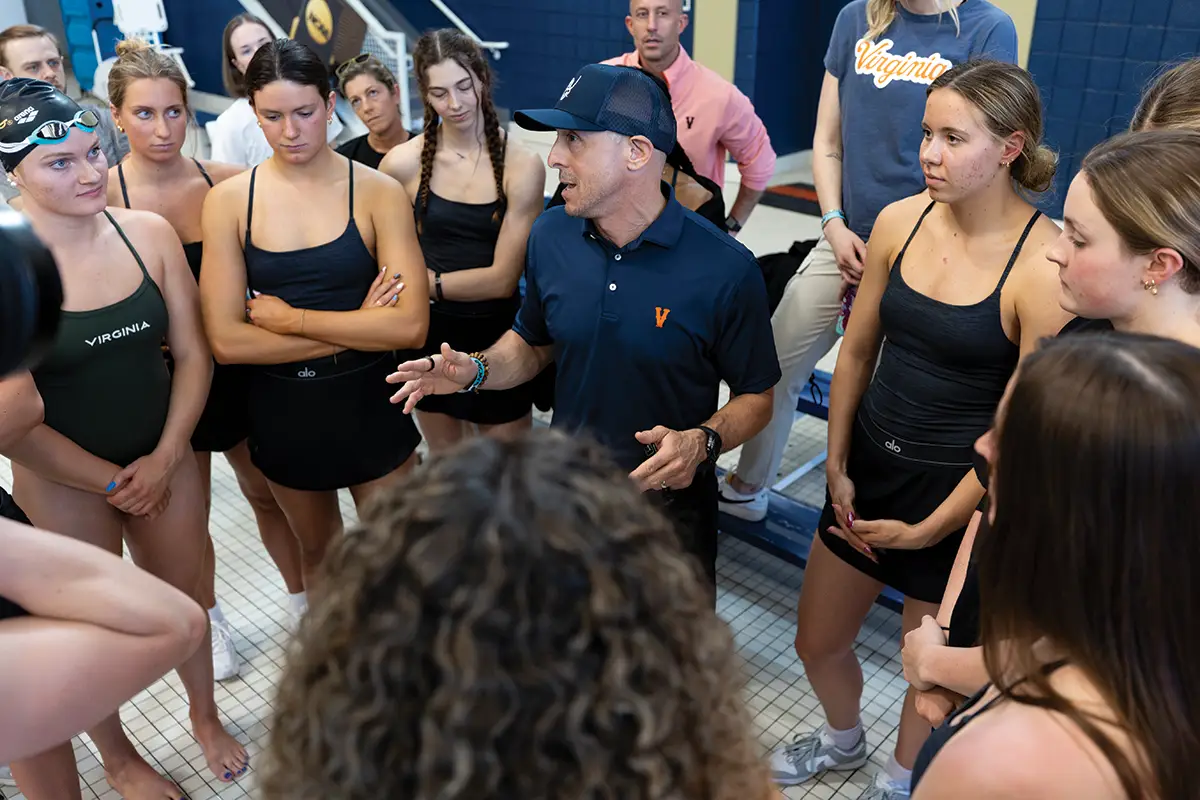
For his first practice with the UVA swimming and diving team in August 2017, head coach Todd DeSorbo wanted to make a statement. He had arrived on Grounds only a few days before, and he didn’t have a lot of preparation time.
Practice started at 5:45 a.m.; DeSorbo and the coaches met beforehand. As they were about to walk onto the pool deck, DeSorbo told them to stop. “We’re not just walking out there,” he said to his staff. “We’re going to go out and yell and scream.”
“It was just this infusion of energy,” senior associate head coach Tyler Fenwick remembered, laughing.
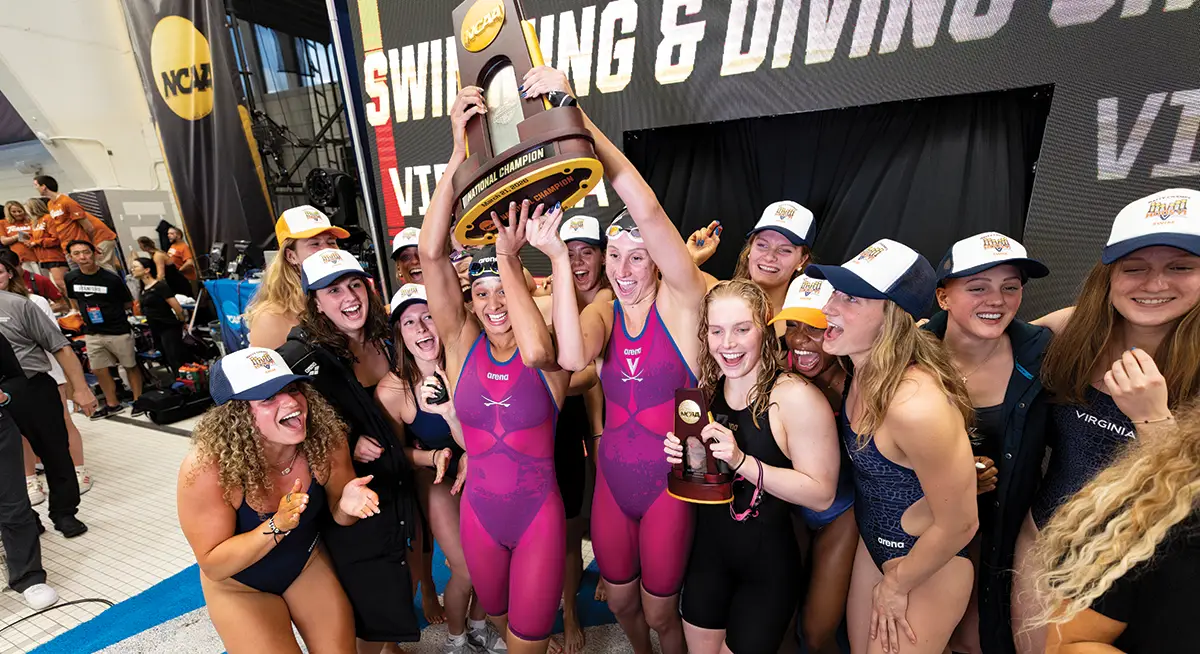
The energy has not subsided since. Nor has the winning. Further cementing its status as the most elite women’s swimming program in the nation, UVA in March won its sixth straight NCAA championship, setting a record for most consecutive national titles within collegiate swimming.
The Cavaliers finished with 589 points, the most in program history and 208.5 more than second-place Stanford. The Virginia women won all five relay events; of the 18 women who competed, 16 scored and were named either first- or second-team All-Americans.
“It’s been a little bit surreal,” DeSorbo said. “Tyler Fenwick actually was talking to me before the trophy ceremony. He was like, ‘Who would have thought in 2017 in August that we’d be sitting here winning our sixth title in a row?’ It hasn’t sunk in yet. I’m going to have to take a couple steps back and let it sink in, but it’s pretty impressive for sure.”
DeSorbo’s first UVA women’s team was not one he recruited. But it was one he knew well. He arrived at UVA after six years coaching at NC State.
In his final season with the Wolfpack, the team’s motto was “TAKE THE 10th.” Virginia had won nine consecutive ACC championships, and DeSorbo’s NC State squad was determined to deprive them of the next. The Wolfpack women won the ACC title that year; five months later, he was at the helm in Virginia.
DeSorbo’s coaching methodology often includes mantras and phrases. His motto for UVA that first year was “ALL DAY.”
“We put the words up immediately in my office—that was the vibe we wanted to impress upon the team,” DeSorbo said. “We’re going full steam ahead.”
The women’s team finished ninth at the NCAAs in 2018. They finished sixth at the NCAAs the next season. “That felt like a championship to us,” said Alexis Wenger (Col class of ’22), who was part of DeSorbo’s first recruiting class. The women’s team had placed fifth in 2015 and 2016, but never any higher.
They entered the 2020 season intent to build on that momentum. With ACC Freshman Swimmer of the Year Kate Douglass (Col class of ’23, Grad class of ’28) on the roster, they won the ACC and had the point totals to compete for—and very likely win—the program’s first national championship. But two days before the NCAA championship meet, the pandemic canceled the competition.
The next season was a test of commitment. Only two swimmers could practice per lane, starting at opposite ends of the pool. They had to put on masks after exiting the water. Three times a week, the team and staff were tested for COVID.
Wenger, one of the team captains, worked with the other captains to find ways to build camaraderie. They’d organize group outings to wineries, having each swimmer bring a blanket to sit 6 feet apart outside. They assigned different apartments for gatherings, ensuring that only five swimmers were in a room at once, and switched the groups so different swimmers spent time together. DeSorbo texted the team every two weeks, asking if they wanted to opt out due to health concerns or opt in and continue training. “A lot of people opted out,” Wenger said. She stayed. Still, “it was sad and hard. It was super weird given how close our team was … to be so isolated from each other.”
The team’s mantra that season was “WE WILL.” “They followed the rules, stuck together, and really committed,” Fenwick said. “I think that’s when our women’s team in particular went from really good to being on track to do something epic.”
Epic, indeed: On March 20, 2021, they won their first NCAA title. “It was maybe one of the biggest reliefs of all time,” Wenger said. “Everything we had sacrificed that year, it was all worth it.”
Alex Walsh (Col class of ’24) was a first-year on the first championship team. The No. 2 high school recruit in the nation, she had envisioned herself swimming for Cal Berkeley or Stanford. But Margaret “Ella” Nelson (Com class of ’24) was a close friend and high school classmate, and when Nelson chose UVA, “that set off bells in my head, like, ‘Something’s going on there,’” Walsh said. She decided to visit.
Driving into town, Walsh saw the V-Sabres adorning Grounds and noticed groups of students hanging out on the Corner. She bonded with future teammates, laughing and sharing stories. She called her mom that night and told her she wanted to commit. “The cohesion of the team was so hard to resist,” said Walsh, a world champion and Olympic medalist. “It definitely was indicative of the great experience that I would have at UVA.”
Alex’s younger sister, Gretchen Walsh (Com class of ’25), arrived at UVA in the fall of 2021. Initially she hadn’t wanted to follow in her sister’s footsteps to UVA. But then she spoke with DeSorbo and visited Grounds. She too was convinced not only that she’d become a faster swimmer, but that she could contribute to UVA’s championship streak.
“I think I valued them equally—the team success and my own success, and that’s kind of the mentality of the whole UVA swim culture,” Gretchen Walsh said. “We make each other better.”
Practices are high energy, with loud music, an infusion of numbers—credit DeSorbo’s background as an accountant—and competitive encouragement. The goal is not slogging through endless laps, but specific plans based on discipline (such as sprints vs. distance), as well as strength, agility and power. Wenger points out how every practice is tailored to each swimmer based on that day. “Todd takes a very individualized approach, which a lot of coaches don’t do,” she said.
In the years since the initial national title, the swimmers’ commitment to DeSorbo and his staff’s plans—and to one another—continued to produce championships. Alex Walsh recalls her fourth year in 2024, when Texas and UVA were very close, points-wise, entering the final day of the NCAA championship meet. The night before, the coaches gathered the team. “Look around at each other,” they told the swimmers. “Remember all that you’ve done together, how you’ve pushed each other. You have some of the best training groups in the world in so many different disciplines.”
“Just being reminded of that was motivation in and of itself,” Alex Walsh said.
The next day, they won again.
Meeting with the team at the start of this season, DeSorbo reminded the women that they wouldn’t have superstars like Douglass or the Walsh sisters dominating every relay—rather, the team would likely have races decided by hundredths of a second. “And I was like, ‘That’s going to be way more fun,’” DeSorbo said. “I think they took the challenge of it.
“They exceeded expectations and still won by a mile,” he added. “A lot of the relays, they weren’t that close. I think they took a little bit of a chip on their shoulder, but the point being, the challenges are what makes it motivating and fun and exciting.”
It might seem that each consecutive championship creates more pressure for the next year. But the coaching staff reminds the swimmers that pressure is a privilege. “I tell them all the time—I’m not good with words, so I say, ‘If we sucked, there would be no pressure,’” DeSorbo said. “‘But you don’t suck! There is pressure and expectation because you’ve earned that.’”
Perennial championships change a program’s profile, including the recruiting process. “Now you almost have to have that X factor,” DeSorbo said. “The depth of the program, the competitiveness, the high-level talent of our athletes—that scares away a lot of recruits. The ones who come here now have the X factor already. They’re not scared of that.”
This year’s squad was full of X-factor swimmers, who dominated regular-season meets as the potential of a historic sixth consecutive title loomed.
And even the top performers credited the team’s togetherness for their collective success. “There was such a cohesiveness that we had, that was unlike anything I’ve ever felt before,” said Claire Curzan (Col class of ’26), who won four individual and two relay events at the NCAA meet, while also coming within 0.01 seconds of her own NCAA and American record in the 200 backstroke.
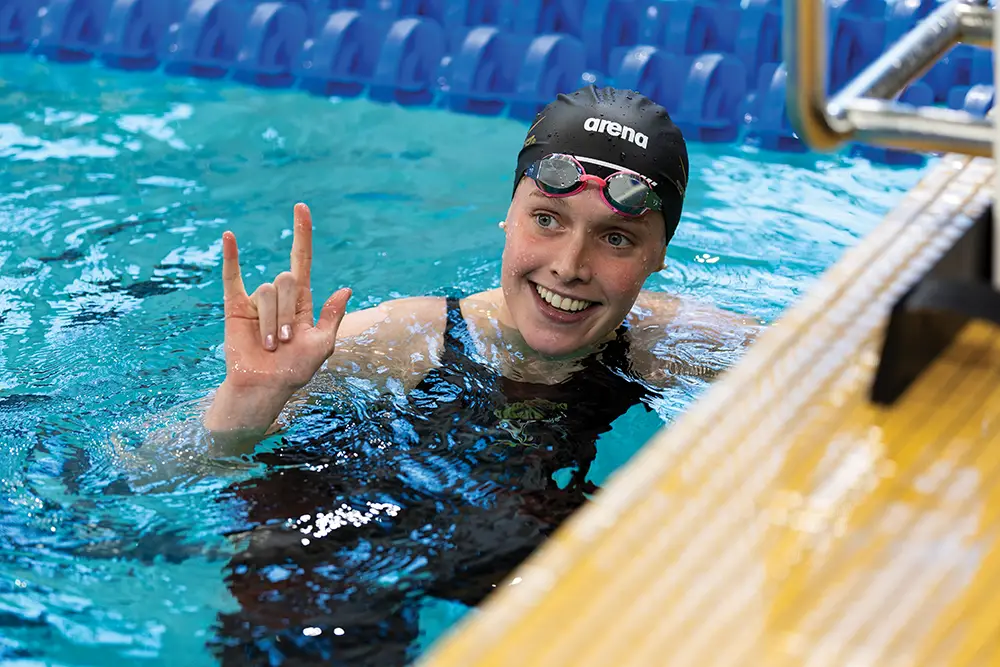
Curzan said that as soon as the team won, while it was exciting and historic, she was already thinking about a potential seventh consecutive national title.
Others are as well. This spring, DeSorbo took part in an ACC Town Hall event where ACC Commissioner Jim Phillips spoke.
“There are three things in life that are guaranteed,” DeSorbo quoted Phillips as saying. “Death, taxes—and Virginia swimming winning.”
It’s a dynasty that, like the swimmers themselves, shows no sign of slowing down.