“What Didn’t I Learn Here?”
Alumna Gov. Abigail Spanberger on UVA, the public trust and governing in divided times
Sanjay Suchak
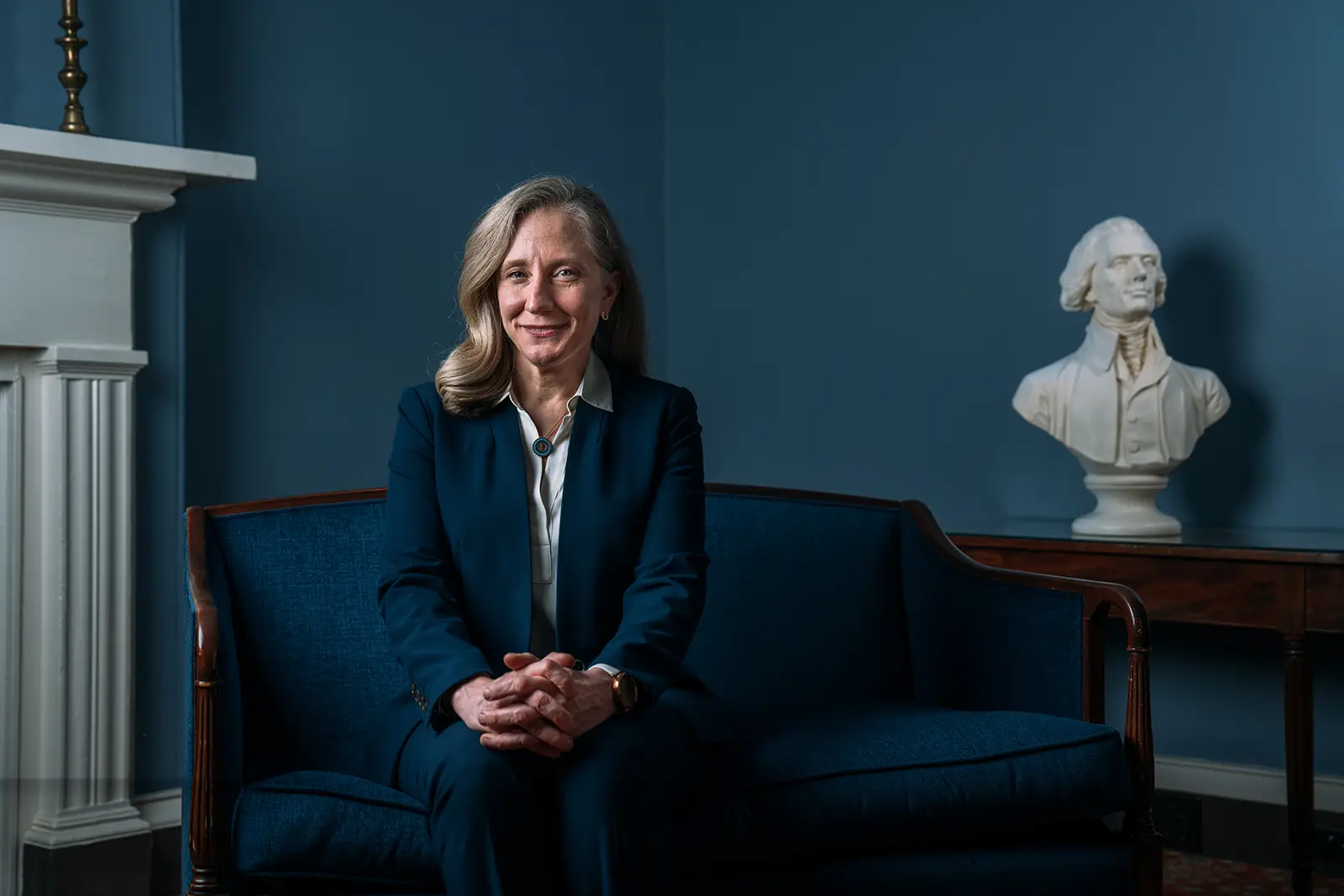
Abigail Davis Spanberger (Col class of ’01) arrived at the University of Virginia in the late 1990s, a French major from the Richmond suburbs with the dream of becoming a spy. A quarter century after graduating, she’s back—as the first female governor in the commonwealth and the official ultimately responsible for the institution that shaped her.
The intervening years were not quiet ones. Spanberger worked undercover for the CIA. She flipped a Republican congressional district that hadn’t sent a Democrat to Washington in half a century. She built a reputation, rare in contemporary politics, for working across party lines. Then, last year, she won Virginia’s governorship by 15 points, the largest Democratic margin since 1961.
In her first months in office, Spanberger, 46, has moved swiftly to reverse policies set by Republican Gov. Glenn Youngkin and the Trump administration, ending state law enforcement partnerships with U.S. Immigration and Customs Enforcement and working with the Democratically controlled General Assembly to lower prescription drug prices, expand affordable housing and cut energy costs.
On the higher education front, Spanberger immediately appointed 27 new members to the boards of visitors at UVA, George Mason University and the Virginia Military Institute, institutions that experienced high-profile controversies over diversity initiatives under the previous administration.
Those moves have attracted national attention. Spanberger was tapped to deliver the Democratic rebuttal to the State of the Union—from Colonial Williamsburg, no less. And party leaders have pointed to her affordability-focused campaign as a potential blueprint for the 2026 midterms. Republicans, however, have challenged her centrist credentials, arguing that her agenda aligns more closely with traditional liberal priorities.
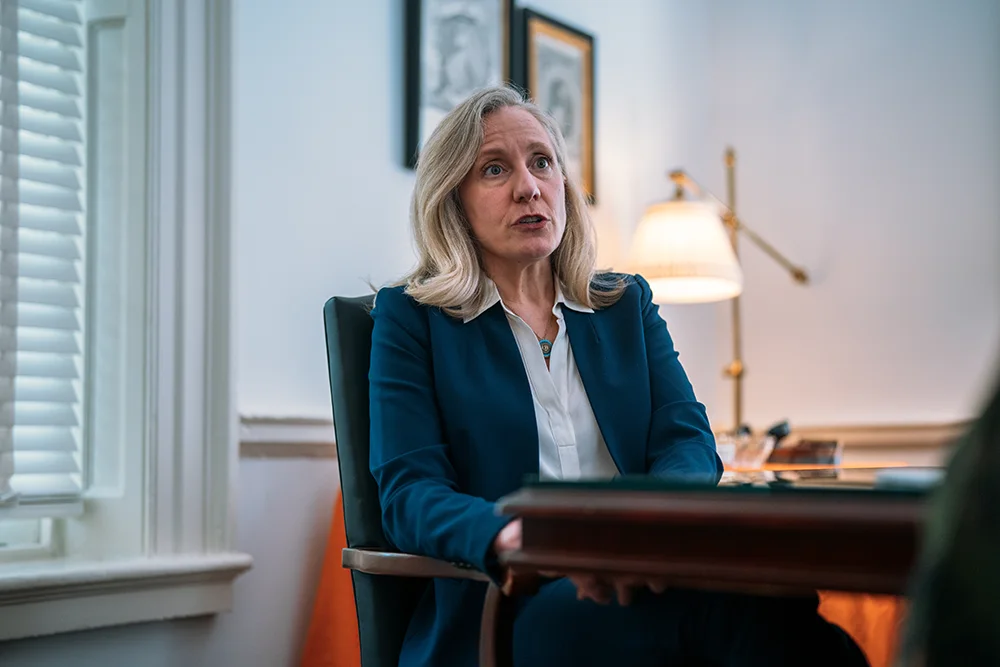
Virginia Magazine sat down with the governor in April at the Colonnade Club to talk about her first months in office, her political trajectory and her vision for the future of higher education in Virginia. What follows has been edited for clarity and length.
You’ve described UVA as the place where your instinct to serve was sharpened. What did you learn at UVA that has guided your career in public service?
My answer would be: What didn’t I learn here?
During my time on Grounds, I studied a mix of languages and foreign affairs. I always knew I wanted to follow a path into public service, but particularly through my foreign affairs class and just getting passionate about foreign affairs, I think I really honed my desire to work in the national security space.
Then the languages I took—and the time I spent developing relationships with other people who loved languages and cultures—I think helped further refine that I wanted to be based overseas and really work to constantly understand differences in order to understand threats and keep the country safe.
In November you asked UVA’s rector and vice rector to pause the presidential search, but they pushed ahead, signing a five-and-a-half-year contract with Darden Dean Scott Beardsley. You replaced both leadership positions and appointed a new majority to the BOV. Can you walk us through your reasoning for what you did and why you believed it was necessary to act immediately?
I’m sure anyone reading this remembers that time when it was just every day a new thing in the news about UVA—every day something new about how it came to pass that President Jim Ryan (Law class of ’92) left. There was this constant drip, drip, drip.
And the agitation that caused within the alumni community, certainly within Charlottesville, and on Grounds for students, professors and staff, put the university into a point of real turmoil.
Thinking back to the fall, and thinking about what it would mean to be governor and to have the responsibility of actually appointing the governing board—the people responsible for the stewardship and the strength of UVA, a place I love so much—it became clear that their obligation is to do right by the university.
At each step along the way, they had choices. They had choices in how they communicated with the public or with any of the constituencies that were upset. They had choices that even if they believed in the decision—for example—if they fully believed in what they did when they ushered President Ryan out, then tell people that and explain it.
Because they didn’t—presumably because they were unable to, in that case—it created this cycle of distrust that I think was really starting to impact not just the university now, but frankly into the future.
With the appointment of President Beardsley, and I’ve said this to him directly, I think it’s unfortunate that here is someone who has worked in support of this great place, and in choosing him the way they did, they put so many hurdles in front of him.
So my choice to replace many of them was a choice to put people on the board who, at the end of the day, would make good decisions for the university and who have demonstrated devotion to UVA.
I’m pleased with the new configuration because I think every decision they make—and I may or may not agree with all of them—will be what they believe ... are in the best interests of the university.
What do you hope those changes ultimately accomplish?
I think it’s better communication. And ideally, it is better decision-making. Even though I think the decisions of the prior board configuration were very detrimental to UVA, I’m willing to concede that if they thought they were better decisions, the way they communicated or didn’t communicate [in] itself did damage.
So what I hope this new board delivers is steadiness, stability.
UVA hasn’t been in the news for anything negative somewhat recently, which is success. We should aim for a space that whatever UVA wants to push forward—whether it’s one of the extraordinary schools, the story of an alum who’s doing something great, an initiative of the new president—gets to break through because that chaos in the governance structure is no longer there.
The upheaval in university governance around the state last year prompted Democrats in the General Assembly to pass legislation that extends board member terms from four to six years and prohibits policies that impede free speech. But instead of signing it, you offered amendments, including keeping the four-year terms in place. Can you explain why?
The members of the General Assembly who put that bill forward were aiming for a comprehensive shift to the board appointment process, and I agree with the idea of taking a serious look at that process. But I did put forward substantial amendments for a few reasons.
One is that we had a bit of a shock in how quickly a board could be disruptive, based on what happened at UVA. There’s not necessarily a reason to believe that four-year terms themselves are the problem. Spacing out the cadence of board service doesn’t automatically provide greater stability—it just shifts the years. If you have a cohort of people, by virtue of who appointed them and when, that intends to be disruptive, it will happen regardless of where you place the terms.
So I stepped away from rewriting term lengths as a direct response. I’m open to discussions about term structure—different universities across the country do things differently—but I didn’t believe a major overhaul in reaction to UVA, or even earlier events at VMI, was the right move without stronger data to show that it would actually be a best practice for Virginia.
I also believe strongly that the responsibility for appointments should remain with the governor, with confirmation by the General Assembly. That responsibility has to be taken seriously. In the amendments, we made very clear expectations around confirmation timelines, including giving the General Assembly 30 days during session to confirm appointments.
President Trump’s administration has initiated more than 90 civil rights investigations at American universities and targeted research funding and diversity, equity and inclusion programs. UVA ultimately reached an agreement with the Department of Justice. You’ve characterized these actions as “attacks” on Virginia’s public universities, while supporters argue they were necessary to address ideological imbalance in higher education. If federal pressure continues or intensifies, how do you believe Virginia’s public universities—and your administration—should respond? Where, if anywhere, do you see room for common ground?
When we look at what I’ve called attacks on public universities and higher education that we’ve seen across the country—denying federal funding, demanding changes of universities—those actions have had negative consequences for research and development and the ability to attract talent, whether they’re professors, graduate students or undergraduates.
Those decisions have impacted us in some ways we may never fully know—scientific research that just won’t happen. When you’re researching cervical cancer, that’s research on women. When targeted research focuses on women, or Black women, or Indigenous women, that is real scientific research that requires breaking down populations and understanding differences.
They’ve brought this oversimplified idea of what they think DEI is, or whatever it is they’re trying to attack, and they’ve done it to the detriment of, in some cases, intellectual inquiry and scientific research.
Moving into the future, my priority as governor is to stand up for our universities, stand up for that type of research, and to be deeply engaged in making every argument for why it’s important to research specific types of cancers, to explore all facets of our history and to teach it to our kids.
When the Trump administration chooses to pursue a path that might be good for our universities or more broadly for Virginia, then I look forward to finding alignment.
Tuition at Virginia’s public universities has continued to rise; today, the total cost of attendance for in-state students is roughly $30,000 per year with room and board, before financial aid. What’s your view of the costs versus the value of higher education, and are there any policies you think the state should consider to make public universities more affordable?
I have three school-age daughters, and I think every parent who’s looking at sending their kids off to college thinks the cost is just too expensive.
When you look at the value—especially across the country—I do think what Virginia’s public universities bring is unparalleled. We have large research institutions, small universities, public HBCUs, land grants. We really have it all here in the commonwealth.
So the question is: How can we maintain that extraordinary quality and continue to bring down the cost per family?
One example of great legislation that was passed through the General Assembly recognizes that there are two different [financial aid] programs at the state level. The application processes were different and separate, and we know some Virginia students who are eligible for support were missing one or both. So that legislation would combine the process by which someone applies or understands that they’re eligible for those dollars.
We’re also working aggressively to increase options for career-related, grant-eligible work. While there’s plenty of on-Grounds work for students [as part of work-study], if we expand the options to the field they might want to be in—such as working at a hospital or in education—there are fantastic possibilities.
Then, notably, building out the education-related or public-service-related loan repayment programs that some of our localities have as it relates to educators.
Overall, the cost of higher education does keep me up at night, both as governor and as a parent. But I do think that we are taking steps forward in creating greater value, while also attempting to mitigate the impact of those rising costs.
You’ve often been described as a moderate, including by members of your own party, while some Republicans argue your early actions as governor reflect a more traditionally liberal agenda. How do you define your political identity, and do labels like “moderate” or “liberal” meaningfully capture how you approach governing?
I would argue no, because some of the labels can be a little too reductive.
I think the best descriptors of my governing style would be that I’m a consensus-builder. I also move with urgency. I’m relatively impatient. And I also think that we have an obligation to try and really create sustainable policy.
When I was first running for Congress, I found it curious that there were some very big government programs that most people accept, love and never critique, like Medicare, Social Security and some of our VA programs. These are programs that cost an extraordinary amount of money but also deliver a substantial value.
After digging into it, using Medicare as an example, I found that when Medicare was passed, it was passed with a broad bipartisan coalition. I think that history—that somebody, somewhere put in the work—was essential to the fact that all these years later, we allow that program to be successful. But at that moment, when it was a new program and people were starting to utilize it, I’m sure there was a learning curve.
I’ve reflected a lot on some of our most sustainable policies. How do you try and mirror the recipe for it? So I do strive to be bipartisan. If I believe I have a good idea, why would I not try and sell it to a broader group of people? As a member of Congress, I had to do that because you needed to get enough votes.
Now, governing a state where people run the gamut of ideas and priorities, to be able to both explain what you are for and how you intend to deliver on those things via policy matters.
But I imagine that as long as I’m in politics, there will be somebody who calls me one thing or the other.
Just five weeks into your term, you delivered the Democratic rebuttal to the State of the Union. You’ve also spoken about Democratic governors as a key counterweight to federal policy under the Trump administration. How do you balance the demands of governing Virginia with your growing role on the national stage? And how do your relationships with other governors and national leaders shape that approach?
First and foremost, I try to ground everything in what matters to Virginians.
When I was asked to do the State of the Union rebuttal, for me it was “What do I want Virginians to hear?” Because I do believe that what matters to Virginians matters to people in the rest of the country. Maybe they articulate it someplace different, or maybe the example is different in other states.
So when I was writing that speech, I kept trying to think about, if I was at a town hall, how would I talk to people about what that State of the Union was and why I think the president’s policies are bad for Virginians. That is really what I try to anchor things on.
As I was running for governor, and since becoming governor, it has been a great resource to be able to connect with other governors about how they’ve solved different issues or how they’ve thought about things. Not because what they did in XYZ state is right for Virginia, but because hearing how other people have thought through major decisions … has been a helpful resource.
I’ll give a specific example. There’s a variety of different lawsuits challenging the Trump administration that our attorney general, Jay Jones (Law class of ’15), has taken on. So whether we are leading or joining with an amicus brief, Virginia has been able to say, “These are also the challenges facing Virginia.”
We’ve spent some of this conversation talking about UVA as a policy challenge. Let’s go back to when it was just a place. Is there a single memory from your time on Grounds—a professor, a moment, a conversation—that has stayed with you?
I would actually say two things.
I was in a Spanish class my fourth year … and there was a woman in the class, another student, who was a refugee from the war in Bosnia.
I remember her vividly telling the story of her family escaping Bosnia and making their way to a refugee camp and ultimately getting placed in Spain. She lived there for a number of years—her Spanish was excellent—and was then moved to the United States, where they were ultimately resettled.
I remember just being so struck by her story and what that hardship was, what that experience was like—the fact that here on Grounds, nobody would know that she had this sort of harrowing tale, and we were only 21 or 22.
I think it did frame how I view the impact of war on kids, the impact of national security questions like how do you keep people and civilians safe?
Then I would say, more broadly, when I lived in the German house at UVA, which used to be this fun and eclectic old house that was turned into a residence down on Brandon Avenue. A random group of people who liked to speak German lived there together.
That place for me was the most kind of grounding place, where I found lifelong friends.
I think that’s the experience that, whether it was just sort of sitting on the front porch talking about life or studying for an exam, was an essential piece of my UVA experience.