UVA reports compliance efforts to DOJ
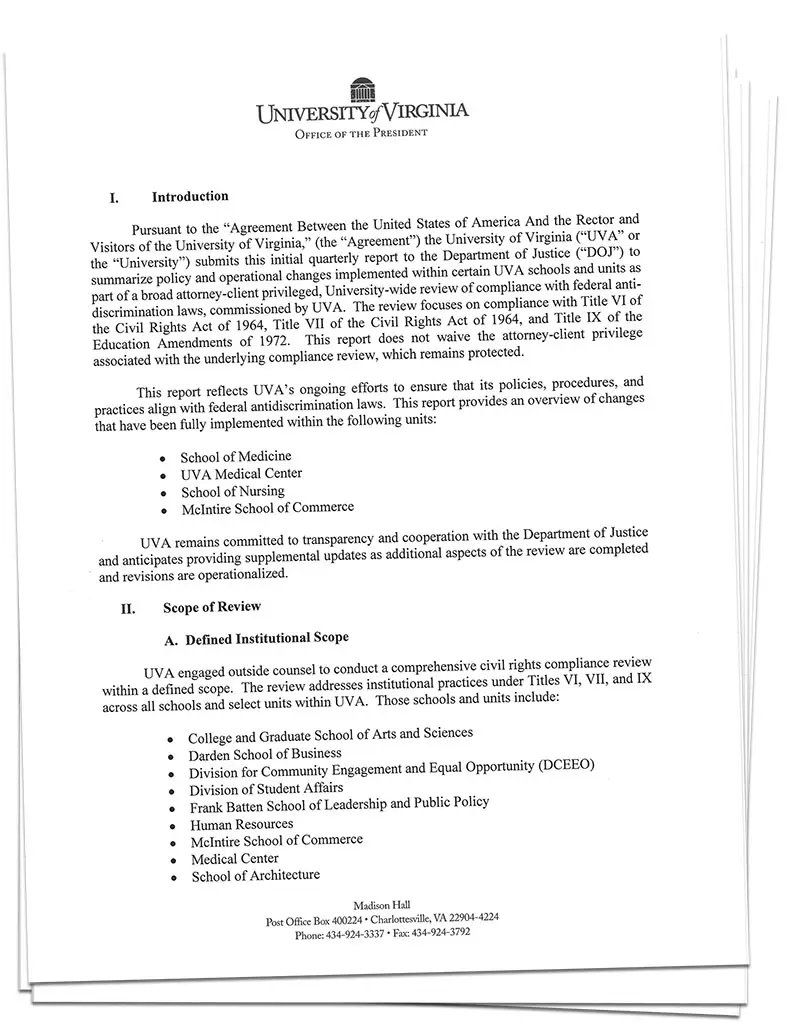
Recent federal compliance reports offer the first detailed account of how the University of Virginia has rewritten policies, overhauled admissions and redirected funding under a deal with the Trump administration to comply with its current interpretation of civil rights law.
The changes are similar to those being made at universities nationwide.
The reports, to be filed quarterly with the Department of Justice through December 2028, outline university-wide changes, as well as actions taken at the UVA Medical Center, School of Medicine, School of Nursing, McIntire School of Commerce, Darden School of Business and Division of Student Affairs—including those implemented before interim president Paul Mahoney signed the October 2025 agreement. Two reports have been submitted so far, in December and March, and are available to the public on UVA’s university counsel website.
Broadly, officials have dismantled the diversity, equity and inclusion office; removed affirmative action and DEI language from websites and program descriptions; and issued written guidance specifying that race, ethnicity, sex and other prohibited characteristics can no longer be used in university decision-making.
School by school, admissions policies are also being scrutinized. At the School of Medicine, for example, officials removed a “diversity-related” application question, eliminated the diversity section of the admissions review rubric and ended implicit bias training for admissions committee members, the reports say.
Money and programming are shifting as well. Organizations once housed within the Division of Student Affairs, such as the Black Presidents Council and Black College Women, now operate independently and receive no university funding. Events have also been changed to “emphasize broad participation by all students” and are widely marketed.
Virtually no aspect of the university, including its multibillion-dollar health system, has gone untouched, according to the reports. At the UVA Medical Center, officials have ended outreach events aimed at communities defined by race or other off-limits criteria. Faculty leadership training and pipeline programs targeting underrepresented groups in medicine have also been discontinued.
The October agreement—the first the Trump administration struck with a public university—paused five Justice Department investigations into alleged civil rights violations in exchange for compliance with then–Attorney General Pam Bondi’s July 2025 interpretation of civil rights law.
UVA President Scott Beardsley, who assumed the top post at the start of the year, told the Faculty Senate in January that he intends to continue complying with the agreement, calling it a “reasonable arrangement for us.”
Under the terms, UVA is not required to pay fines, admit wrongdoing or submit to oversight by an external monitor, provided that federal officials determine it is making adequate progress.
If not, the DOJ can revive the paused investigations or pursue new ones.
UVA’s work is part of a compliance review that is ongoing and started last spring. It is being coordinated by Richmond-based law firm McGuireWoods.