UVA-DOJ deal pauses investigations, adds reporting requirement
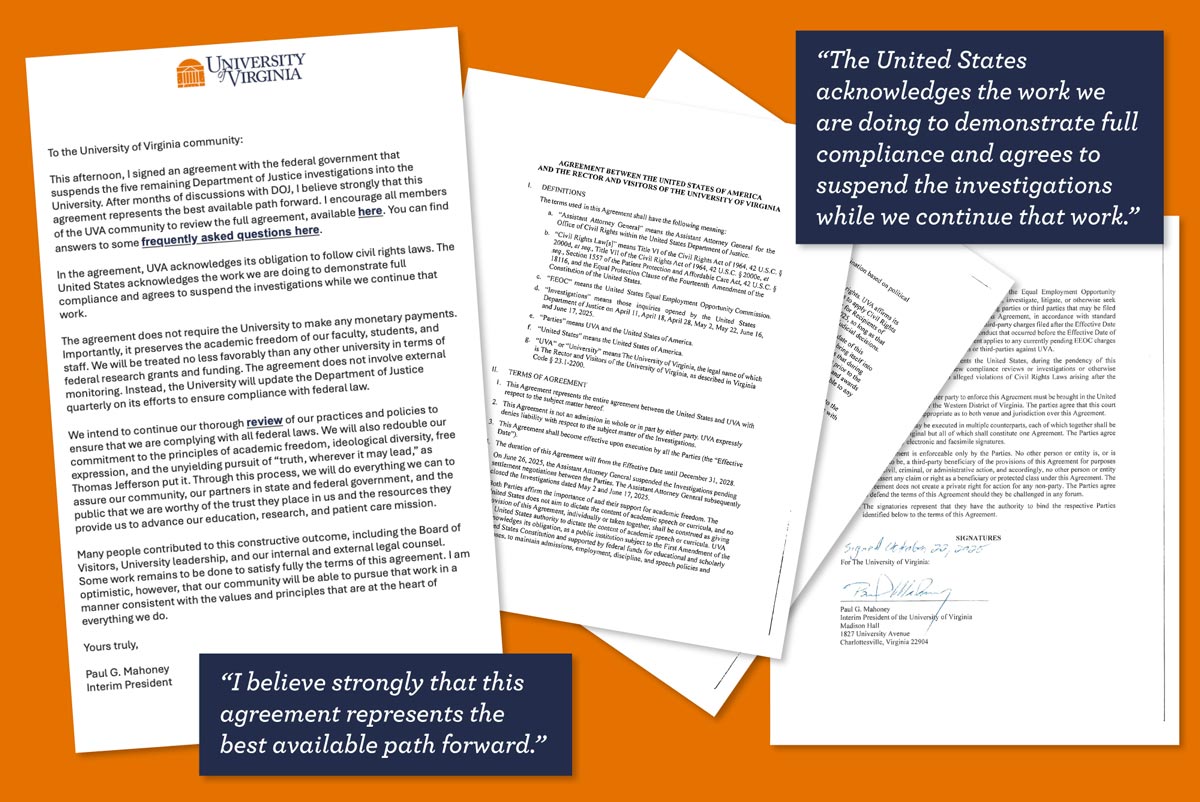
After months of negotiations, interim UVA President Paul Mahoney signed an agreement that suspends the Department of Justice’s five open investigations into potential civil rights violations at UVA. The standstill agreement, signed in late October, requires the school to comply with the DOJ’s current interpretation of civil rights law—articulated in a nonbinding memo released at the end of July—and to report to the DOJ quarterly on its progress toward this compliance.
“I believe strongly that this agreement represents the best available path forward,” Mahoney wrote in an email to the university community announcing the news.
If at any time during the agreement period the DOJ determines that UVA is making insufficient progress toward compliance with the current interpretation of civil rights law, it will give UVA 15 days to make appropriate progress. If it then determines that the university has not made sufficient progress, the DOJ can terminate the deal, which lasts through 2028, and resume any of its investigations and/or pursue new ones.
If, however, at the end of 2028, federal officials determine that UVA has made accurate reports and adequate progress, they agree to close the remaining investigations and pursue no enforcement actions for any alleged violations prior to the agreement.
UVA’s three-page agreement, the Trump administration’s first such deal with a public university, is spare compared with agreements struck in July to close investigations and restore federal funding to Brown and Columbia universities. Among other things, Columbia agreed to end its DEI programs, pay more than $220 million, and hire an administrator to work with an external monitor. Brown agreed to pay $50 million to state workforce development organizations and to limit gender-affirming care; its agreement does not include an external monitor.
At the heart of UVA’s agreement is a memo sent by U.S. Attorney General Pam Bondi to all federal agencies offering “non-binding suggestions to help entities comply with federal antidiscrimination laws.”
The nine-page memo is part of an expanding interpretation of unlawful discrimination by administration officials since President Trump took office in January. Some previous guidance has been enjoined in courts, such as a Feb. 14 Department of Education Dear Colleague letter broadening the interpretation of the 2023 Supreme Court ruling banning race-conscious admissions practices to encompass all “aspects of student, academic and campus life.”
The July memo provides a long list of examples of what it calls unlawful discriminatory practices based on characteristics such as race, color, religion, sex and national origin. Among them: race-exclusive opportunities such as mentorship programs or leadership initiatives; DEI policies that prioritize candidates from “underrepresented groups” for admission, hiring or promotion where those groups are determined by race; university spaces that may give any impression that they are not welcoming to all students; ensuring a “diverse slate” of candidates in hiring; and the use of other criteria as substitutes for explicit consideration of protected characteristics, such as statements in which applicants describe obstacles they have overcome “in a manner that advantages those who discuss experiences intrinsically tied to protected characteristics,” for example race and sex.
UVA’s agreement to use the guidance comes with an asterisk: The university will apply it as long as it remains in force “and to the extent consistent with relevant judicial decisions.” That exception already applies to the U.S. attorney general’s memo’s recommendation to disallow trans women from intimate facilities and sports teams designated for women, interim Provost Brie Gertler told the Faculty Senate at its Oct. 24 meeting.
In two 4th Circuit cases, judges have ruled that Title IX prohibited restricting transgender students’ access to bathrooms, and that a transgender girl could participate in girls sports. The Supreme Court is set to review the latter decision.
Mahoney signed UVA’s agreement with the Justice Department less than a week after he sent a letter to officials at the Department of Education declining its offer of preferential funding in exchange for signing onto the proposed Compact for Academic Excellence in Higher Education. Of the nine schools that were initially offered the federal compact, UVA was the fifth to reject it.
According to letters sent to UVA at the time, the DOJ in April began investigating UVA’s compliance with the 2023 Supreme Court ruling that deemed race-conscious admissions practices unlawful. The department ultimately opened seven investigations about both admissions practices and allegations that the school was not complying with the widening federal interpretation of civil rights law. It was also investigating compliance with a March Board of Visitors resolution dissolving the school’s Office of Diversity, Equity, Inclusion and Community Partnerships and requiring a review of university programs and practices to align with the Trump administration’s interpretation of the law. One of the letters alleged that then-President Jim Ryan (Law class of ’92) in particular had defied the orders.
After months of growing pressure, Ryan announced on June 27 that he would resign. The New York Times reported at the time that DOJ officials privately demanded Ryan’s resignation in order to resolve their investigations. Assistant Attorney General for the Civil Rights Division and agreement signatory Harmeet Dhillon (Law class of ’93) has denied that claim.
While details of the negotiations that led to the agreement and any investigation findings are not public as of this writing, some pieces of this summer’s timeline have become more widely known.
One important piece is an internal compliance review begun under Ryan, Gertler said. On May 28, then-University Counsel Cliff Iler sent deans, vice presidents, vice provosts and other university leaders a guidance document outlining UVA’s updated understanding of civil rights law. The guidance was intended to help the schools and units complete a review of their policies, programs and practices as directed by the BOV in its March 7 resolution.
That guidance document, under which the university has been conducting an ongoing review, is “broadly the same” as the DOJ guidance UVA has agreed to comply with, Gertler told the Faculty Senate.
“What we have just agreed to in agreeing to following the DOJ guidance does not change in content the guidance that we have already been using, and that we independently adopted in the spring,” she said.
Gertler said the compliance review, now coordinated by Richmond-based law firm McGuireWoods, was expected to be finished by mid-2026.
Also in late June—the day before Ryan announced his resignation—Assistant AG Dhillon suspended the investigations pending settlement negotiations. She has subsequently closed two of the investigations, which Mahoney announced in September.
UVA’s agreement has been lauded in editorials, including in The Washington Post and The Wall Street Journal, calling it “probably the best the state’s flagship school could have hoped to secure,” and “a way out of the legal showdown while preserving the crucial essence of academic freedom.”
However, some UVA community members are wary. At its October meeting, the Faculty Senate passed a resolution expressing “grave concerns” with the agreement and calling on Mahoney and BOV Rector Rachel Sheridan (Col class of ’94, Law class of ’98) to clarify the circumstances and negotiations that led to its signing.
Faculty Senate Chair Jeri Seidman, a McIntire professor, said she worries about the effect the quarterly certification from the president “under penalty of perjury” will have on UVA’s search for a 10th president after Ryan’s resignation.
“If you are a potential candidate and you see that,” she said, “if you don’t think you have a really good relationship with the Department of Justice, you might be worried that whatever you sign is going to be claimed as perjury. And even if it isn’t, just the disruption and the personal reputation cost of that being suggested and having to defend yourself is going to be tremendous.”
Andrew Block, a professor in the School of Law who serves on the Faculty Senate Executive Committee, said it’s important to remember that the agreement must be considered in conjunction with Ryan’s resignation.
“Arguably, this is what we got in exchange for [Ryan’s] resignation,” he said. “The leadership of the university is saying this isn’t so different from what we were already going to do. If that’s the case, and if President Ryan had set in motion the compliance review and a lot of the things that they’re now saying they have to do pursuant to this agreement, why did he have to resign? And if it wasn’t to make substantial changes at the university, then why was it?”