Gov. Abigail Spanberger reshapes UVA Board of Visitors after turbulent year
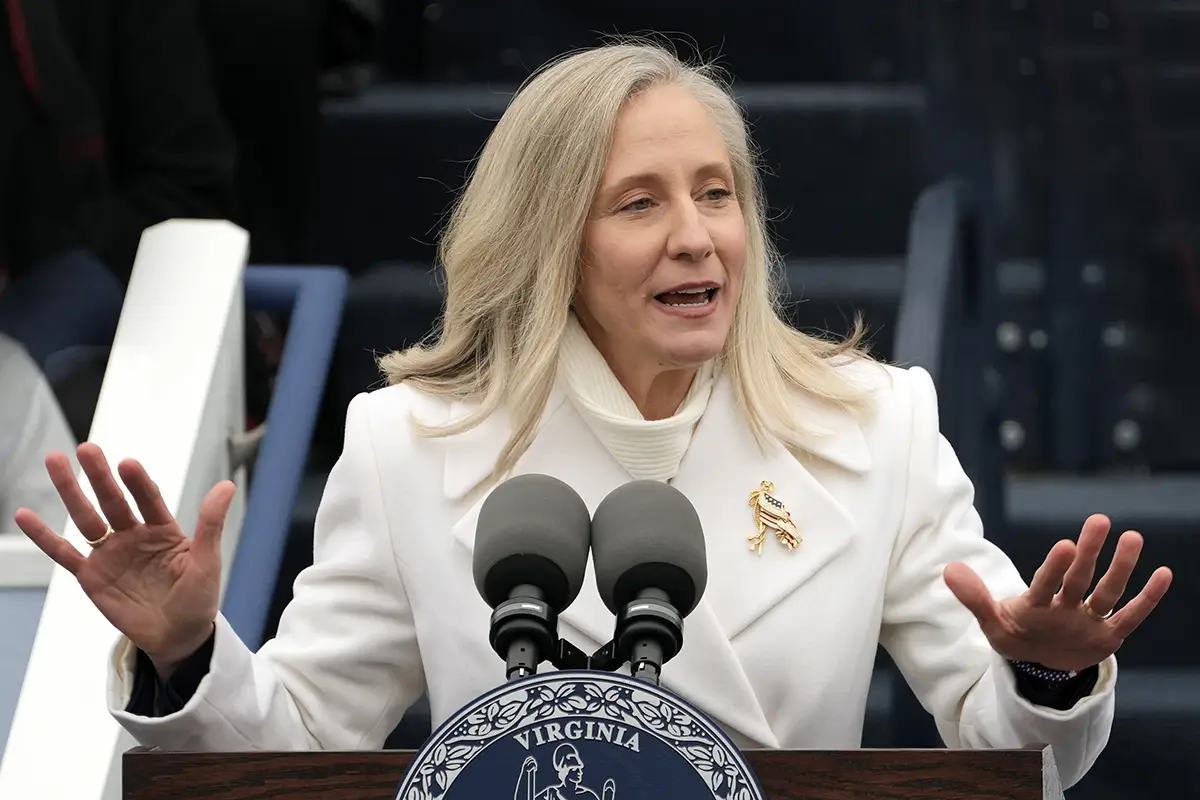
In one of her first official acts as governor, Democrat Abigail Spanberger (Col class of ’01) last month appointed 10 new members to the University of Virginia’s Board of Visitors, assuming majority control of the governing body after a turbulent year marked by pressure from the Trump administration, the ouster of popular President Jim Ryan (Law class of ’92) and the ascension of Darden School of Business Dean Scott Beardsley to the university’s top post.
A day before Spanberger’s inauguration on Jan. 17, five board members resigned, reportedly at the urging of the incoming governor, including Rector Rachel Sheridan (Col class of ’94, Law class of ’98), Vice Rector Porter Wilkinson (Law class of ’07) and Paul Manning, who gave $100 million to the university in 2023. According to written accounts by Ryan and Sheridan, all three interacted with Justice Department officials in the run-up to Ryan’s forced resignation in June.
Another five seats on the 17-member board had been vacant since the summer, when the Senate Privileges and Elections committee refused to confirm Republican Gov. Glenn Youngkin’s appointees.
Spanberger’s nominations are moving through the Democratic-controlled General Assembly, which is also debating potential changes to the board appointment process. Senate Majority Leader Scott Surovell (Law class of ’96) said in an interview in late January that the goal is to curb the ability of any governor to “unduly politicize” public university boards.
Meanwhile, the appointees can begin serving on the board with full voting power, he said. The next regularly scheduled meetings are March 5 and 6.
From resignations to replacements
Spanberger’s picks include high-powered executives in business, finance, law and medicine, many of whom have been active at the university for years.
All are alumni, and four have served on the BOV before: Peter Grant II (Col class of ’78, Darden class of ’86), a private equity investor who chaired the university’s recent $6 billion capital campaign; Victoria Harker (Col class of ’86), a former Tegna executive who was appointed by former Republican Gov. Bob McDonnell in 2012; Carlos Brown (Col class of ’96, Law class of ’99), an executive vice president at Dominion Energy who served as vice rector from 2023 to 2025; and Evans Poston Jr. (Darden class of ’17), a director at Troutman Strategies who was appointed by former Democratic Gov. Ralph Northam in 2018.
Five of Spanberger’s appointees—Harker, Poston, Rudene Haynes (Col ’96), Owen Griffin Jr. (Com class of ’93, Grad class of ’94, Darden class of ’99) and Michael Bisceglia (Col class of ’79)—have each given tens of thousands of dollars to Virginia Democrats, including Spanberger, according to the Virginia Public Access Project, a nonprofit that tracks campaign contributions. Bisceglia, a business executive who served on Spanberger’s transition team, gave the most to her election effort: $24,000 to her gubernatorial campaign and $12,500 to the inaugural committee.
Grant, on the other hand, has contributed exclusively to Republican candidates, including Youngkin. Harker also gave $6,600 to the Spirit of Virginia PAC, which supported Youngkin and other GOP candidates, in 2023.
Other GOP donors currently sit on the board, including Marvin Gilliam Jr. (Col class of ’78), a former coal mining executive who has donated more than $1.7 million to Virginia Republicans since 1998, and John Nau III (Col class of ’68), owner of a Texas beer distribution business, who has given $1.3 million to Virginia GOP candidates since 1999, according to VPAP.
A search under scrutiny
Shortly after Spanberger was elected Nov. 4 by a 15-point margin, she issued a letter asking the board to delay selecting a replacement for Ryan. The Faculty Senate and nine deans also called for a pause in the search.
But the Board of Visitors acted otherwise, inking a five-and-a-half-year contract with Beardsley on Dec. 19.
In an appearance before a Virginia Senate subcommittee on Jan. 12, then-Rector Sheridan defended Beardsley’s hiring, saying the board needed to stabilize leadership and earn trust on Grounds. She also said Beardsley was far from a political ideologue.
But text messages among BOV members, released last month in response to a private citizen’s public records request, showed board members coordinated with Youngkin or his top aides frequently, according to a report in The Washington Post. Some messages, written between June 2023 and December 2025, also showed members using blunt or incendiary terms when discussing Ryan and the university’s diversity initiatives, the Post reported.
Jeri Seidman, chair of UVA’s Faculty Senate, said now that Spanberger has made changes to the board, it is time to let members get to work.
“We need to trust the newly constituted board in a review of the presidential search process rather than presuppose the outcome,” Seidman wrote in an email. “Whether it feels the search and appointment were proper and affirms the presidential selection or initiates a new search, I hope the board communicates as much information as it is able in order to help the community understand and accept its decision.”
Contracts and costs
Still unknown is what the new board will do regarding Beardsley, 62.
According to his contract, provided by the university, Beardsley’s compensation package includes $1.3 million in annual base pay, a $250,000 yearly deferred compensation plan, housing in the president’s residence, a car allowance and the potential to earn both merit and cost-of-living raises.
If terminated for a reason not specified in the contract, UVA would be on the hook to pay Beardsley 12 months’ salary and 12 months’ sabbatical leave, plus any sabbatical time already vested. That could mean a hit of more than $3 million if, for instance, two-thirds of the board determines the search process was flawed and votes to remove him or return him to his faculty position.
Ryan’s contract obligated UVA to pay 12 months’ salary plus any vested sabbatical but did not include the additional year of sabbatical pay. Ryan earned a base salary of $750,000 in 2018, increasing to $1.1 million by mid-2024.
Beardsley’s deal also guarantees him 10 years of employment as a Darden faculty member at 60 percent of his presidential pay or his prior dean’s salary, whichever is less. If he is terminated without cause from that position, UVA must pay Beardsley a lump sum equal to the greater of 24 months or half the remaining months of the 10-year period’s total compensation.
Ryan had no guarantee of faculty employment but was eligible to earn 75 percent of his compensation as president if he remained as a tenured professor. After a sabbatical, Ryan will return as a law and education professor, the university reported in July.
Beardsley said in an interview last month that the board approached him with a contract largely modeled after those of prior presidents. When asked whether he did much negotiating, he said, “Not a lot. There wasn’t much time.”
“The idea that you have a contract and there might be uncertainty and what do you do if?—this is not unusual,” Beardsley said. “I think they probably did something they felt was commonplace.”
A statewide and national moment
Spanberger’s move to overhaul the board is the latest in a broader national fight over the future of top-tier universities. The Trump administration has intensified scrutiny of institutions it argues are too progressive, deploying tactics such as withholding research funding and launching Department of Justice investigations into admissions practices and diversity, equity, and inclusion policies. Faculty and students have countered in protests and public resolutions that these actions undermine institutional autonomy and pose a serious risk to academic freedom.
In October, interim President Paul Mahoney entered into an agreement with the DOJ to pause five federal investigations into UVA around what the department called potential illegal discrimination. Two other investigations had been previously closed, including an investigation into admissions at the Batten and McIntire schools, and the university’s response to allegations of antisemitism.
In addition to reshaping the UVA board, Spanberger appointed 12 new board members at George Mason University and five at the Virginia Military Institute. At George Mason, Trump administration officials and Youngkin appointees attempted to oust President Gregory N. Washington. At VMI, the board voted last February not to renew the contract of its superintendent, Maj. Gen. Cedric T. Wins. Both are Black and considered to be champions of diversity initiatives.
Spanberger also issued an executive order giving Secretary of Education Jeffery Smith 60 days to recommend legislative changes to the Board of Visitors appointment process. A handful of legislators, including Surovell, have filed their own reform bills in the session currently underway.
Senior Writer Ed Miller contributed to this report.