BOV elects Darden dean as 10th president
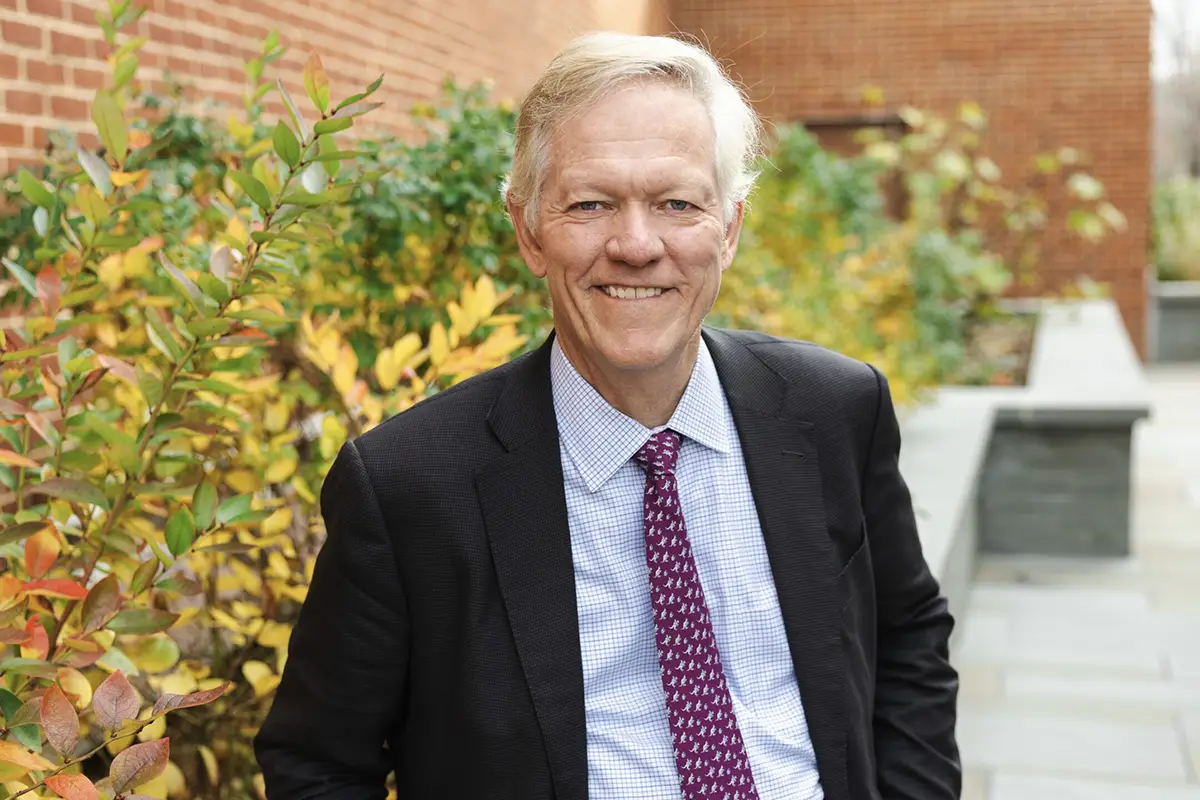
UVA’s Board of Visitors unanimously elected Darden School of Business Dean Scott Beardsley as the university’s 10th president.
The appointment came on Dec. 19, the last day of academic exams, at a special meeting of the BOV that was scheduled despite calls to cease the presidential search. According to the resolution appointing him, Beardsley, 62, was to begin Jan. 1 and serve through June 2031.
In prepared remarks at the meeting, BOV Rector Rachel Sheridan (Col class of ’94, Law class of ’98) praised his leadership, noting that the search committee reviewed more than 100 candidates across higher education, public service and the private sector.
“As the search progressed, one candidate consistently distinguished himself through depth of experience, clarity of vision, and a demonstrated ability to lead with steadiness and purpose,” she said. “Scott Beardsley rose to the top of an exceptionally strong and competitive pool. Committee members and Board members alike were struck by his ability to engage across disciplines, listen carefully, and articulate a thoughtful, forward-looking vision for the university.”
Beardsley came to Darden in 2015 from consulting giant McKinsey & Company, where he worked for 26 years and was a director for 15 of those. He holds a bachelor’s degree in electrical engineering from Tufts, an MBA from MIT, a doctorate in higher education management from Penn, and is studying philosophy part-time at Oxford.
In 2025, Darden was ranked the No. 1 public business school by U.S. News & World Report for the first time; the school ranked No. 11 overall. According to its website, more than 70 new faculty have joined Darden in the past 10 years, and as the school’s chief fundraiser, Beardsley helped raise funds to bring endowment assets to $1 billion.
In prepared remarks, he spoke of his love of UVA and attitude moving forward.
“I want everyone to know that I stand before you as a mission-driven leader, not a politically driven leader. I want you to know that I stand before you because I love this university,” he said.
“I believe that the best way forward is together. I take this role and responsibility with the utmost seriousness and humility. This is a moment to move beyond division, to renew trust and to focus on what unites us.”
Professor Mike Lenox (Engr class of ’93, class of ’94) has been named Darden’s interim dean.
Beardsley has been involved in the effort to fill another high-profile vacancy, chairing the search for UVA’s next provost, launched in September. Deputy Provost Brie Gertler has been serving in the role in an interim capacity since Ian Baucom left it in March; a previous search last year failed.
At its Dec. 12 meeting, Beardsley told the Faculty Senate that committee members were still taking candidates and had just started initial interviews in the first round, which would continue through the end of January, with some selection continuing well into February. He said they “don’t have an end date.”
“Our mandate that was given by the [interim] president was to give three unranked finalists. That was our mission. We’re not even close to getting there yet.”
It’s unclear whether Beardsley will continue to lead that search.
Beardsley’s appointment came about a month after Virginia’s Gov.-elect Abigail Spanberger (Col class of ’01) publicly urged Rector Sheridan and Vice Rector Porter Wilkinson (Law class of ’07) to pause the search. In a letter, Spanberger encouraged the BOV not to name finalists or a president until she filled the five current vacancies on the board after her Jan. 17 inauguration. The Faculty Senate and a group of nine UVA deans—which did not include Beardsley—also publicly called for a pause in the process, and members of United Campus Workers of Virginia and the American Association of University Professors protested outside the meeting.
The appointment capped a tumultuous year in which UVA’s ninth president, Jim Ryan (Law class of ’92), abruptly resigned under pressure from the Trump administration’s Department of Justice. Former law Dean Paul Mahoney was appointed as interim president and served in the role just under five months; in that time he negotiated a deal with the DOJ and declined to sign the Trump administration’s “Compact for Academic Excellence in Higher Education.”
In her remarks, Sheridan briefly noted the turmoil.
“It’s important to acknowledge that this has been a tumultuous few months for our institution,” she said. “The challenges we have faced together have only made it clearer that we need a proven leader who loves this institution and who stands ready to lead UVA forward.”
As of this writing, Spanberger has not made a public comment regarding Beardsley’s appointment.
When asked if he had spoken with the governor-elect before accepting the position, Beardsley said that he hadn’t but looked forward to speaking with her, and that he “didn’t get the job offer until very, very, very recently.” He also mentioned that he and his family were already on holiday break in Costa Rica when he was called for more interviews and then an offer.
“I was headed off to play some tennis, and my phone rang, and it was Rachel Sheridan saying, ‘You’re our choice for president, but by the way, can you come on Thursday?’ I’m like, I thought this was going to be much later,” he said.
Under state code, oversight of UVA’s president sits with the BOV. Virginia’s governor appoints members of the BOV on a rolling basis to four-year terms; each appointment must be approved by the General Assembly.
As of this writing, the BOV has 12 members, all appointed by outgoing Gov. Glenn Youngkin, a Republican. Over the summer, the Democratic-majority Virginia Senate Privileges and Elections Committee rejected Youngkin’s last two slates of board appointees, including five to UVA’s BOV.
The BOV is required under state code to include 12 UVA alumni and 12 people from within the commonwealth. It currently has neither. Spanberger, a Democrat, joined others in arguing that the BOV should wait until it is fully constituted and in statutory compliance before making a presidential appointment. In a response to Spanberger, Youngkin said the Court of Appeals of Virginia had refuted such compliance claims.