Piecing together the last days of Ryan’s presidency
Since the moment then-President Jim Ryan (Law class of ’92) announced his sudden resignation in June, members of the UVA community have clamored for answers. What happened leading up to his resignation? Who met with the Department of Justice and when?
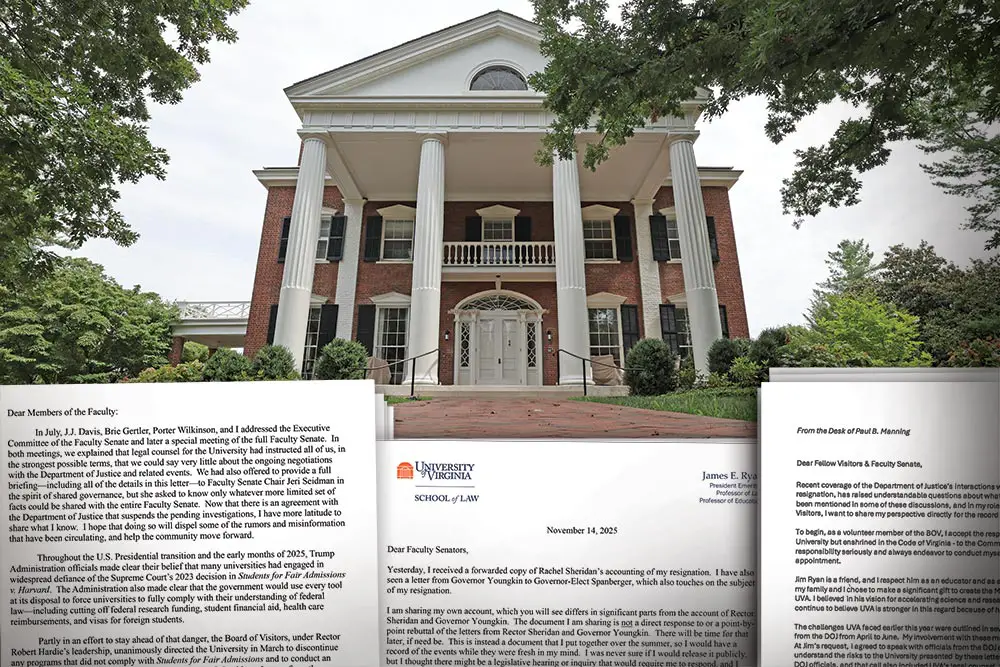
Over the past few months, a mountain of communications—either written for release or produced in response to Freedom of Information Act (FOIA) requests—about that period have become public. In November, then-Rector Rachel Sheridan (Col class of ’94, Law class of ’98) and Ryan each broke their respective monthslong silences and sent their personal accounts to the Faculty Senate. In December, then-Board of Visitors member Paul Manning, mentioned in both Ryan’s and Sheridan’s letters, followed suit. And in January, UVA produced nearly 1,000 pages of text messages among BOV members in response to a FOIA request.
Taken together—and even when sometimes conflicting—they provide some answers and reveal surprising details of the turbulent last months, and even hours, of Ryan’s presidency.
The DEI resolution
“The trouble began,” according to Ryan’s account, when UVA received a resolution regarding diversity, equity and inclusion drafted by the office of Gov. Glenn Youngkin, a Republican. Ryan wrote that the sweeping resolution, filled with “inflammatory rhetoric,” was the first one he’d seen drafted by the governor’s office on behalf of the BOV.
The BOV ultimately passed a milder resolution that directed the university to ensure that it complied with federal civil rights law; dissolve the Division of Diversity, Equity, Inclusion and Community Partnerships; move permissible programs to a new organizational home; and update the board within
30 days.
Ryan immediately stated that he would comply, and did, he wrote. But the university has not given any public update about that directive’s implementation. Ryan blamed the silence on the BOV, writing that while UVA administrators had updated the board before its 30-day deadline and prepared a message for the community, Sheridan and other board members wanted to meet to give feedback before communications went out. Later, after the DOJ began its investigations, board members continued to insist that the university not update the community until they had delivered a response to the DOJ.
“Which meant continued silence, which worried our community and buttressed the false narrative that we were dragging our feet,” Ryan wrote.
Interactions with the DOJ
According to all accounts, Ryan never met or interacted with the DOJ. Everything from the DOJ was reported through Sheridan; Manning; and Porter Wilkinson (Law class of ’07), Sheridan’s then-vice chair on the BOV’s Audit Committee who would go on to become vice rector, Ryan and Sheridan both wrote.
Sheridan wrote that she interacted with the DOJ three times—once in person and twice by phone—with legal counsel for UVA, including outside counsel, leading the interactions.
The in-person meeting took place Tuesday, June 3, about two months after the DOJ opened investigations into UVA and a few weeks before Ryan would resign. Sheridan and Wilkinson, along with counsel, met with department officials. Ryan wrote that he offered to attend the meeting but was told he was not invited; Sheridan wrote that neither Ryan nor then-Rector Robert Hardie (Col class of ’87, Darden class of ’95, class of ’99) wanted to attend, so she and Wilkinson “reluctantly agreed” to Ryan’s request that they go instead.
At that meeting, Sheridan wrote, DOJ lawyers indicated that they “lacked confidence in President Ryan to make the changes that the Trump administration believed were necessary to ensure compliance” with federal law. Sheridan wrote that she fully briefed Ryan and the BOV afterward.
The second interaction was a call on Tuesday, June 24, and included Sheridan, Manning and counsel, she wrote. Manning wrote that, between that meeting and the letters, it was clear that “the DOJ was prepared to suspend federal funding to UVA immediately if certain steps were not taken, including a change in university leadership.” Ryan wrote that Manning told him DOJ lawyers threatened to “bleed UVA white” if he didn’t resign.
The last call with the DOJ was on Thursday, June 26, at Ryan’s suggestion. Even before these events, Ryan had grown increasingly inclined to leave UVA’s presidency before his contract ended; among other reasons, he had hit a milestone with the Honor the Future campaign and was finding it untenable to work with the “increasingly combative” BOV members, he wrote. On June 25, he told Sheridan and Manning that the 2025–26 school year would be his last, and he asked Sheridan to convey that to DOJ lawyers to see if it would improve UVA’s situation with the department.
The DOJ official made clear that Ryan’s resignation needed to be more immediate, Sheridan wrote. That day, The New York Times published a story using anonymous sources saying the DOJ had been pressuring Ryan to resign in order to resolve its investigations. Department lawyers were angry and surprised by the story and expressed as much to UVA counsel, she wrote.
Throughout this time, UVA administrators and counsel were also gathering information to respond to the DOJ’s investigations, Ryan wrote. “[A] pattern evolved. We assembled voluminous information … and a few days before the deadline for submission, we would receive another DOJ inquiry asking about another school. … Each time the scope of the DOJ inquiry expanded, our lawyers asked for and received extensions for submission of material.
“At several points, I suggested we submit what we had already put together and ask for an extension only with respect to the most recent inquiry, but I was told we should take the extensions and wait to submit a comprehensive response. Which meant that, by the time I resigned, we had yet to respond to the DOJ’s inquiries, despite receiving seven letters and despite having assembled hundreds of pages of responsive information.”
He added: “There was never any finding of any legal liability by the DOJ prior to my forced resignation.”
Ryan’s resignation
Around 1 p.m. on Thursday, June 26, Sheridan and counsel called Ryan to discuss their final call with the DOJ, Ryan wrote. The DOJ lawyers were upset about the New York Times story and said he needed to resign, effective before students returned in the fall, by 5 p.m. that day or DOJ would take or block hundreds of millions of dollars from UVA.
Ryan wrote that Sheridan and the lawyers told him the DOJ had offered “an amazing deal—unlike any the lawyers had ever seen,” granting blanket immunity: Investigations would be stopped, there would be no financial penalties, and agencies would not cut off research funds. Ryan wrote that he asked repeatedly throughout the afternoon, as his 5 p.m. deadline approached, for Sheridan and counsel to get this deal in writing, and to see it. Ryan wrote that Sheridan told him at least part of the deal was in writing, but for fear of another leak, he could not see it.
Assistant Attorney General for the Civil Rights Division Harmeet Dhillon (Law class of ’93) has publicly denied the claim that she or anyone from her office demanded that Ryan resign as part of an agreement.
In his letter, Ryan narrated the tense afternoon as the pressure built up. He gathered colleagues to try to work through the best course of action. They unsuccessfully tried to forestall or see if this was a bluff, but signs indicated it was not. Sheridan, counsel and Manning called “a couple more times.”
“I was repeatedly told that 5 pm was the point of no return,” he wrote.
Ryan spoke with Hardie, who had only recently been briefed on the situation. Hardie told Ryan there was no good option but that they should take the deal, Ryan wrote. Finally, he wrote, “around 4pm one of my closest and wisest colleagues said: ‘If you don’t have any Board support, it’s over. You can’t fight this on your own.’”
At 4:25, Ryan submitted his letter of resignation to Hardie and Sheridan. He announced it the next day.
Who knew
Sheridan and Ryan both presented narratives of board members working at times without the knowledge of the rector, who is elected by members of the BOV as their presiding officer—the first one having been Thomas Jefferson. At several points, according to the letters, Sheridan and Manning reportedly spoke with Ryan and/or the DOJ without then-Rector Hardie’s knowledge.
A July text message from Hardie to Manning and Sheridan reveals his perspective: “I have had almost a month to think about this. And something that doesn’t sit well with me is that I didn’t know as Rector that both of you were speaking with DOJ at Glenn Youngkin’s suggestion well before you told me on the Wednesday before Jim resigned. I was the Rector of our board and I didn’t find out until the clock on the bomb was ticking. If I had known before, I would have enjoined Senators Warner and Kaine and others, and perhaps we could have avoided the shitshow that UVA now encounters. This is really upsetting to me.”
Both Manning and Sheridan responded to tell Hardie that his assertions were incorrect. Sheridan responded with the events that she later described in her letter to the Faculty Senate, including that Hardie and Ryan had been the ones who had asked her to attend the first DOJ meeting. It’s the last message in the text chain.
While Hardie did not put out a public statement and has not responded to interview requests, the Cavalier Daily reported that he had twice confirmed that his recollection of events aligned with Ryan’s.
In her letter, Sheridan wrote that she and Wilkinson briefed UVA leadership and her fellow BOV members after the June 3 meeting with the DOJ; in Ryan’s telling, she told him privately that they basically insisted he resign but left that part out when they briefed the board.
It’s also unclear what, if anything, rank-and-file members knew or thought about the other interactions; most have kept quiet. Ryan wrote: “The entire Board should have had a chance to weigh in on this decision, which unfolded over three weeks. This is not a decision that should have been made by a tiny subset of the Board and especially without informing the Rector and Vice-Rector—the latter of whom was kept entirely in the dark, as far as I know.”
The faculty representative to the BOV during this time, Michael Kennedy, told the Faculty Senate in July that he learned of the increasing DOJ pressure from the New York Times article and that he had spoken to other board members who reported the same.
While Sheridan wrote numerous times that the decision to resign was Ryan’s, she did not indicate willingness to fight the Trump administration if Ryan chose not to resign. “I know that many believe that the Board should have refused to accept President Ryan’s resignation and essentially dared the Department of Justice to pursue enforcement actions,” she wrote. “The outcome of that fight would have been highly uncertain, and no legal process or even victory in court could have protected the university from much of the resulting harm.”
Ryan wrote that, with the encouragement of some colleagues, he considered refusing to resign and forcing the BOV to fire him—he wanted the board to meet to discuss that but was told there wasn’t time. He also considered going public but that it “felt like a hostage situation, where the kidnapper threatens harm if you do not keep information about the demands confidential.”
Ryan’s 12-page letter is peppered with questions that have still not been answered several months after his resignation. They include whether the threats to UVA were real “or whether the idea came from the Board members who spoke with the DOJ lawyers, our own lawyers, the Governor, or some combination of that group.”
“We were committed to following the actual law,” he wrote. “We were also open to changing policies and practices if they were not working well or if there were persuasive, principled reasons to change course. At the same time, I was never going to give up the core values of UVA or my own principles to satisfy the prevailing political winds or the political ambitions of some.
“In the end, that may have been the real problem, though I will probably never know.”