Unsettled: International students on edge
The political environment adds new anxieties to life far from home for UVA’s international students
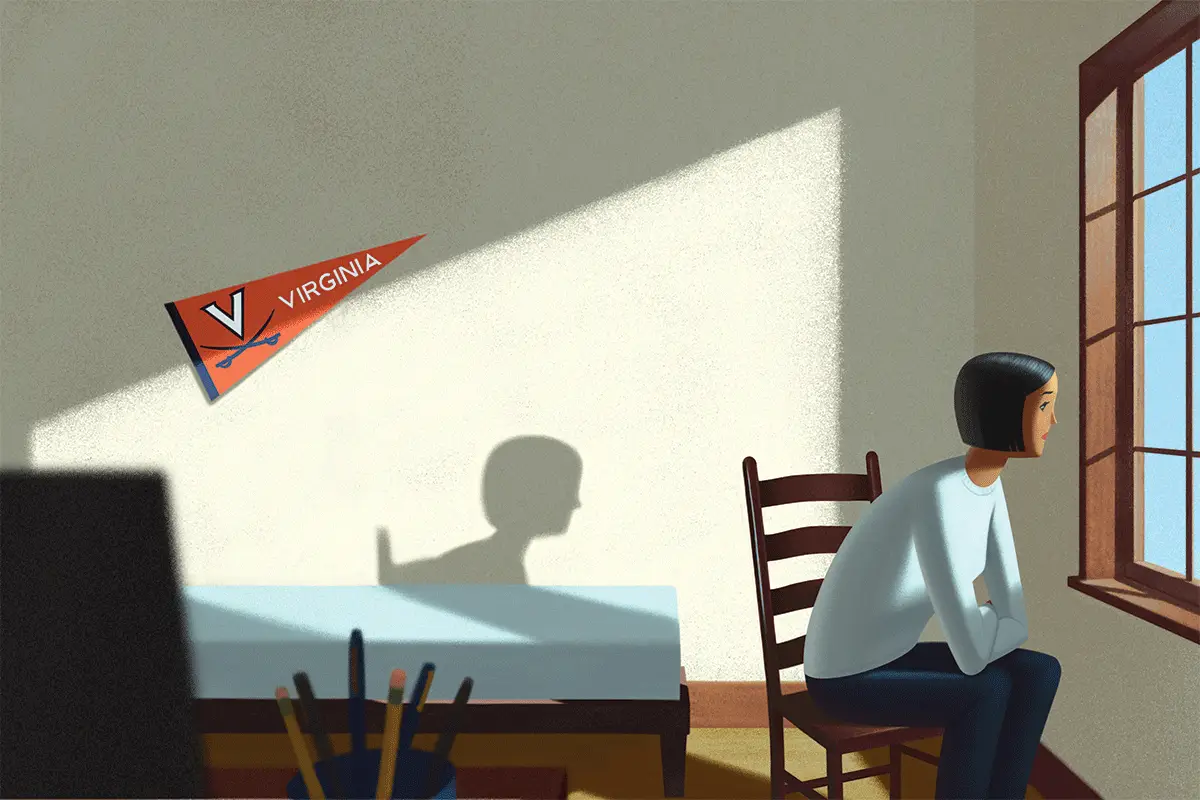
A first-year from India carries her student visa with her at all times, along with the Form I-20 that confirms she’s enrolled at UVA. A first-year from Canada avoids posting anything on social media related to politics, immigration policy or ICE.
During the school year just completed, the advising sessions offered by UVA’s International Students & Scholars Program were almost entirely booked, said adviser Caren Freeman (Grad class of ’96, class of ’06). A staff of six spent four hours each day primarily counseling students on how to maintain their legal status.
“We go from 20-minute appointment to 20-minute appointment, talking to anxious students,” Freeman said.
These are indeed unsettling times for some international students. On top of the logistical challenges and cultural adjustments that can come with studying in a different country, students are facing additional uncertainties as a result of policies implemented by the Trump administration.
“Immigration-related policy changes and proposals have been announced at a rapid-fire pace, resulting in an immigration landscape that has been extremely dynamic and unpredictable,” Adrienne Kim Bird, associate director of the International Students & Scholars Program, wrote in November on a website for UVA’s international community.
The changes include expanded vetting of the social media accounts and online presence of visa applicants; travel bans preventing or severely restricting entry by citizens of 39 countries; and the aggressive and controversial immigration enforcement carried out across the country over the past year by U.S. Immigration and Customs Enforcement.
“Students and faculty at American universities have had their visas and immigration status canceled or been detained and threatened with deportation on the basis of past legal infractions, including minor offenses, and activities that the federal government believes undermine U.S. foreign policy, including participating in protests, writing opinion pieces, posting on social media, and other expressive activities,” according to UVA’s Federal Information site, set up in 2025 to address questions regarding Trump administration policies.
Students are taking precautions, with travel a common source of anxiety. Some students were rethinking plans to visit home, for fear that they might have trouble getting back into the United States, Kim Bird said. “I’ve had a number of conversations with students in tears, because maybe they had a sick parent at home that they hadn’t seen,” she said.
That’s a concern for the Indian first-year who carries her papers in case she encounters immigration enforcement agents. She returned over the semester break armed with a “big folder” of documents to present at immigration. Thinking about traveling home again for summer break was making her nervous, she said in March.
“I was wondering, ‘Am I going to be let back in even though nothing has changed?’” she said. “It’s scary to think about.”
Like others interviewed for this story, the first-year, who holds a position that puts her in contact with many other international students, requested to remain anonymous for fear of facing deportation over something she said, like the Tufts student who was detained and whose F-1 visa was revoked last year after she wrote an editorial critical of the university’s response to Israel’s actions in Gaza.
A student from Columbia University who was active in pro-Palestinian protests was arrested in March 2025 and transferred to a detention facility in Louisiana, where he remained for 104 days. His case is ongoing.
“Everybody just seems on edge, I would say,” the first-year said. “This is completely unprecedented.”
In the fall of 2024, international students made up about 5 percent of undergraduates at UVA and 21 percent of graduate students, according to numbers provided by the International Students & Scholars Program.
All told, there were 1,533 graduate students, 740 undergraduates, 94 students not seeking degrees and 820 enrolled in Optional Practical Training, which is temporary employment related to a student’s field of study.
Students from China made up the biggest group. Among UVA undergrads, there were 380 students from China, 166 from India, 143 from South Korea, 125 from Canada and 115 from the United Kingdom.
Among graduate students, 560 were from China, 250 from India, 95 from Bangladesh, 91 from South Korea and 67 from Iran.
Beyond their contributions in the classroom and community, UVA’s international students contributed $130.1 million to the state’s economy and supported 1,333 jobs in 2024-25, according to UVA Global, which cited figures compiled by NAFSA, the Association of International Educators.
Immigration-related policy changes and proposals have been announced at a rapid-fire pace, resulting in an immigration landscape that has been extremely dynamic and unpredictable.
For those reasons and others, colleges have been alarmed by the events of the past year. In April 2025, more than 1,800 current and recent students at 280 schools—including three at UVA—had their visas abruptly revoked and then restored, according to news reports. In May 2025, visa processing was halted for three weeks while the Department of Homeland Security implemented new vetting protocols for the social media accounts of applicants.
When processing resumed in June, the State Department cited national security when it required applicants to make their social media profiles public. In August, U.S. Citizenship and Immigration Services announced that vetting would be expanded to include “anti-American” activity, a vaguely defined category that critics charged could have a chilling effect on free expression.
The first-year student from Canada said those policies have had precisely that effect on him.
“I’m very careful,” he said. “I don’t post anything that could be flagged. Within my friend group, we avoid reposting anything that has to do with protests or politics.”
Exactly what might be flagged can be difficult to predict, as Abhishek Kulkarni, who enrolled in 2023 as a doctoral student at Darden, discovered last summer.
Kulkarni had completed the second year of a five-year program when he returned to his native India in May 2025 to get married, he said. While at home, he misplaced his passport and had to apply for a new student visa.
Visa appointments were backlogged for months in India, so he applied first in Kuwait, where his father lived, he said. He received a rejection letter saying he had not provided sufficient documentation. He returned with letters from his program director and advisers at Darden, he said.
During the second interview, the consular officer asked Kulkarni about his performances as a stand-up comic in Charlottesville, where he had participated in open mic nights, he said. Kulkarni’s popular stand-up gigs were the subject of a story and video in University Communications’ UVA Today in January 2024. Organizers of the comedy nights tagged Kulkarni in Instagram posts about the shows, he said.
“I guess in their enhanced social media checks they had issues,” he said. “The questions started: ‘Do you perform stand-up? What kind of jokes do you do?’”
Kulkarni did not engage in political humor and wasn’t paid for performing, he said. But his application was turned down again.
Kulkarni applied a third time, after getting an appointment in India. He again brought letters from Darden, as well as bank statements showing he had not been paid to perform stand-up. The officer looked at his file and without asking any questions told him he was not eligible for a student visa, he said.
Kulkarni said he spoke to a private passport agency in India, which advised that he wait three to five years before reapplying. He lost his research funding—he was studying the role of humor in entrepreneurship—and the stipend for living expenses that UVA had provided.
His wife is finishing her master’s degree at Harvard and will return to India after the school year, Kulkarni said. Initially granted a leave of absence from Darden, he withdrew in April after finding work in India, according to his adviser, Darden professor Bidhan “Bobby” Parmar (Col class of ’03, Darden class of ’11).
“I really do want everyone to understand the severe disruption these policies are causing for students like me,” he said.
UVA has for the most part avoided disruptions that have occurred elsewhere. But international enrollment in graduate programs fell 13 percent across the state between fall 2024 and fall 2025, according to the State Council of Higher Education for Virginia. Rachel Banks, a senior director at the National Association of International Educators, told Virginia Public Media that the drop was attributable to the pause in visa processing, the revocation of some students’ visas, crackdowns on student protests and the overall uncertainty of the current environment.
At UVA, international graduate enrollment was off just 3 percent and total international enrollment down just 1.8 percent. Kim Bird credits an early push by UVA to issue I-20 forms to students, enabling many to get visas before the pause in processing.
I really do want everyone to understand the severe disruption these policies are causing for students like me.
Whether enrollment will remain steady is unclear. Applications from international students for graduate study were down 47 percent year over year as of late March, said Associate Vice Provost Phil Trella (Grad class of ’00, class of ’10), director of UVA’s Office of Graduate and Postdoctoral Affairs.
The drop is consistent with figures at peer schools, Trella said. It also comes after years of significant increases in applications. In its core academic programs—excluding professional programs such as Darden, law and the medical school—UVA received 22,000 applications last year, he said. “There are still many times more applications than we will be offering students,” he said.
Absent changes in federal policy, Trella doesn’t anticipate the downward trend reversing.
Though the current landscape is complex, international students enjoy plenty of support. UVA offers webinars that cover topics such as immunization, insurance and academic culture. There are mentorship programs; counseling; and support groups focused on maintaining mental health, bridging cultural divides, finding community, and polishing English language skills, among other topics.
On a Wednesday evening in March, a dozen international students sat at tables in the Language Commons in New Cabell Hall for VISAS Café, a weekly gathering in which participants eat snacks, practice their English and exchange stories about their cultures.
To get the conversation started, a student volunteer prompted the group with questions, including this one:
“Have you ever tried to translate something like a joke, a phrase or a feeling, and it just didn’t work?”
“Always!” one student said, to widespread laughter.
The conversation flowed. As he prepared to leave, a doctoral student from Vietnam said he looks forward to the weekly sessions.
He came to UVA in the fall semester and had already made many friends, he said. He’s aware that some international students have experienced problems but has not had any difficulties himself, including when he returned home for the semester break, he said.
“ICE? I know the news, but I don’t worry about it,” he said. “Everything is OK for now.”