Just around the Corner
Alumni share memories of their favorite spots
A Gus Burger at 1 a.m. A pewter mug with your nickname on it. A Grillswith before an all-nighter. Alumni shared with us memories of their favorite spots, and we did some digging of our own.
The Virginian
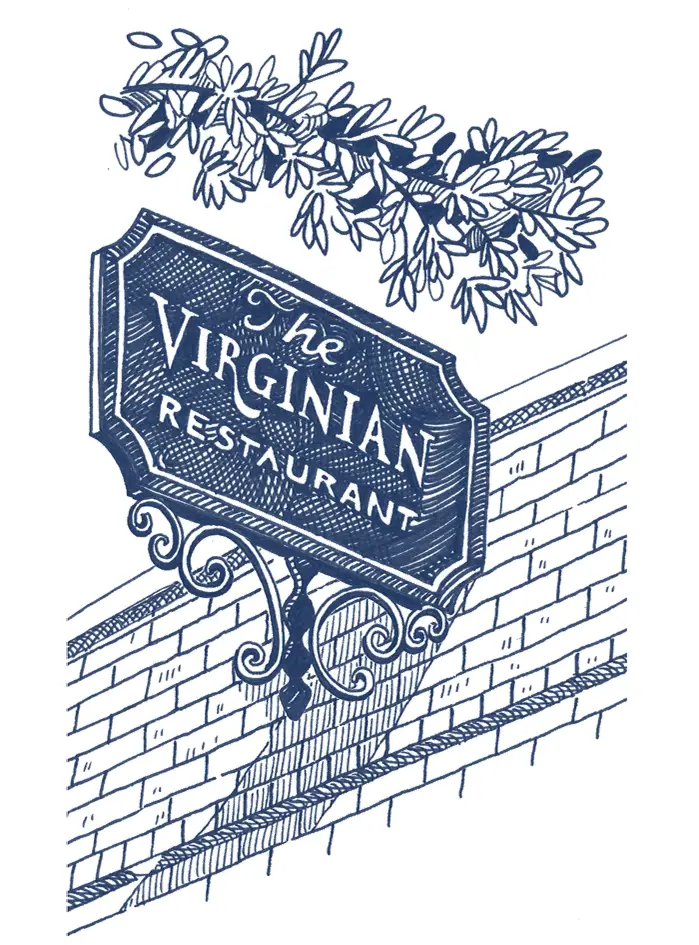
The Virginian, a shotgun-style restaurant with just 14 tables, has fed generations of UVA students, faculty and alumni for more than a century. For owner Andy McClure (Com class of ’01), keeping it going feels a lot like an obligation—and he’s happy to oblige.
“It’s being a steward of something that people love, and that is a responsibility that I actually take quite seriously,” McClure says. “I love UVA … and I love this town. Having that restaurant be such a major institution here is just awesome. It’s just a crown jewel.”
The Corner staple has occupied the same spot at 1521 University Ave. since its opening in 1923, making it the oldest restaurant in Charlottesville. Over the decades, McClure writes in a history of the restaurant, The Virginian has weathered Prohibition, wartime shortages and a rough patch in the 1990s.
McClure’s connection to The Virginian began because he needed a job. Walking down the Corner in the late 1990s, he saw a help wanted sign in the window and was hired on the spot. At that time, the restaurant wasn’t the packed landmark it is today. It had closed at least twice in the 1990s amid ownership changes and other issues.
The previous owners had been more focused on their neighboring restaurant, the Greenskeeper, and The Virginian was “kind of left by the wayside,” McClure says. The finance major started suggesting changes; over time, the owners took him seriously and helped finance a deal that made him the restaurant owner at just 22.
His strategy for reviving the landmark was straightforward: “Make it cleaner, make the service better, make the food better, and capitalize on its age and the tradition and history that makes it so unique,” McClure says.
Today, The Virginian leans into its century of tradition. McClure and his team refurbish rather than replace, studying old photos to keep both the facade and interior true to the past. “We’ve tried to stick to the roots as much as we possibly can,” he says.
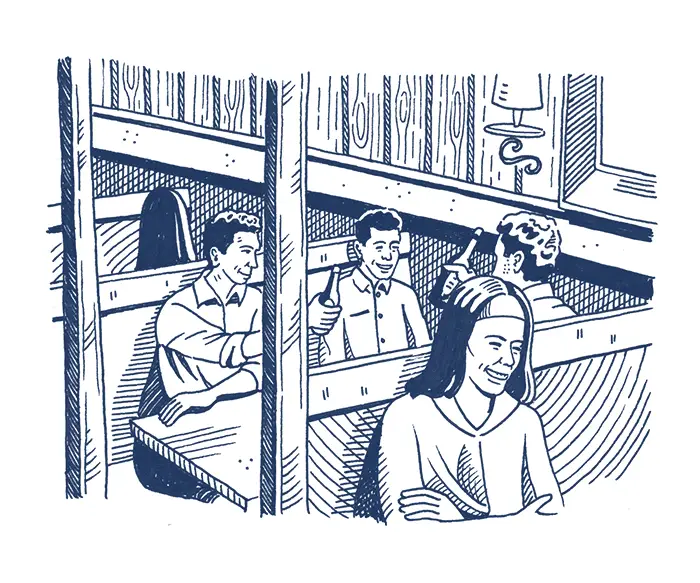
“My favorite spot on the Corner in the 1960s was The Virginian, where I often dropped in for lunch, dinner or just a few beers. I enjoyed just sitting in one of the booths, eating and/or having some beers, reading a book or magazine and listening to the music on their jukebox. I particularly remember enjoying ‘500 Miles,’ ‘Both Sides Now,’ ‘Play With Fire,’ ‘It Ain’t Me, Babe,’ and anything by Joan Baez or Peter, Paul and Mary.”
“The Virginian, hands down. Table dancing later in the night, wildly good food and affordable drinks. What’s not to like? I got married in Charlottesville, and where did I spend my final night as a bachelor? Atop the tables with my crew, as it was meant to be.”
“The Virginian. I wrote my thesis on top of the pinball machines there. My engineering adviser said it was one of the best he had seen.”
“The Virginian. Great gathering spot with friends after studying, and I met my wife there. We have been married 42 years. We live in Charlottesville and still go there to dine and celebrate.”
“The Virginian was my favorite spot at the Corner because it was within walking distance of the nursing school, a fun spot to go with a date and get a 3.2 beer. In 1964, women were either in the nursing or education school. Very few of us gals had a car, so we either walked or dated someone with ‘wheels.’ Fun times!!”
Littlejohn’s New York Delicatessen
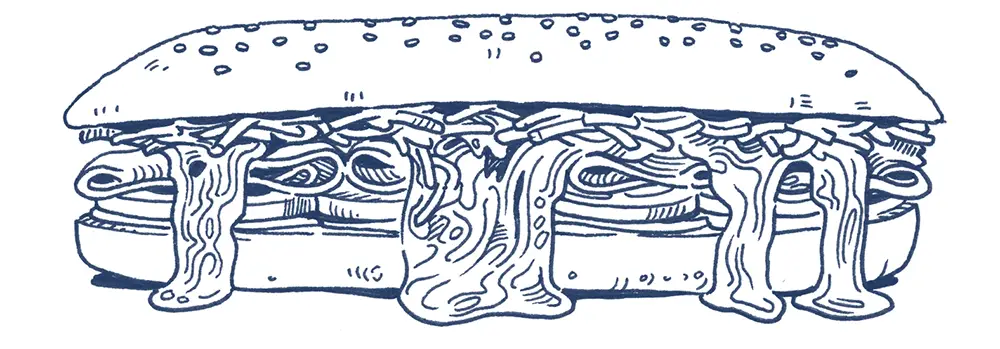
Nuclear Sub. Five Easy Pieces. Wild Turkey. Ask an alum from the 1970s to the early 2020s, and there’s a good chance they can rattle off their regular Littlejohn’s order.
John M. Crafaik Jr. (Col class of ’67) opened the 24-hour deli in 1976, and it quickly became a favorite Corner spot for its sandwiches, early morning hours and live music. Local musicians would gather in the restaurant’s front window to perform.
In the book Regarding Charlottesville Music—An Oral History by Rich Tarbell (Arch class of ’89), Charlottesville-area musician Jimmy O recalls coming across a notice for someone to play there.
I didn’t have any equipment. I didn’t have a song list. I didn’t know anything, but I had a guitar,” he told Tarbell. “They said they’d give me a sandwich and all the beer I could drink, which sounded pretty great. That was the start of my career.”
In 1980, a Daily Progress story recounting a night out in Charlottesville noted that a long line of students was waiting at 10:30 p.m. to place their orders. Through the years, Littlejohn’s embedded itself in UVA culture, naming sandwiches after UVA sports stars such as Ralph Sampson (Col class of ’83), Chris Long (Col class of ’08) and Kyle Guy (SCPS class of ’25).
And so it went until 2020. As the pandemic sent UVA students home, the restaurant’s owners put out a call for help, launching an online fundraising campaign and declaring the deli in crisis. After the death of a key member of the business and the inability to raise the needed funds, it closed its doors.
A new ownership group reopened it in early 2024 but closed it again in May 2025 because of “circumstances beyond our control,” an announcement said. “It’s been a true honor to serve you.”
“Littlejohn’s was my favorite spot on the Corner! I loved that the sandwiches were cheap, toasted and delicious (with a side of chips from a giant barrel next to the register). It was open super late, and the line was a fun place to run into friends.”
“Littlejohn’s. It was such an iconic spot on the Corner when I was a student for either lunch between classes or building a base before a night out. After graduation, I would always go back, including bringing my girlfriend there on our first trip to C’ville before proposing to her on the Lawn.”
“Littlejohn’s was my go-to spot on the Corner. As a student in the A-school in the mid-1980s, it was a quick walk from the studio to take a break and grab a quick bite to refuel before going back to a late night of work. My favorite was the Zonker—a bagel with cream cheese, onion, bacon and tomato.”
“Littlejohn’s was my favorite spot. As a recent immigrant, money was tight, so I couldn’t visit the Corner as often as my peers. However, I fondly remember splurging on Nuclear Subs the few times I could. Because it was open 24 hours, it was the perfect, convenient place for a late-night snack. Truly great, memorable times. I was saddened it recently closed for good.”
University Diner
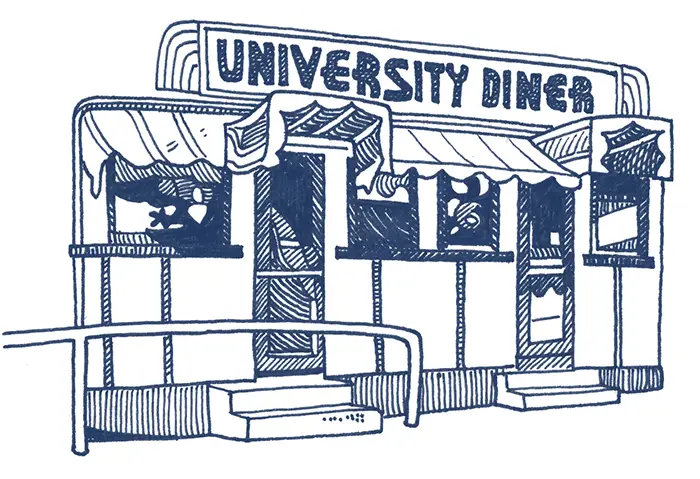
Across its 57 years, the University Diner—known to most as the “U.D.”—was a no-frills, late-night institution staffed by unforgettable characters. A decade after it closed, in a Daily Progress obituary for former owner Alma Shiflett Pogolowitz, Alexander “Sandy” Gilliam (Col class of ’55) summed it up:
“The diner was the place you went to if you were pulling an all-nighter at four in the morning and you were falling asleep over your books and needed a cup of coffee,” said Gilliam, who served as a longtime Board of Visitors secretary and special assistant to UVA presidents. “I can say I was a habitué.”
There was the food. The diner served up traditional fare, but a few items took on a life of their own. The “one-eyed” bacon cheeseburger featured a fried egg as the eye. Then there was the Grillswith—two donuts grilled with a scoop of vanilla ice cream in the middle—which became so beloved that other restaurants on the Corner have served up their own versions.
There were also the people. The Shifletts, the U.D.’s longtime owners, were known to dole out a free meal to a student in need. Ethel Mae Booker, a longtime server, was tough, warm and unflappable. Vernon Elwood Breeden, short-order cook, was behind the grill for 28 years, sometimes making 1,800 Grillswiths in a weekend.
Coy Barefoot (Grad class of ’97), author of The Corner: A History of Student Life at the University of Virginia, interviewed longtime U.D. owner Irvine Lee Shiflett, Alma’s son who died in 2014, about the genesis of the Grillswith. Shiflett told him the dish was created sometime in the late 1940s or 1950s.
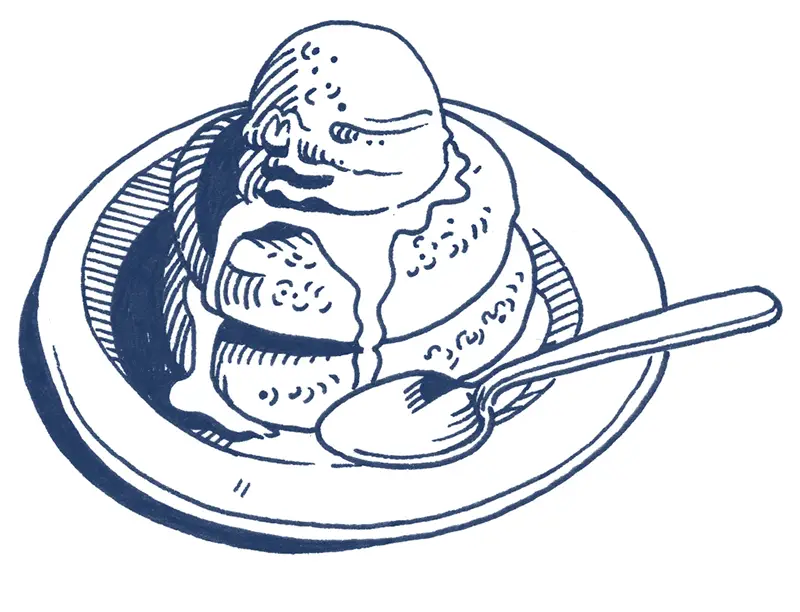
“Someone must have ordered a couple of hot, grilled doughnuts one day and asked to have a scoop of ice cream put on top. Grilled doughnuts with ice cream—the Grillswith,” Shiflett told Barefoot. “It really caught on as a Corner tradition in the 1960s. We used to get 150 dozen doughnuts delivered every weekend, and by Sunday they would all be gone.”
The last night of the U.D., in May 1985, was so chaotic that the Shifletts had to call the police. People were pulling letters from the restaurant’s outdoor sign, The Daily Progress reported.
“We ran out of food, and they still lined up outside the door,” Fay Shiflett, Lee Shiflett’s wife, told a Progress reporter at the time. “We started serving one-eyed bacon cheeseburgers, then it was one-eyed cheeseburgers, then it was one-eyed hamburgers. Then we ran out of burgers, but that didn’t stop them.”
“University Diner. Open all night, great place for typical college food in the late 1960s and 1970s. My dad (from the Class of 1950) and a friend took a horse into the U.D.”
“Most definitely the University Diner, fondly known as ‘the U.D.’ What a great place to hang out with friends, eating one-eyed bacon cheeseburgers and fries. No trip to the U.D. was complete without a Grillswith for dessert. Best mind your manners around Fay and Ethel, though. They wouldn’t hesitate to toss ne’er-do-wells out the door. I wonder just how many Grillswiths were made on Vernon’s grill.”
“What I liked the most about the U.D. was the bacon double cheeseburger and fries. I was there the last day it was open in May 1985 and have attached the receipt from my last meal at the U.D.”
Mincer’s
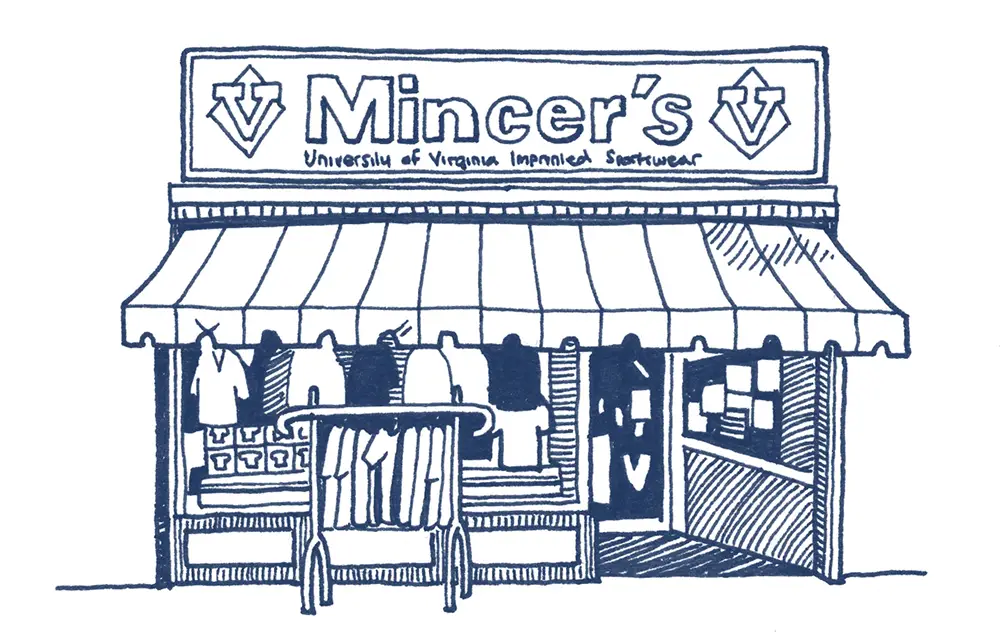
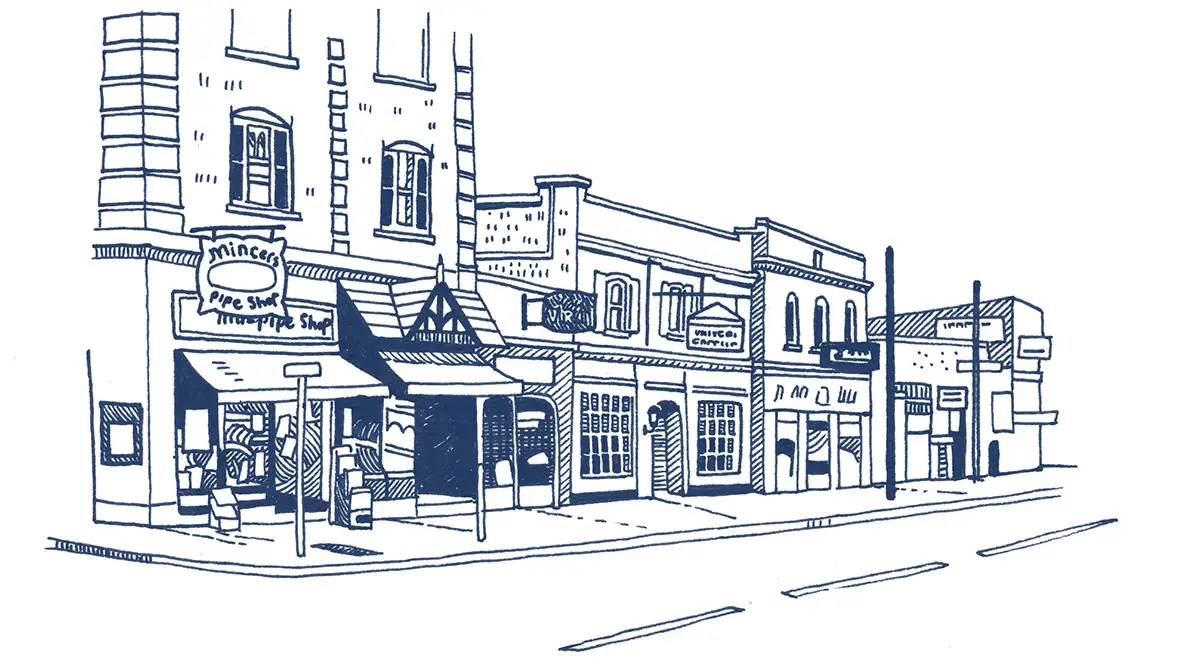
Somewhere above Mincer’s at the corner of Elliewood and University avenues, a few tobacco pipes remain, a reminder of the store’s origins. As does a vintage handwritten sign that advertises a sweatshirt for $15.
“There’s not a lot of throwing things away going on around here,” jokes the shop’s fourth-generation leader, Cal Mincer.
UVA alumni from the 1980s and after know Mincer’s mostly as a shop devoted to UVA apparel and gear. But its origins have everything to do with a surplus of military-issued pipes flooding the market at the end of World War II, according to a history of the store—leaving founder Robert W. Mincer out of a job at a Long Island pipe factory and contemplating a potential opportunity.
College students liked pipes, he figured. Why not open up a pipe shop in a college town? He landed in Charlottesville, and Mincer’s Humidor opened in July 1948, a few storefronts away from its current location, where it moved in 1954.
Over time, the store’s inventory evolved to include more than tobacco and expanded into the space next door. Through the decades, it sold records, newspapers and textbooks and served as Charlottesville’s Western Union agent.
The big shift came in 1976, when the men’s basketball team won its first ACC Tournament championship. Mincer’s marked the occasion with a simple orange T-shirt. Then came the Ralph Sampson (Col class of ’83) era, and demand for UVA apparel began to take off.
“Dad was very good at capitalizing on what’s missing from the market in the area around us,” says Cal of his father, Mark Mincer (Com class of ’85), who died in 2023. “Once a couple records sold, we jumped on that. Once a couple ACC shirts sold, we jumped on that.”
These days, sitting among reminders of the store’s past in his office, Cal Mincer spends a lot of time thinking about the future. The store prepares T-shirt designs as if UVA will win every championship and, in March, unveiled a new design to celebrate the women’s swim team’s sixth straight NCAA title. (See story, Page 26.)
“We’re running out of ideas for swim designs because this is the sixth year in a row we’ve had to do it,” he said of the women’s team’s March win. “But that’s awesome.”
For all the change, much has stayed the same. “I like that if you know what you’re looking for and you have experience shopping at Mincer’s, [you can] not see us for 20 years and come back and jump right back,” Mincer says. “It just feels the same.”
“Mincer’s Pipe Shop. As a former pipe smoker, I enjoyed being able to put together a particular blend of tobacco that they kept on file for me. After I left the university and entered the military, I was able to have the tobacco mailed to me, regardless of where in the world I was serving. Smoking a bowlful, sometimes under inhospitable circumstances, brought back fond memories of Charlottesville.”
“The third floor of Mincer’s Pipe Shop, as it was called when I was there. I rented one of the rooms that faced the main drag and the Grounds across the street. Several of us on the third floor were already friends, so we ended up being a tight-knit group, partying together regularly, perhaps to excess. On one of those occasions, we engaged in a bowling tournament in the hallway. Unfortunately, the bowling ball managed to roll down the stairs and was lost, we thought, until we learned years later that Mr. Mincer the Elder kept it in his office as a souvenir!”
“Mincer’s. I worked there about 20 hours per week during my third and fourth years. Through that I met many varied and interesting people that I would never have been able to know. In the days before ATMs, Mincer’s was the only place in town that a student could cash a check from 8 a.m. to 9 p.m., seven days per week.”
The White Spot
Plenty of businesses have come and gone on the Corner, but one spot has remained pretty much the same: The White Spot. The late-night institution is best known for its Gus Burgers—a fried-egg-topped patty known as the go-to remedy after a long night out.
Or, as the Cavalier Daily noted in a 1973 roundup of Charlottesville restaurants: “If your grease tolerance is especially high, give the Spot a go. Another 24-hour restaurant, the Spot seems to attract an intriguing clientele.”
The White Spot opened in 1953 inside a storefront previously occupied by a beauty salon. Its name, according to Barefoot’s book, came from the circular impression on the floor where one of the salon’s heavy chairs once stood. The Spot’s original owner painted it white.
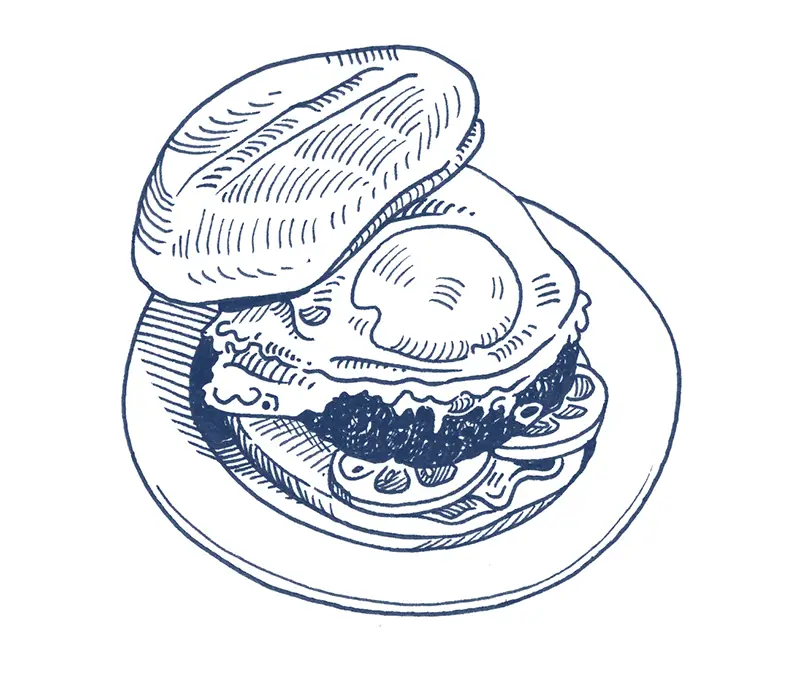
At first, a hot dog with melted cheese and bacon was a White Spot favorite, until around 1960, when the Gus Burger was born, Barefoot writes. The Gus Burger is named in honor of Dr. Gus Egor, a UVA doctor who reportedly requested a cheeseburger with a fried egg on top daily, according to The White Spot’s website. The rest is UVA gastronomic history.
Today, the Spot endures in the hearts and minds of UVA alumni across the generations—and may have even made it to Netflix. In The Four Seasons, co-written by and starring Tina Fey (Col class of ’92), the fifth episode finds the characters back at their alma mater, walking along a Corner-like street where they discover that the fictional “Hot Spot”—famous for its burger topped with a fried egg—is now a vape shop.
“Why would they close the Hot Spot?” asks Jack, played by Will Forte. “You think it was a pandemic thing?”
The real White Spot, however, survived the pandemic. In 2021, a group of UVA alumni from the 1960s to 2000s took ownership of the landmark, according to its website. The Gus Burger is still on the menu.
“The White Spot. After sharing a pitcher or two of the usual beverage at a Corner watering hole, only a Gus Burger could soak up all that beer, so you could walk to class from the fraternity house without a hangover the next morning! (Harold and Dimitri, the staff of The White Spot, also were always entertaining.)”
“Have to get my Gus, my Motor burger, every time I am in Charlottesville. It is like a magnetic pull. Anytime I am near UVA, I have to stop there. I know the guys behind the counter—great guys—and they always remember me. Food has not changed, even under new ownership.”
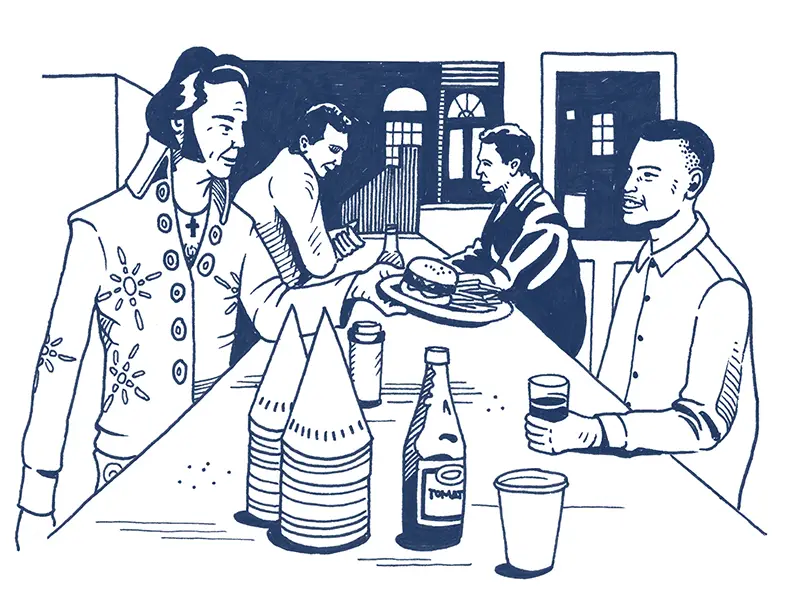
“The White Spot. Gus Burgers were amazing after a night out. There was an Elvis impersonator that worked the grill. Also, back when I was there, from 1995 to 1999, there was a pay phone at the end of the counter. After a night out we sometimes just called the pay phone to see who would pick up and then have random conversations with other students who were there. It was a fun way to talk/meet others!”
University Cafeteria
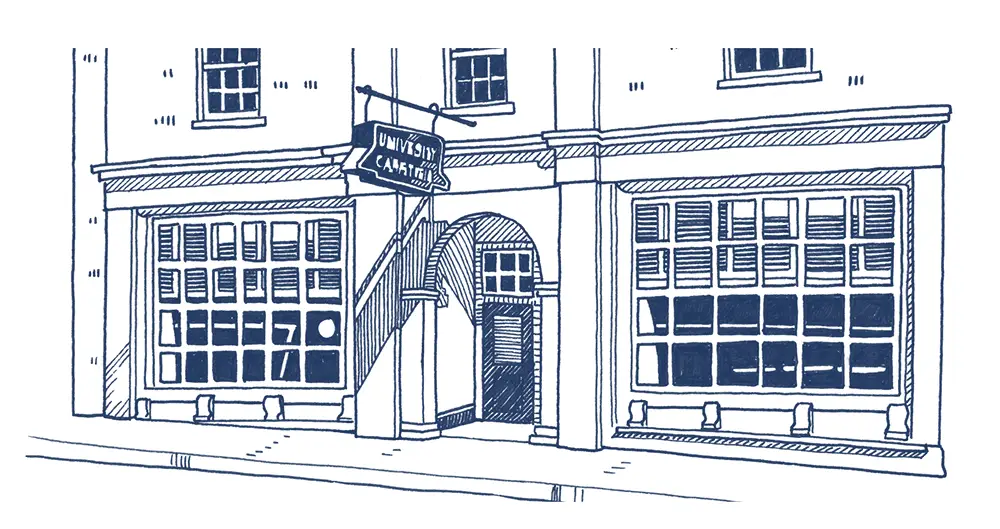
National chains have filled the storefront in the 1500 block of University Avenue in recent years—Raising Cane’s Chicken Fingers since 2023, a Sheetz before that, and local favorites like Armand’s Pizza and the Greenskeeper in earlier years. But the one that alumni remember most fondly predates them all.
For four decades—from 1942 to 1983—the University Cafeteria was a focal point on the Corner. And the U-Caf or Uni-Caf, as it was fondly called, announced itself with a rooftop sign in large, looping script that spelled out the restaurant’s name.
The self-service restaurant offered big plates of affordable comfort food seven days a week to hungry crowds of students, faculty and staff. Fried chicken, spoon bread and roast round of beef were regulars on the menu.
As civil rights protests swept the country in the 1950s and 1960s, the U-Caf, without any fanfare, made history of its own. Sometime in the 1950s—years before other Corner restaurants followed in 1963 and early 1964—it became the only Corner restaurant to serve Black customers, Barefoot writes in his book.
Cleve Webber, longtime manager, recalled the moment to Barefoot when a Black student, likely attending the law school, walked in one afternoon with a couple of other students.
“They went through the line, got their food, then went and sat down smack-dab in the front window so everybody walking by could see them,” Webber said. “People would stop and look and stare in the window. I know people were asking, ‘Has Webber gone crazy?’ But it passed without any incident at all. Sure, we had some old diehards who would get upset about it. And some of them told me they thought I was wrong. But you know, the Black people sat down and ate like everybody else. I didn’t see any reason to raise hell about it.”
What was getting noticed was the food. In 1976, The New York Times called it “legendary,” and through the years, other publications—including Glamour, McCall’s and the Mobil Travel Guide—praised it for its quality.
While the U-Caf remains beloved among students of certain eras, its closing in 1983 didn’t spark the kind of fanfare that the University Diner’s closing would earn two years later. The Daily Progress reported that it closed due to financial insolvency.
Changing trends and customer tastes had a lot to do with it. It was a concept past its time, said Robert H. Mincer (Com class of ’58), then the second-generation owner of Mincer’s next door, in a Daily Progress story about the U-Caf’s closing.
“I think it’s the end of an era that we don’t have a cafeteria on University Corner,” Mincer said. “I think it’s sad. We live in an era of fast food, of people in a hurry.”
“The University Cafeteria was a great favorite in my time. After all these years I still recall spaghetti Milanese and French apple pie. Nutritious homemade food at affordable prices.”
“University Cafeteria. As a first-year in 1970, I did not have a meal plan, and even my hallmates with meal plans looked forward to going with me to ‘UC’ for Sunday lunch and their great fried chicken.”
“University Cafeteria, aka Uni-Caf. Oh! The homemade stewed tomatoes and the green beans flecked with bacon, and the service was loving. Just what a homesick first-year needed.”
College Inn
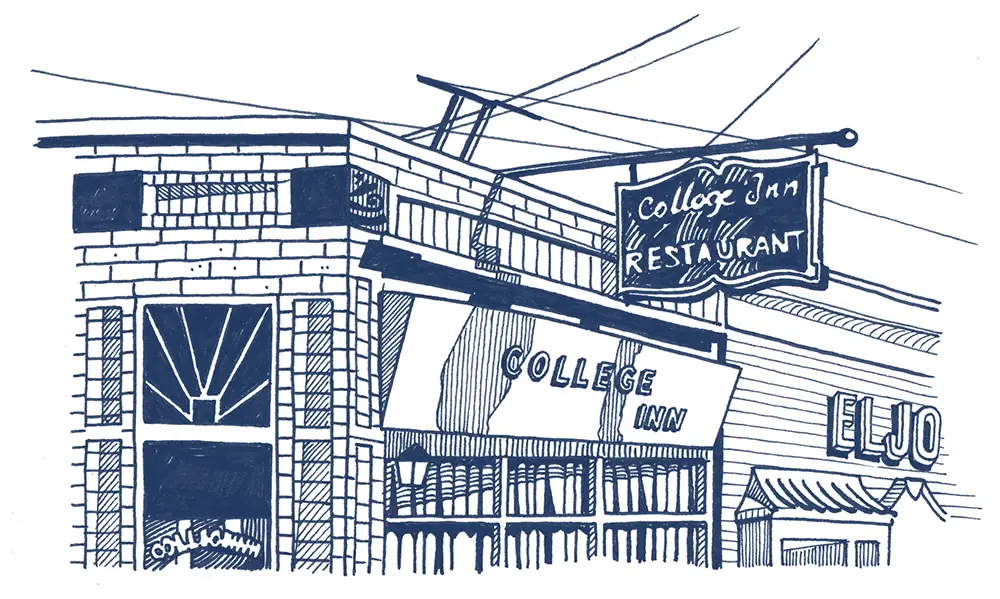
With padded booths and framed UVA memorabilia on the walls, there was nothing fancy about the College Inn. But what it lacked in flair, it made up for in consistency. Reliably good cheesy bread and steak fries, gyros and chicken parm, with good delivery into the wee hours of the morning.
And for nearly 75 years, the College Inn was reliably there—until it closed in 2021.
The sign above the door said it was established in 1953, though one of the original owners told Barefoot it opened in 1952. The College Inn was the brainchild of two brothers, Elliott and Joseph Hyman, who were also behind another Corner favorite, Eljo’s. Eljo’s opened in the summer of 1950, and there weren’t many restaurants on the Corner at the time, Joseph Hyman told Barefoot. So they opened the College Inn before selling it about a year later.
“We were both young and full of energy,” Joseph Hyman told Barefoot. “We didn’t need much sleep in those days.”
The restaurant quickly became a mainstay, beloved for filling, inexpensive meals and friendly staff. In 1971, Cavalier Daily writer Fen Montaigne (Col class of ’74) praised College Inn server Dotty Bunch, calling her the “most loving and kind woman that ever served up a BLT on rye toast.”
“She cares, and not in just a small-talk sort of way,” wrote Montaigne, who would eventually become a journalist, author and Pulitzer Prize finalist. “If you walk in with a headache, she’ll know it.”
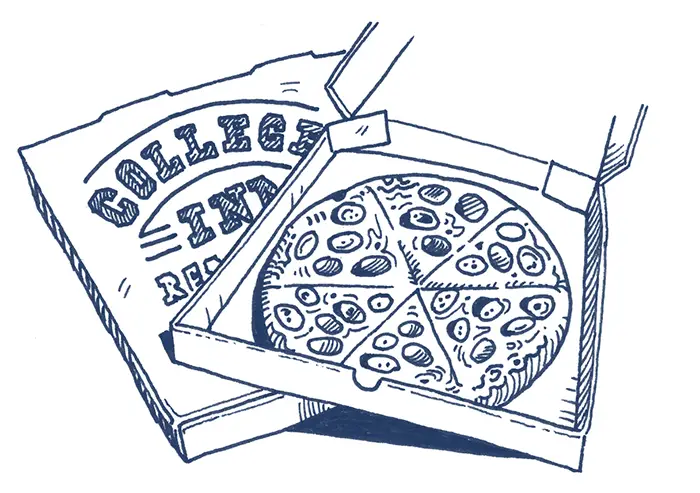
Just as enduring was the delivery service. The College Inn took orders until 2 a.m., just as the bars closed, delivering food as late as 3:30 a.m. Stu Rifkin, a final College Inn co-owner, refused to outsource to apps like DoorDash or Grubhub, insisting on using their own drivers. On weekend nights, nine or 10 drivers were on the road.
But during the pandemic, staffing grew more difficult, and some key equipment failures became too costly to fix, just as the lease came up for renewal. The landlord had a lucrative national tenant—Chipotle—ready to pay more and fund a major renovation. Altogether, those factors helped drive the decision to close the College Inn.
As it shut down, the restaurant’s memorabilia and kitchen gear were sold or given away to customers, former staff and other local restaurants. Proceeds, Rifkin says, went to the restaurant’s last employees.
“A much-beloved place. I’m proud of my time there,” Rifkin says. “I do tell people, sometimes with a bit of hesitation, that I was one of the last owners of the College Inn.”
“College Inn. Nothing hit better than a chicken parm sub and some onion rings in their god-tier ranch after a night out.”
“College Inn. The delivery service to dorms into early hours made it a staple for Emmet first left in ’81-’82. Its pizza threaded the needle of not being from a mainstream pizzeria, and yet not being too fancy. The roast beef sub and onion rings were sleeper items on the menu if you ventured away from ordering a pie.”
“College Inn. Terrific food, not too expensive. Service was great and staff was friendly. Good memories of lunches and dinners there with friends during my time at UVA.”
1505 University Ave.
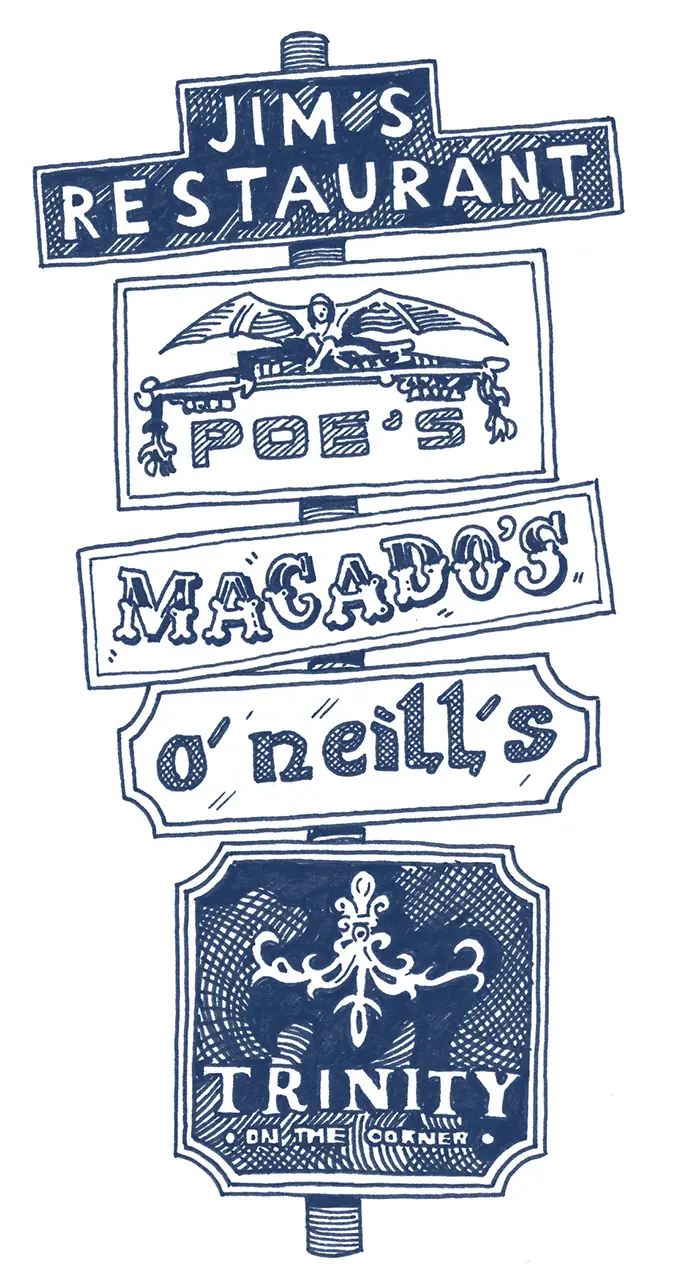
For nearly seven decades, a string of popular restaurants and bars has lured students to a single address: 1505 University Ave.
In the early 1960s it was Jim’s Restaurant, operating despite an early stumble: Three men, including restaurant owner James Sprouse, were jailed for stealing more than $400 of pots, pans and utensils from Newcomb Hall. Sprouse was still running the restaurant in 1963, when he worked with police to catch an employee suspected of larceny.
Alumni from the 1970s may remember it as Poe’s, which had its “fair share of run-ins with the Internal Revenue Service,” Barefoot wrote in his book, but became a favorite of students for its stuffed taxidermy raven, “Spanish dungeon lights,” live music and 35 kinds of imported beers.
By the time Poe’s closed in 1982, the multistory building included a second-floor game room and third-floor disco, Barefoot wrote.
Next came Macado’s in 1983, a regional chain that alumni from the 1980s and 1990s still fondly remember for its Long Island iced teas, pitchers of beer and cheap food. It closed in 1997, a victim of the Corner’s parking woes and the building’s multiple levels, the owner said at the time.
Since 1999, 1505 University Ave. has been home to Irish pubs—first O’Neill’s, and now Trinity on the Corner, whose Instagram page touts weekly specials like “$10 Natty Pitchers” and $5 wings.
The names change, but the vibes inside 1505 have long stayed the same.
“I was there in March of ’76 when the ’Hoos won our first ACC men’s basketball tournament, beating UNC in the final. Although it was the start of spring break, the Corner exploded with incredulous and ecstatic fans. I was standing on a table in Poe’s with about 10 others when it collapsed and we fell into the supportive arms of the masses therein assembled. I also witnessed chandeliers pulled from the ceiling by the celebrating throng. Needless to say, the place was utterly destroyed by the festivities but continued to be the go-to place for the remainder of my cherished days at UVA.”
“O’Neill’s had everything a broke college student could want. It was an easy place to hang out with friends, decent enough food for a date, and featured some trendy drink specials like ‘Survivor hour’ on Thursdays! While O’Neill’s has sadly since closed, at least Trinity in the same spot keeps some of the Irish spirit alive on the Corner!”
“Macado’s! So many good memories of going there with big groups of friends and dormmates, and also going on dates with the guy I would end up marrying. They had good food, and it was cheap (a requirement for a college hangout). Heading up the stairs for the restaurant just seemed so cool somehow!”
St. Maarten Cafe and Trading Co.
The regulars at St. Maarten Cafe and Trading Co. didn’t just have a favorite barstool or booth. The truly devoted became part of its mug club. Heavy pewter steins engraved with nicknames hung on the wall in numbered slots. Mug club members didn’t buy their way in, says Mary Katherine “MK” King (Engr class of ’02). They got a mug by showing up so often that the staff knew them by name.
King earned her own mug application on her 21st birthday. “It was like, you made it. You were a part of [something],” said King, now a Charlottesville real estate agent. “‘I go to this bar, and I’m a member.’ That doesn’t sound cool anymore, but it did when you were 21.”
St. Maarten opened in 1985 and over three decades became a second home to a devoted mix of UVA students, alumni and locals, drawn to the friendly atmosphere, the Cajun cheese fries, wings of every spice level and good beer specials.
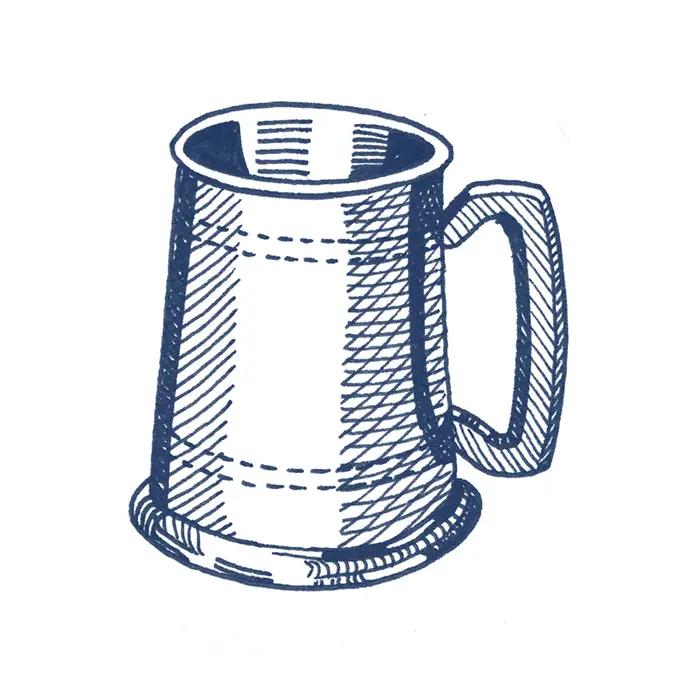
Some student groups even claimed it as their home away from home. Trigon Engineering Society and University Transit Service student bus drivers were among the regulars who made it their unofficial headquarters. The decor was tropical, complete with a fish tank, but the walls were dotted with callouts to its regulars—including the steering wheel from a UTS bus and a plaque listing Trigon presidents.
“Maarten’s was for all the other kids,” King said. “We were not a frat party establishment, more like the land of misfit toys.”
In its heyday, students and locals formed long lines outside on the busiest nights for a spot at the bar or one of the booths. In 2012, St. Maarten closed for a few months before five Trigon alumni, along with two longtime employees, worked together to reopen it. The group added some TVs, tweaked some specials and bought St. Maarten about five more years. Last call was in November 2016 after the final football game of the season.
“My favorite spot on the corner was St. Maarten Cafe! I loved it because loyal customers could have their own personalized mug hanging at the bar so they could have their favorite beverage served in their own mug. We would go there after a late night on Rugby Road and have their famous loaded chili cheese fries! Of course, who can forget St. Maarten’s wings, which ranged from Fire to Hell hot. There are even off-menu levels of the wings—all the way up to Seventh Plane of Hell Death Wings.”
“St. Maarten. It was our home away from home at the end of a long day. Good food, beer and company. And if you were a regular, you had your own beer mug hanging over the bar waiting there for you.”
Other favorites
“Two clothing shops: Eljo’s and Ed Michtom’s. Great ‘threads,’ as we called them in the late 1960s. But I mostly drooled over clothes rather than bought them there. I didn’t have the ‘bucks.’ I knew clothing was changing when J. Press of New Haven stopped its visits and ads in the CD.”
“Armand’s Pizza. All-you-can-eat lunch buffet and Thursday night Seals and Butler acoustic music.”
“There were afternoons when my dear friend Haber McCarthy and I would go to the Rexall Drugstore to look at funny greeting cards. We would not buy them, just simply read them and laugh or cringe. Haber passed away far too soon, and I cherish so many memories of him and think of him every time I buy a greeting card.”
“The Biltmore! Their huge salads with ‘pizza bread’ on the side and Toll House Pie were among our menu favorites.”
“The Mousetrap. During the Ralph Sampson era when UNC dominated, I remember watching UVA come back from a 17-point halftime deficit to win. By the end, everyone there was standing in their chair.”
“TJ’s, a favorite watering hole for students and the occasional ‘townie.’ They had a tradition of ‘dime time,’ 10-cent beers for an incredibly short duration! It would get so crowded that groups would send one person to the bar to buy as many beers (in flimsy plastic cups) as they could hold and bring them back to the table for everyone. We’d all chug as quick as we could and then go back for more until time was up. They also had an awesome Halloween costume contest every year! One year, us friends went as a box of crayons and another year a portable bar, complete with 7Up, Seagram’s Seven, ice cube, Wahoo cup, etc. Such fun times!”
“Martha’s Cafe. They made great use of the space in the traditional frame building, and the food (usually quiche, salad and a muffin) was a novelty for a rural Virginia bumpkin like me.”
“Take It Away. I will never forget those sandwiches! The sprouts, house dressing, the oblong shape of their bread. Those sandwiches accompanied me on so many favorite UVA memories. I loved stepping inside—the checkered floors, the baskets of chips, the anticipation!”
“Michael’s Bistro! Gone now, but unforgettable. That bistro gave me my first taste of Belgian ale—Delirium—and a duck shepherd’s pie that was pure comfort. Dark wood, low light and an inviting warmth made it the kind of place you wanted to linger. Some places close; the memory doesn’t.”
“I liked so many spots like Mincer’s, U-Caf and Eljo’s (just because of the smell), but I had a special liking for Rohmann’s Sporting Goods next door to Mincer’s (and later the newer half of the expanded Mincer’s). They really catered to the racket sports, and everything there was priced so that it came out to an even dollar amount with tax. As silly as that sounds, I loved that.”
“Coupe’s. There was nothing better than a spring in Charlottesville and feeling the beautiful breeze coming up from Elliewood Avenue. The live music was to die for, and the drinks were unnameable. Always has and always will be my favorite spot on the Corner. Having worked at Trin and Coupe’s, there shouldn’t be a debate as to which is the best.”