“I have to earn people’s trust”
After a controversial election process and an unconventional path to the presidency, UVA’s new leader says he’s ready to listen and learn.
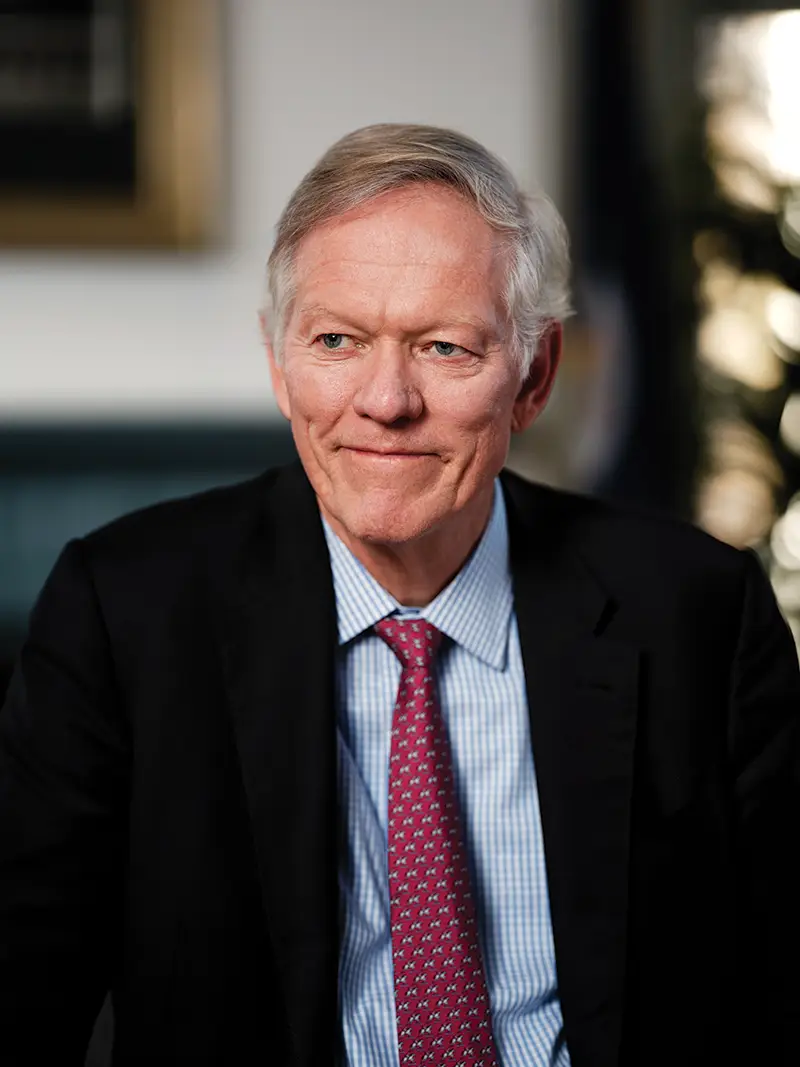
Scott Beardsley wrote the book on nontraditional college presidents. Published by UVA Press in 2017, Higher Calling studied the rise of leaders who did not come up through the traditional faculty tenure-track path, but from the worlds of business, law, government or the operations side of college administration.
Beardsley didn’t just write about them. He aspired to join their ranks. In January, his ambition was realized when he became the 10th president of UVA.
Like those in his book, Beardsley’s route to a college presidency was unconventional. He had no higher education experience when he left a 26-year career at consulting giant McKinsey & Company to become dean of the Darden School of Business in 2015.
The circumstances of Beardsley’s election were also outside the norm—and unprecedented in university history. The Board of Visitors voted to elect Beardsley on Dec. 19, the last day of academic exams, at a special meeting, despite calls from both inside UVA and in Virginia’s government to cease the presidential search. Members of the United Campus Workers of Virginia and the American Association of University Professors protested outside the meeting.
After Beardsley took office Jan. 1, faculty groups continued to question the legitimacy of the selection process—which took just less than four months—calling it rushed, opaque and politically motivated. Many also questioned whether the board, which had just 12 members and did not have the number of UVA alumni or Virginians called for in state code, was properly constituted.
Five members of the board that appointed Beardsley, including then-Rector Rachel Sheridan (Col class of ’94, Law class of ’98) and then-Vice Rector Porter Wilkinson (Law class of ’07), resigned in January at the request of incoming Democratic Gov. Abigail Spanberger (Col class of ’01), it has been widely reported. Spanberger replaced those five with her own appointees and also filled five vacancies, giving her appointees a 10-7 majority on a board previously made up of members appointed entirely by former Gov. Glenn Youngkin, a Republican.
Beardsley said he takes over in this partisan environment with no political agenda—but with awareness that some have questioned his decision to take the job given the concerns raised about the process.
“I knew some people thought no one should be selected at all,” he said. “But basically, at the end of the day, it was my love for the university and my belief in the mission, and that we need somebody to bring stability and to contribute.”
Beardsley said he was surprised when he received the call informing him that he’d been selected.
“Leading the University of Virginia is such an incredible honor,” he said in an interview with Virginia Magazine. “I figured the competition would be incredibly strong. “To have assumed that I would be the president is just not consistent with who I am, which is a very humble person. I felt like I was qualified and that I could add a lot of value. But at the end of the day, I was surprised that I actually made it all the way through.”
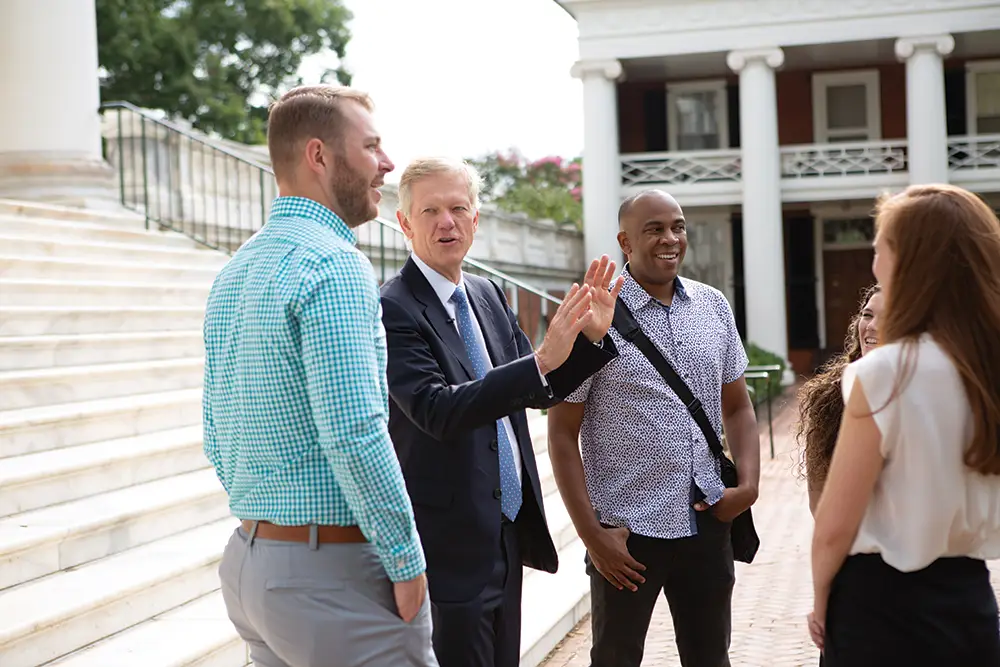
Many of those who worked for or with Beardsley at Darden were not as surprised. They point to Darden’s ranking in 2025 as the No. 1 public business school by U.S. News & World Report, the first time the school has achieved that distinction. They cite Beardsley’s strategic vision, his fundraising prowess and his ability to build bridges with other schools across Grounds.
“Scott is a man of action,” said Frank Sands (Darden class of ’94), immediate past chair of the Darden Foundation Board of Trustees. Sands called Beardsley’s academic and business credentials “the best of both worlds.”
John Macfarlane (Darden class of ’79), who served on the Board of Visitors when Beardsley was hired at Darden, said he was among those who nominated him for the presidency. Macfarlane said Beardsley is “perfectly suited” for this moment in higher education, in which federal and state funding is declining and the value of a college degree is being challenged by rising tuition and the threat to some entry-level jobs posed by artificial intelligence.
“What the university needs now—and what every school needs now—is someone with practical business experience,” Macfarlane said.
Others say Beardsley must work to win over those who question the legitimacy of the selection process. David Leblang, a politics professor who served on the presidential search committee, said that although Beardsley is equipped to be a “great” president, he will face an uphill battle to win over those, like himself, who believe Beardsley should not have accepted the job given the calls for delay.
“It just raises a whole set of questions about governance,” Leblang said.
Emphasizing the need for insitutional stability, the Student Council in late January passed a resolution supporting Beardsley, while also criticizing the selection process.
Student Council President Clay Dickerson (Col class of ’26) met with Beardsley before the resolution passed, and secured commitments to fund several council priorities, he said.
“I felt like I was qualified and that I could add a lot of value. But at the end of the day, I was surprised that I actually made it all the way through.”
Dickerson said his meeting was “entirely separate” from the resolution. “He knows he has to earn our trust. It can’t be bought, and it wasn’t bought.”
Jeri Seidman, chair of UVA’s Faculty Senate, said in an email that Beardsley will need to have some difficult conversations to build trust.
“He needs to listen widely, and he needs to stand in the awkward and uncomfortable space during that listening,” Seidman wrote.
Beardsley said he is ready to listen. “I don’t believe I deserve anything in particular,” he says. “I have to earn people’s trust.
Born in Maine and raised in Alaska, Beardsley earned a degree in electrical engineering from Tufts University and an MBA from MIT. In 1989, he began a career at McKinsey that took him to 40 countries. According to his book, he was elected as a senior partner in record time, leading McKinsey’s strategy practice. He then took over the firm’s leadership development program, a “huge university-like engine,” as he described it in his book.
Beardsley was considering a career shift when he applied for the Dartmouth presidency in 2012, ignoring the “obvious fact that Dartmouth would never have considered someone with my lack of credentials for that role,” he wrote. Despite his lack of academic bona fides, he received a first-round interview with a well-known search firm, Issacson, Miller.
Beardsley writes that the firm told him his nontraditional background and lack of a Ph.D. made him a long-shot candidate. That assessment was confirmed when he applied for the Yale presidency and didn’t receive a response, and again when he was told he was the token “nontraditional” candidate by an unidentified East Coast liberal arts college where he applied to be president, he wrote.
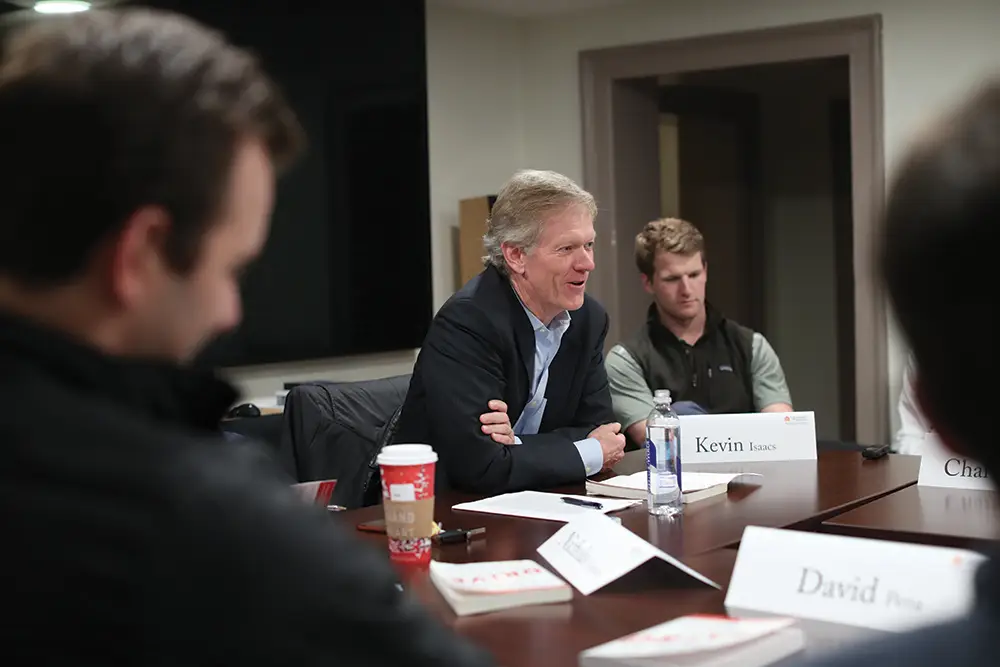
To boost his credentials, Beardsley pursued a doctorate in higher education management from the University of Pennsylvania. The two-year program required a monthly commute to Philadelphia from his home in Brussels, Belgium.
Beardsley wrote his thesis on nontraditional leaders in higher ed, interviewing presidents as well as search firm executives. One of the executives he interviewed, Ken Kring of Korn Ferry, was leading the search for a new Darden dean and encouraged him to apply, Beardsley said.
At Darden, Beardsley took over a school that had made strides under Robert Bruner, who served as dean from 2005 to 2015 and elevated the school’s reputation and rankings. Beardsley came in as an outsider but quickly earned everyone’s respect, said John Fowler (Col class of ’79, Darden class of ’84, Law class of ’84), chair of the Darden Foundation’s board of trustees.
“You see some CEOs come in and say, ‘Here’s five things I’m going to do,’” Fowler said. “Scott had a more thoughtful, consultant-like approach: ‘Let me get here, let me listen to all the different constituents and evaluate and synthesize what I learn. Then let me lay out a vision and a plan and define what issues we are going to address.’
“Scott came in and did the analysis that a consultant does. The big difference is, he then truly executed on it.”
One example of that execution is the opening in 2018 of Darden’s Northern Virginia campus, called UVA Darden DC Metro. Located in Arlington, it’s home to Darden’s executive MBA and part-time MBA programs, as well as executive education programs and a Master of Science in business analytics co-sponsored by the McIntire School of Commerce.
Expanding to the D.C. area had been discussed for the better part of a decade, said Michael Lenox (Engr class of ’93, class of ’94) who has been on the Darden faculty since 2008 and currently serves as interim dean.
“I had been a part of at least two different faculty working groups looking into D.C.,” Lenox said. “Scott came in and said, ‘Let’s go do it.’”
Beardsley approached Sands and his father, Frank Sands Sr. (Darden class of ’63), owners of the investment firm Sands Capital, about sponsoring the new venture, the younger Sands said.
“We said, ‘Yes, if you’re actually going to do it,’” Sands said. “And he did it.”
Another major initiative completed during Beardsley’s tenure is the Forum Hotel. Opened in 2023 with 198 guest rooms and 22,000 square feet of gathering and classroom space, it houses Darden’s executive education and lifelong learning programs. It replaced the aging Inn at Darden, where some long-term clients no longer wanted to send their executives, Beardsley said.
A year after the Forum opened, workers broke ground on Darden’s first dedicated student housing, which is scheduled to open in 2027. Darden also added 70 new faculty during Beardsley’s tenure. As the school’s chief fundraiser, he helped bring in $523 million for Darden—and helped grow its endowment to more than $1 billion.
Happily situated in Pavilion I on the Lawn, Beardsley began his 11th year at Darden in 2025. He said he was contacted over the years by schools gauging his interest in various roles but was happy in Charlottesville and at UVA.
“I loved Darden, and in a way, Darden was like leading about the same size and scope of a small liberal arts college,” he said. “I mean, roughly. Of course, it’s different because it’s a business school and you don’t have athletics and stuff like that reporting to you.
“But my main focus was on Darden and just doing the best job I could.”
The tumultuous events of 2025 created a new opportunity. UVA’s ninth president, Jim Ryan (Law class of ’92), resigned under pressure from the Trump administration’s Department of Justice on June 27. Former Law Dean Paul Mahoney was appointed as interim president Aug. 4. In October, he signed a deal with the DOJ but declined to sign the Trump administration’s “Compact for Excellence in Higher Education.”
“He needs to listen widely, and he needs to stand in the awkward and uncomfortable space during that listening.”
Beardsley said he chose to pursue the job because he believed his experience matched the qualities UVA was seeking in a president.
“For example, they wanted somebody comfortable with strategy and developing a vision,” he said. “Well, I used to lead the strategy practice for McKinsey. I said, ‘OK, I know how to do that.’”
Beardsley also brought a deep knowledge of UVA, a familiarity with athletics—he played intercollegiate tennis at Tufts—and an appreciation for the health system, he said.
Beardsley’s track record at Darden, which is financially self-sufficient, established that he could meet the requirement of being a good financial steward, he said.
“I thought, well, OK, I can contribute in some way to these parts of the mission,” he said.
Beardsley is not the first UVA president who did not begin their career in academia. Colgate Darden (Col 1922) served two terms in Congress and one as Virginia’s governor before becoming the university’s third president in 1947.
In speeches in his first weeks in office, Beardsley outlined a few broad priorities. In time, he will produce a more detailed strategic plan, he said.
“We’ll update it, but I think the general direction of the university is a good one, so we don’t need one immediately,” he said.
In an address to the university’s fundraising community two weeks after he took office, Beardsley said he hopes to focus on what he called “human-centered innovation” and how artificial intelligence is reshaping the workforce and society.
Beardsley recently completed coursework for a master’s degree in practical ethics from Pembroke College at the University of Oxford. His focus was the ethics of artificial intelligence.
“I think that one of our opportunities as a university is to ensure that [AI] is used for ethical purposes, that it’s used to advance the human cause and not just advancing itself,” he said. “So I think that’s something we’ll have an opportunity with the faculty, the staff, the students, and with alumni and actually industry partners to think about how we can take that to the next level and help our students be ready to lead in an AI world.”
Beardsley also said he’ll continue to champion financial access. As a “need-based” student, scholarships helped pay for his own education, he said.
“Making UVA a place that is affordable and accessible to all no matter what your background, I think, is a noble cause,” he said. “But it’s also the right way to stay the most excellent university because you can get the best people coming here and changing their lives.”
Beardsley also said he’ll focus on wellness for students, faculty and staff, as well as student outcomes. Of his overall approach, he said: “I’m not here to fix problems per se. I think more to seize opportunities. It’s not always about a big bang. Sometimes it’s about just taking something you’re already doing, [and] doing it just a little bit better.”
In his book, Beardsley wrote that university leaders “must operate and succeed in inherently and increasingly volatile and complex environments that include the various power brokers in shared governance.”
It’s an apt description of the task ahead as he assumes the presidency. In his first weeks on the job, Beardsley testified before a Virginia Senate subcommittee and also met with Spanberger, who had called on the BOV to wait to name a president until she had filled vacancies on the board after her Jan. 17 inauguration. (The Faculty Senate and nine of the 14 UVA academic deans—which did not include Beardsley—had also called for a pause in the process.)
There’s also the matter of what, if any, influence the Trump administration will attempt to exert over UVA. Beardsley said in late January that he had not spoken to anyone in the federal government but that “of course, we obey the law.”
Here on Grounds, Beardsley will work for a much different board from the one that elected him. He said he’s ready to listen and hopes to come to a “shared understanding of where we are.”
Beardsley signed a contract through June 2031 that pays a base salary of $1.3 million. The terms of his contract were called into question by a pair of researchers at George Mason University, who wrote in the Richmond Times-Dispatch that it was structured in such a way as to make it prohibitively costly for a new board to rescind his appointment.
If terminated without cause, Beardsley would be owed 12 months’ salary and 12 months’ sabbatical leave, plus sabbatical time already vested. He would also be entitled to remain on the Darden faculty for 10 years at 60 percent of his annual salary as president or an amount equal to the salary of the Darden dean, whichever is less.
The terms are more generous than those in the contract of former President Ryan. UVA was obligated to pay Ryan 12 months’ salary and any vested sabbatical pay but not the additional year of sabbatical pay. Ryan was not guaranteed faculty employment but was eligible to earn 75 percent of his salary as president, which was $1.1 million as of July 1, 2024.
Beardsley said the contract was prepared by the BOV and that there was not much time for negotiation. As for the buyout provision, he said: “The idea that you have a contract and there might be uncertainty and ‘What do you do if …?’ This is not unusual. I think they probably did something they felt was commonplace.”
Working in 40 countries taught him how to bridge cultural and political divides, Beardsley said. His approach in general is to focus on what unites various stakeholders, he said.
“What do we all share together? And to tap into that strength that we have, recognizing that there are differences as well that sometimes need to be ironed out or that can’t necessarily be ironed out, but at least could be understood.
“Maybe we agree to disagree.”
Asked what success in his job would look like in a year, Beardsley said results often come from focusing on the journey, rather than the destination.
“It’s about getting UVA focused on our mission, focusing on the basics, educating the next generation of students, taking care of our patients every day, helping our faculty with thought leadership, raising money to support the mission, helping our athletics teams perform at their highest levels, and doing that to your fullest extent.
“In a way every day, but let’s say every year, if you do those things, eventually they will add up to bigger victories.”