Students support students in STEM
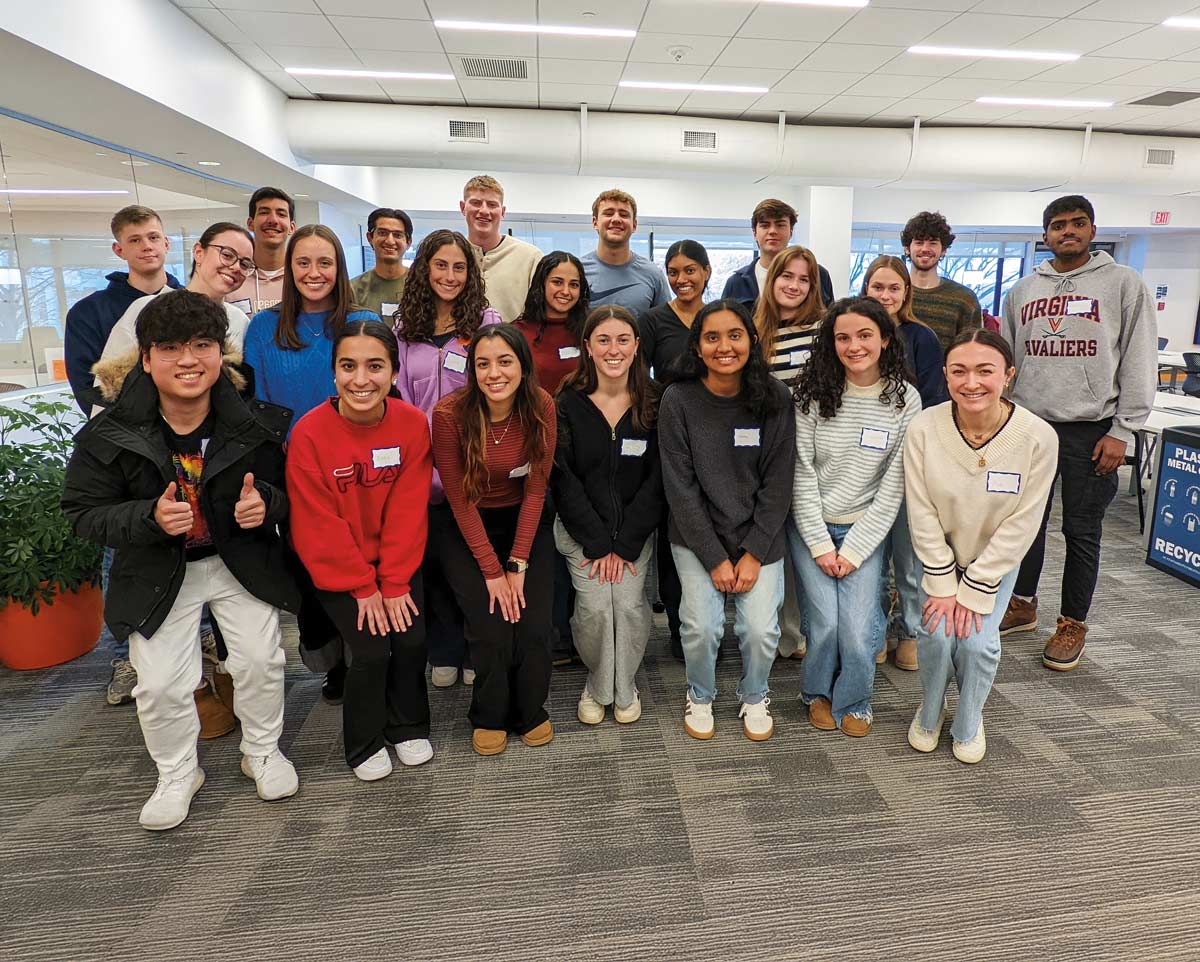
UVA’s Peer Led Learning program, or P2L, trains students to help their peers navigate challenging science and math classes.
When April Hippenstiel (Col class of ’25) coached undergraduate students in UVA’s introductory biology classes, she came prepared. She met weekly with course professors to stay on top of what topics they were teaching. She created worksheets and group activities tailored to what the students were learning.
And she geared up for the toughest weeks—when classes dove into complex topics like cellular respiration and glucose metabolism. Hippenstiel would explain the material, but she also helped students develop study strategies to both dig into the details while stepping back to grasp the bigger picture reasons behind each process. “What’s really tough about biology is that everything builds on itself,” Hippenstiel says.
Hippenstiel, who graduated in May, was part of a team of undergraduates leading study sessions through UVA’s Peer Led Learning program, or P2L. These peer coaches—students who’ve successfully completed the same challenging introductory science and math classes—are trained to help others navigate the material.
The program is popular, its leaders say. In the fall 2024 semester, the program recorded 5,304 student visits. Among the students who participated, 98 percent reported that attending sessions improved their understanding of the course material, and 93 percent reported a boost in their academic confidence.
It’s also relatively new, part of UVA’s first large-scale academic support program, which launched in fall 2020, says Katie Densberger, UVA’s director of academic support and advising initiatives. Before the pandemic, she says, academic support was limited to the Writing Center, operated by the English department, and math tutoring, managed by the math department, along with scattered resources from individual departments or Student Affairs.
Now UVA’s academic support programs include Peer Led Learning with group review sessions and Peer Academic Coaching, which provides one-on-one academic coaching and study strategies. They cover about 30 core science and math classes, Densberger says.
“It’s really great for the students to learn from each other, to understand that their peers may also be struggling,” she says. “It creates a more collaborative, cooperative learning environment for everybody.”
Alex Haas (Engr class of ’26), a computer science major, has coached P2L sessions in applied mathematics and physics. Haas says he’s often catching students up. The math class that he’s tutored assumes some foundational knowledge in precalculus, but not every student has it. That prompted the creation of a precalculus session for students to strengthen those skills.
Study skills are another issue, which Haas says he learned as a first-year when his high school study habits no longer served him well. Now he counsels students to deploy more active studying strategies such as writing notes by hand, summarizing them and practicing problems.
“I was one of the people in high school who would try and read my notes over and over,” Haas says. “And I found, especially when I came into college, that didn’t really work.”
Another benefit of the program, say Haas and Hippenstiel, is that the sessions help students realize they’re not alone in struggling with the complex material. That community-building is especially critical post-COVID as some students still have trouble connecting with others, Hippenstiel says. She arrived on Grounds in fall 2021, as the pandemic still raged, after attending a small private Christian high school in Chesapeake.
“I was one of the people that felt really alone,” Hippenstiel says. “I used to tell [students] all the time that I wish I had this program for myself to help me academically in that course, to develop study strategies, but to also form those friendships with people in your class—to know you’re not alone because I feel like a lot of students in STEM courses really feel alone.”