“When I was at the university from 1972 to 1976, we didn’t carry backpacks, but I remember how you could leave your bag, purse and books any place and not be concerned that they would be stolen. The Honor System then seemed like it guided a lot more than just academic behavior. I know it was not perfect, but it was deeper than just a fear of the single sanction. Somehow, being on Grounds made you part of this community of trust that felt special and unique.”
Nan Warren (Col class of ’76)
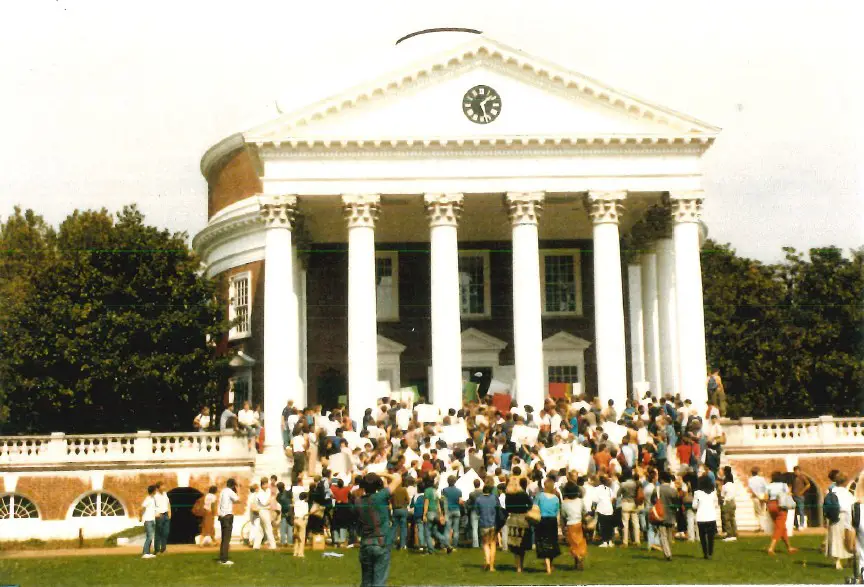
“The ‘Apartheid Protest Shanties Trial’ before the University Judiciary Committee in April 1986. The committee dismissed charges brought by the university against the student leaders of the Students Against Apartheid Coalition (SAAC), finding that the students did not violate the policy against camping on the Lawn. I was a second-year law student and the Law School Judiciary Committee representative on the panel that heard the case. In response, the university then adopted a new policy restricting ‘any structure or extended presence’ on the Lawn, which was promptly challenged by SAAC in federal court.”
David J. Gogal (Col class of ’85, Law class of ’88)
“The sweep of the Virginia Progressive Party slate in the College of Arts and Sciences in spring 1969, leading to (the) resolution to admit women.”
Tom Gardner (Col class of ’71)
“Being part of the University Judiciary Committee (UJC) was one of the most meaningful experiences of my undergrad and, honestly, of my life. After a particularly difficult trial, a student thanked me for making them feel heard. They hugged me and said I helped make an intimidating and inevitable process feel understandable and less frightening. That interaction fulfilled me in a way no other college activity ever did. Having these important responsibilities be entirely student-run is what makes UVA unique and sets it apart from anywhere else.”
Christina Propheter (Col class of ’25)
“I served on an Honor trial committee in 1971. The weight of deciding a fellow student’s continued presence at the university was huge. If found guilty, there was only the single sanction available: permanent expulsion. We found that the evidence indicated that a student had cheated on an exam. He appealed, and the original committee got to decide if he could receive a retrial with a different committee. We did not agree. As I look back on it, that process was wrong. He should have been able to appeal to a new committee without our permission. While student governance was a very positive thing during my time on Grounds, it was not perfect.”
Bill Mims (Darden class of ’71)
“As vice president of the E-school during 1963–64, I was a judge or juror for several Honor trials. I was always impressed with the seriousness that my fellow Honor Committee members exhibited. In one instance we used an electron microscope to try to determine if the student who was accused of cheating had erased his test answers and copied another student’s paper. We concluded that he had, in fact, cheated. No one ever thought of their role as a game. We always did our best, working together, to reach an appropriate decision.”
Vic Bell (Engr class of ’65, Darden class of ’67)
“When I served on the University Judiciary Committee as vice chair nearly four decades ago, we took our role in dealing with student misdeeds very seriously. One area of complaints came from landlords about student behavior. We developed a landlord-tenant agreement for students.”
Andrea Bear (Col class of ’77)
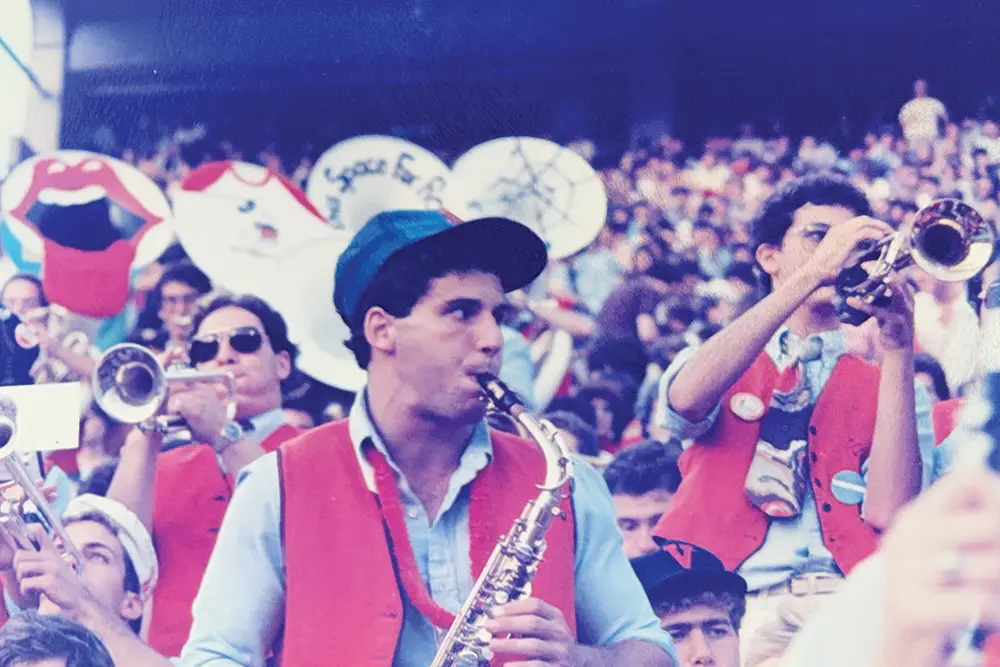
“The UVA Pep Band was entirely student run and managed, allowing for maximum creativity for our performances. I was on the committee that wrote the football game halftime performance shows in 1987, creating many memorable moments for fans. As a four-year member of the smaller basketball band, I felt we made a tremendous impact on the games through our student-curated music and cheers in relatively small venues.”
Avron Stoloff (Com class of ’88)
“Serving as counsel in University Judiciary Committee and Honor Committee hearings while a law student (1988–1990). It was a remarkable experience to be given that level of direct involvement in a wholly peer-led process. It came full circle during my 14 years as UVA dean of students (2007–2021), when I brought cases in the UJC, was represented by a student as my counsel and was questioned in hearings by the student panel. A core value of the university for so many years.”