The future of student self-governance
Amid existential threats, can UVA’s defining tradition hold on?
The words “student self-governance” may never have flowed from Thomas Jefferson’s quill, but the concept was on his mind in the earliest days of UVA’s founding. In the margins of a letter to his granddaughter in August 1825—just a few months after UVA’s first class began—Jefferson wrote: “We studiously avoid too much govt. We treat them as men & gentlemen under the guidance mainly of their own discretion they so consider themselves and make it their pride to acquire that character for their insti[tution].”
Student self-governance at UVA—the idea that students have authority and agency in most aspects of their college experience—hasn’t always worked out as Jefferson hoped. In fact, from the university’s earliest days, some students have failed to take pride in developing their own good character as he envisioned.
Still, in a place so steeped in tradition, this particular tradition has endured, becoming a defining part of UVA’s culture and experience, sustained by generations of students, alumni and administrators.
“The University of Virginia has always done experiential learning, and we’ve always done it really well, and we’ve called it student self-governance,” says student Board of Visitors member Gregory Perryman (Col class of ’26). “I have learned as much outside of the classroom as I have learned inside the classroom. And that’s what makes a UVA education.”
Through the centuries, student self-governance has weathered challenges. In the post-COVID era especially, it has faced significant threats and setbacks. Just this year, the University Guide Service was stripped of its official role of conducting admissions tours; a report about the November 2022 shooting identified student self-governance as a potential obstacle to public safety; and the U.S. Department of Justice included student groups, such as the Honor and Judiciary committees, among the UVA entities under compliance review for potential discrimination violations.
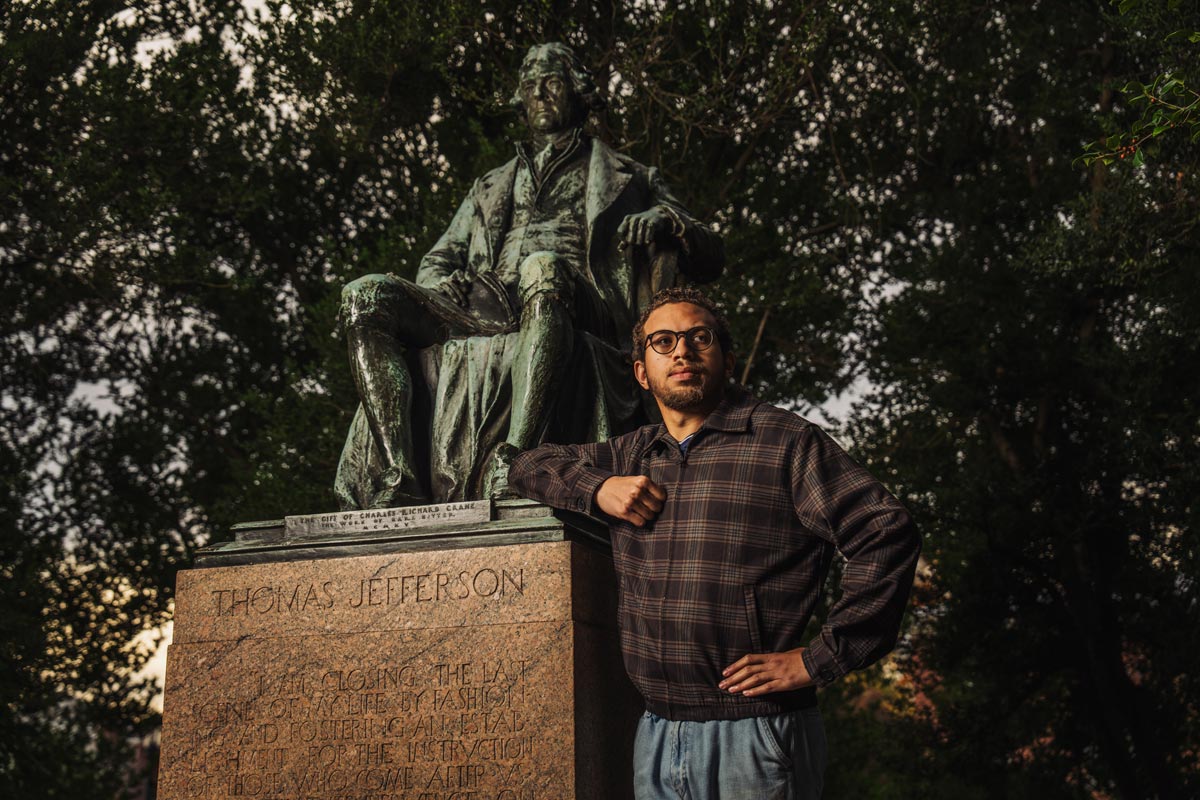
On Grounds, student leaders say, it’s an uncertain time. What happens next might be out of their hands—a stark reminder that student self-governance has long required buy-in from administrators and other leaders.
But if history is a guide there are reasons to be hopeful. Julie Caruccio (Col class of ’94, Educ class of ’13), assistant vice president for strategic initiatives in UVA’s student affairs office, has seen the evolution of student self-governance, both as a student in the ’90s and as a longtime student affairs administrator at UVA.
“I would say, in the fall of 2025, student self-governance is actually thriving. And I say that having really worried about it.”
Building a ‘community of trust’
Because of student self-governance, UVA operates differently from many other higher education institutions. The Honor and Judiciary committees are the clearest examples.
The committees are part of a group of Agency Organizations at UVA that also include the University Programs Council (formerly University Union) and Residence Life. These groups are tasked with fulfilling duties that, at other universities, staff would be responsible for. Unlike typical campuses, where administrators oversee student discipline, for example, UVA entrusts many decisions to students.
Michael Lenox (Engr class of ’93, Engr class of ’94) compares academic integrity panels at other colleges to “star chambers,” the secretive early English courts. Lenox served as Honor Committee chair as a fourth-year, earned a Ph.D. at MIT, was a dorm parent at MIT and Harvard, and taught at NYU and Duke before landing at Darden, where he is a professor.
“It’s very efficient,” Lenox says of how he’s seen other elite universities operate. By comparison, the Honor System—and student self-governance more broadly—can be messy.
But, he says, its strength is in the collective promise among students and the larger community to uphold integrity and honesty. It fosters a community of trust that encourages service to others, assumes honesty and good intent, and promotes openness to different perspectives and the pursuit of truth, he says.
“These are actually the critical parts of the Honor System in my mind, not what happens when I commit an offense and what’s the process that I go through,” Lenox says. “That, to me, is the critical linchpin.”
Beyond the Agency Organizations, students can participate in self-governance in hundreds of ways through three other types of entities on Grounds.
Special Status Organizations include Student Council, Class Councils, the University Board of Elections and, until recently, the University Guide Service. These groups also perform specific duties that UVA administrators would otherwise be tasked with, such as holding elections or doling out student activity fees.
Contracted Independent Organizations (CIOs) comprise more than 900 student-run groups—from storied a cappella groups to championship club sports teams. No adviser is required for CIOs.
Greek organizations also are independent from UVA, but they operate with a Fraternal Organization Agreement, under which they are subject to UVA’s conduct standards.
Giving students the agency and authority to shape their college experience is not just a cornerstone of the UVA experience, Caruccio says, but also, research shows, a driver of student motivation and success wherever it happens.
“The opportunity to develop agency—it’s connected to all kinds of thriving,” she says. “All the things that we want them to do are connected to opportunities to develop their own sense of agency.”
The beat doesn’t go on
Giving young adults agency can be fraught. In 2003, UVA’s scrappy, satirical student-run Pep Band was disinvited from performing at athletic events after years of increasing administrative pressure over its edgy shows.
At its performance at the 2002 Continental Tire Bowl against West Virginia, its halftime show, which bowl officials had approved, angered Mountaineers fans who didn’t like how the band portrayed a West Virginia character in a skit—wearing overalls and pigtails. There was already bad blood between the Pep Band and the Mountaineers after a 1985 on-field skit that suggested the state lacked indoor plumbing and birth control.
After the bowl game, West Virginia Gov. Bob Wise sought an apology from then-UVA President John Casteen (Col class of ’65, Grad class of ’66, class of ’70), who obliged. The bowl game would be the last big gig for the band, which was banned from playing at UVA athletic events and replaced with the UVA-run Cavalier Marching Band. It was a shift in student control and campus tradition.
Years later, in 2021, former Director of Athletics Craig Littlepage told Virginia Magazine that the end for the Pep Band was more about shifting institutional priorities than their brand of humor. “There were a lot of people that just felt as though if we are serious about a high-quality athletic program, part of that in terms of presentation at football or basketball games should be a more standard approach,” he said.
For Pep Band member Ed Hardy (Col class of ’02), the move away from a student-run organization was a blow to student self-governance. “Being in the band was one of the better examples of student self-governance,” Hardy says. Students set up practice times, bought and repaired instruments, and wrote shows.
Hardy wonders whether the band could have been saved. “Had we been able to maybe drop some of the ideals of student self-governance, there might have been a way through—to really work more closely [with the athletic department] and actually have a survival of some form of the satire and comedy and antics of the band,” he says. “But of course that hindsight is 20/20.”
University Guides loses status
Today another longstanding student organization is trying to survive, even if it’s in a different form: the University Guide Service. Loosely formed in the 1950s by Rotunda hostess Madge Schultz, the guide service was formalized in 1961 by her successor, Mary Hall Betts, and it rapidly grew. By 1967, student guides were leading 15,000 people a year on tours through Grounds, The Daily Progress reported.
For decades, the prestigious organization attracted top students to its ranks through a rigorous application process. In the fall of 2014, just 12 percent of applicants were accepted on average, according to a Cavalier Daily story about the most popular student groups at the time. But that’s also around the time when cracks between Guides and administrators began emerging.
“I would say, in the fall of 2025, student self-governance is actually thriving. And I say that having really worried about it.”
In 2013, four students were hospitalized for alcohol poisoning during a new-member event. As a result, UVA administrators required the group to rewrite its constitution, reform its disciplinary system and restructure its new-membership program, the Cavalier Daily reported. Because it was a Special Status Organization that conducted activities on behalf of the university, UVA had some purview over operations, then-Dean of Students Allen Groves (Law class of ’90) said at the time.
In 2022, the University Judiciary Committee found the group again responsible for hazing, including forcing new members to chug alcohol. After the hazing was initially reported, UVA suspended the portion of the group’s Special Status Agreement that pertained to new-member recruitment and training, according to a report.
After the COVID-19 pandemic, the group faced other difficulties. In August 2024, UVA suspended it from conducting admissions and historical tours. In a letter to the editor in the Cavalier Daily, Stephen Farmer (Grad class of ’86), UVA’s vice provost for enrollment, wrote that the group wasn’t scheduling enough members to fill tour slots and that members were failing to show up for committed tours. Some visitors also complained that tour guides were too negative about UVA, Farmer wrote.
Like the Pep Band incident, the suspension sparked national headlines. The New York Times noted that the Jefferson Council, a group of conservative alumni, had long criticized the group for being too “woke,” such as mentioning that enslaved laborers built the Rotunda. Farmer wrote in his August 2024 letter that organizational challenges, not historical content, were the real issue.
A few months later, when Guide leaders announced that they would offer unsanctioned history tours on Grounds, they blamed the suspension of the historical tours, in particular, as a “reaction to the anti-history voices who have long been attacking our organization,” they wrote in a letter to the Cavalier Daily. “This loud minority has put continuous pressure on the University to curtail our touring responsibilities.”
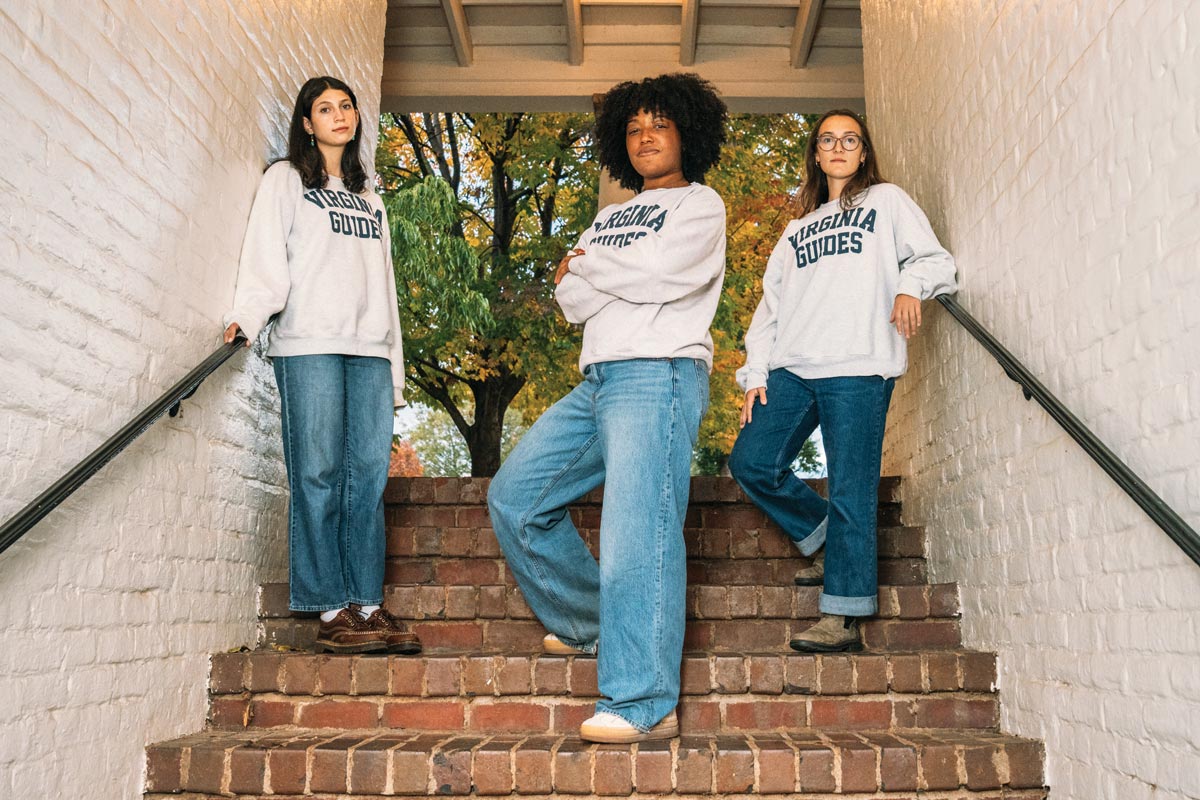
After more than a year of attempted resolution, including required training for guides, UVA terminated its Special Status Agreement with the group in February. Student interns now run admissions tours through the Office of Admission. The group lost its historic home in Pavilion VIII, along with funding and publicity from the university. But it has a new mission in a new form as a CIO that is no longer affiliated directly with UVA administration, its co-chairs Rose Haron (Col class of ’27) and Nina Accousti (Arch class of ’26) say.
Haron and Accousti aren’t interested in relitigating the past but are focused on keeping the historic group afloat into the future. The group now is providing regular historical tours of Grounds. “The history of UVA is too meaningful to not have an organization specifically dedicated to preserving it and sharing it,” Haron says.
The group’s leaders also are concentrating on boosting morale and confidence among the remaining guides; seeking funding and donations; and actively reaching out across Charlottesville and travel agencies to attract tour-goers.
“Having that CIO status this year has honestly been a lot of safety and security for us, and it’s given us a lot more freedom in terms of what our organization can do and how we can structure our history tours,” Haron says.
The ‘spirit’ of George III
Competing pressures between student autonomy and administrative control have long created friction at UVA. A nearly decade-old research report that dove into the history of student self-governance found plenty of evidence of both overstepping administrators and disengagement among students. The project was initiated by leaders of the Honor and Judiciary committees and Student Council.
Flare-ups mentioned in the report include an incident after Vietnam War protests in 1970. Then-President Edgar Shannon and BOV members were upset when the Judiciary Committee dropped cases against students involved in the protests. That summer, the Judiciary Committee chair and a BOV member drafted new conduct standards, which were rolled out that fall.
“Students, at the end of the day, still really care about each other and about UVA. That was one of the things that convinced me to go to UVA.”
The new standards sparked outrage because of the lack of student input and administrative overreach, the report says. The Union of University Students petitioned for a referendum, beginning their demands with a reference to one of Jefferson’s nemeses: “Whereas George III is dead but his spirit lives on …” The BOV agreed to make minor revisions to the standards, but it later rejected more substantial changes that Student Council had proposed.
By 1979, the report notes, student apathy was so widespread that voters elected the fictional “Howard the Duck” as Student Council president. That apathy, the report found, persisted for decades.
Worries about faculty and administrative support of student self-governance partly prompted the report, says Abraham Axler (Col class of ’17), who served as Student Council president and worked on the report. At the time, longtime administrators such as Leonard Sandridge (Grad class of ’74), former executive vice president and chief operating officer, and Pat Lampkin (Educ class of ’86), former chief student affairs officer, were retiring or preparing to.
“I know that these people behind the scenes were extraordinary advocates for student self-governance,” Axler says, “but that newer people—and the university was growing and has continued to grow and evolve—were not necessarily steeped in it.”
In the report’s introduction, Axler noted that student self-governance isn’t self-sustaining; it requires active student participation. But because each student is at UVA for only a few years, faculty members and administrators play an important role in helping students “remember the past and evolve from it,” Axler wrote. “A faculty and administration that understands self-governance becomes woven in its fabric and assures its endurance.”
External pressures have also threatened self-governance, including an increasingly litigious culture. By the time Thomas Hall (Col class of ’02, Law class of ’06) was Honor chair from 2000 to 2002, the group had already weathered a wave of lawsuits in the 1990s, particularly claims about due process failures and wrongful expulsions.
“We solved that, in part, by hiring a legal adviser to help buttress student self-governance—not replace it, but support it,” Hall says. “And we helped solve that problem by adding more process into the Honor System, so that when students are disciplined by the Honor System, they have gotten an exhaustive due process before there’s a decision made.”
But building in more processes created another issue, Hall says. “The downside of that decision, of course, has been that it made administering the Honor System extremely complex, and it deterred faculty and students both from initiating cases, because it would take months or even longer for a case to be decided,” he says. “So we solved one problem but I think created another.”
COVID leaves its mark
COVID-19 introduced a wave of new disruptions to student self-governance, including from students themselves. Even before the pandemic, some students had questioned whether their work in the name of self-governance amounted to unpaid labor for the university or complained that UVA expected students to do things administrators should be doing, Caruccio says.
The pandemic magnified some of those concerns as students were asked to make major decisions during a period when even seasoned administrators struggled with unprecedented uncertainty. At the same time, she says, some administrators newer to UVA were unaccustomed to the concept of student self-governance and saw its risks more than its benefits.
When Greek leaders faced the question of moving recruitment online, for example, some administrators and students wondered why the fraternities and sororities couldn’t just be told what to do, Caruccio recalls. Instead, in keeping with the tradition of self-governance, UVA gave student leaders access to senior administrators and data to inform their choices.
“That is the beautiful tension, freedom of responsibility … that’s why it’s meaningful work,” Caruccio says. “They have to have skin in the game. The consequences have to be real.”
But on the student side, the pandemic also posed another threat: a breakdown of institutional memory, Caruccio says. Before the pandemic, student leaders had formal and informal practices to pass down information about how to manage budgets, plan events and run organizations.
“One of the downsides of a student-run process is that their transition documents and processes are often less than ideal,” she says. Before COVID, it usually worked out. But during the pandemic, as student groups went virtual, canceled programs and lost leaders to graduation, much of that institutional memory vanished.
When the University Programs Council returned in 2022, its executive board had never even attended an in-person UPC-run event, Caruccio says. Now they were suddenly tasked with pulling them together.
“Without that meaningful work,” Caruccio says, “it really has taken organizations a long time to get back to their level of effectiveness.”
Caruccio worried about the future of student self-governance, but she says she’s not so worried now. UVA is more intentionally hiring student affairs professionals who appreciate the value of student self-governance, she says. The department looks for people who are eager to “coach, not play.”
“Working as a student affairs professional in a student self-governance environment is not for everybody,” she says. “You have to start by trusting students and believing that they can do the hard thing and not thinking that it’s our job to keep them from experiencing difficulty and be willing to let them fail in ways that are not life-changing. … Our guardrails come when they’re going to do something illegal, or when it could be life-changing in a bad way.”
Students also recognized the threats to their autonomy and, in the spirit of self-governance, started doing something about it, she says.
In the spring of 2021, top student leaders presented to senior administrators about the importance of student self-governance and the challenges facing it. The presentation is now part of onboarding for new student affairs employees, Caruccio says.
“They saw and felt these threats, and so they got very vocal about what they saw were the benefits of student self-governance,” she says.
A fight for agency
Student leaders have kept at the work to keep self-governance alive across Grounds. For Ava MacBlane (Col class of ’24), who served as editor-in-chief of the Cavalier Daily in 2023, the focus, at first, was on getting students reengaged in its practice.
Apathy persisted in Student Council elections, and some positions went unfilled, MacBlane says. Club leaders were struggling to get students to attend in person. And too many students didn’t understand how they were engaging in student self-governance if they weren’t directly involved in the Honor Committee or UJC, she says.
But then the concerns turned to protecting the institution itself, she says. Turnover in the student affairs office and in other leadership positions at UVA posed a growing threat, according to a March 2023 editorial written by the Cavalier Daily’s editorial board. The column urged students to be “careful stewards” of the tradition and cited the hiring or appointment of university leaders who might not understand the importance of self-governance.
“Beyond mere ignorance, some leaders might even be hostile to the idea of student self-governance, perhaps expressing their distaste for student leadership by calling us a bunch of ‘numnuts,’” they wrote, referring to a text written by then-BOV member Bert Ellis (Col class of ’75, Darden class of ’79) and obtained through a Freedom of Information Act request and shared with the paper.
“[Alumni] had the ownership … So they look back fondly on a place they helped build, they helped govern, they helped organize.”
“If we want to ensure the tradition of self-governance is not lost, the student body cannot continue to sit in complacency,” the editorial said. “If we don’t fight for our own agency, nobody will.”
MacBlane worked with Class of 2024 President Kyle Woodson (Com class of ’24) on a pamphlet primer for new students that explains what student self-governance is. Resident advisers distributed it to their first-year residents.
“As students, we are given the keys necessary to enact real change—all we have to do is participate,” the pamphlet urged.
Toward the end of her fourth year and during the summer after graduation, MacBlane worked with Caruccio to develop online content that goes deeper into the ways students can engage in student self-governance on Grounds. While also acknowledging the ongoing challenges, MacBlane graduated feeling optimistic about self-governance.
“Students, at the end of the day, still really care about each other and about UVA,” she says. “That was one of the things that convinced me to go to UVA. Everyone really seems to truly love it there.”
Existential questions loom
Better training or education, however, may not be able to resolve some of the questions swirling around the tradition today, including those raised by federal investigations and a national dialogue about student discipline.
In 2024, UNC-Chapel Hill replaced its student-run Honor Court with a staff-run board. UNC administrators cited concerns over heavier caseloads, 100-day resolution times and an increasingly complex legal terrain that students were navigating.
Similar concerns about UVA’s Honor and Judiciary systems surfaced after the 2022 shooting in which a student killed three classmates and injured two others near the Culbreth Road parking garage. An independent review by law firm Quinn Emanuel Urquhart & Sullivan flagged the concerns.
“Because virtually all non-criminal student conduct matters are processed through the Honor or UJC systems, the University administration appears to lack meaningful processes to enforce its policies,” said the report, which was released in 2025. “These student-run bodies can be slow-moving and there is a sense that the UJC may not be taken seriously by the student body as a tool to ensure discipline and safety.”
Around the same time, UVA also began fielding U.S. Department of Justice allegations that it did not comply with antidiscrimination law. This spring, DOJ officials notified UVA that the department was broadening its compliance review to include student-run groups—the Law Review, Honor and Judiciary committees, and the University Guide Service, “to name but a few,” they wrote. The June 16 letter did not make explicit allegations against the groups. And, on Oct. 22, UVA reached an agreement with the DOJ, which is suspending its investigations, for now.
“There’s definitely been a couple watershed moments where I feel like, from the student self-governance perspective, some existential questions that maybe don’t typically come up in more normal times are topics of discussion for us about how do we preserve our authority, our independence and our relationships with the other entities at the university whom we serve and who allow us to do our jobs,” says Judiciary Committee Chair Allison McVey (Col class of ’26).
For alumni watching from afar, Hall, the former Honor chair and current chair of the Board of Managers overseeing the UVA Alumni Association, which publishes Virginia Magazine, acknowledges that there’s plenty of uncertainty. He says alumni care deeply about the future of the groups and ideals they devoted their college years to.
That legacy of student self-governance is a big reason why alumni are so devoted to the university, he says.
“They had the ownership. They cared about the institution. They were engaged in the governance of the institution,” Hall says. “And so they look back fondly on a place they helped build, they helped govern, they helped organize, as opposed to just a place that taught them some classes and then they left.”
Alumni can offer valuable historical perspectives about why certain traditions mattered to past generations in a respectful way, Hall says. But ultimately, student self-governance allows current students to decide how they want to be governed. “It’s the whole point of student self-governance,” he says. “It’s not student self-governance that alumni get to direct.”
Where students belong
Despite the existential threats, students point to signs that the tradition is alive and well. The Judiciary Committee, for example, continues to handle a high volume of cases, including one of the largest caseloads in the committee’s history last year. McVey, the current UJC chair, says she expects the number to rival that during her term.
The committee is also working to improve student behavior, she says. Under a 2022 Virginia law, it must submit annual reports on hazing cases and related sanctions. After sanctioning or terminating five fraternities during the 2023–24 academic year, the docket was clear of hazing cases in late August, a shift that McVey credits in part to increased outreach and education.
The March 2022 and 2023 votes that ultimately led to the replacement of UVA’s single-sanction Honor System with a multi-sanction version that still allows for expulsion, was another expression of student self-governance. After decades of failed attempts to make the shift, students were able to get the votes required to make the change.
“The Honor System is, in many respects, the epitome of one of UVA’s strongest and most important traditions: student self-governance,” wrote then-President Jim Ryan (Law class of ’92) in his Virginia Magazine President’s Letter after the 2022 vote. “The Honor System is run by and for our students, and they have the right to change it. The fact that they did may be worrisome to some, but accepting student self-governance means accepting that students will make some decisions that their elders would not have made.”
And, says today’s Honor chair, the switch to a multi-sanction system has transformed both how often cases are reported and how students choose to take responsibility. Before the switch, the number of guilty verdicts was essentially zero, other than blips during the pandemic, says Honor Committee Chair Thomas Ackleson (Engr class of ’26). “Students were unwilling to expel someone, even if they thought they were guilty.”
Now reports of potential Honor violations have gone up, and the number of students who agree to take responsibility for their actions through an option called Informed Retraction also has gone way up.
“Single sanction worked for a long time, [but] society is changing,” Ackleson says. “People value restorative justice more now, and that’s a good thing.”
What happens next to student self-governance depends on forces pulling it in different directions—students’ determination to govern themselves, administrators’ willingness to let them, and the political and cultural forces that threaten to upend both.
As the current student BOV member, Perryman will have a front-row seat to many of those debates. He remains hopeful about the future of UVA’s most enduring tradition. And, in fact, he has an idea for its growth.
Unlike past student BOV members, who came from traditional student leadership roles, Perryman served as student representative on an advisory committee to the University of Virginia Investment Management Company, which manages UVA’s investments.
That committee is one of 23 University-Associated Organizations, which support UVA’s mission, strategy and operations, according to the university. Perryman says he hopes to see more student representatives on these boards, which shape UVA’s future—from academic foundations to athletics—and offer a growing forum for students to contribute ideas and influence decisions.
At a university that prizes student self-governance, students belong in those spaces, he says. “In any conversation where there’s decisions being made that are going to affect students in a really substantive way, which is most conversations at the university … it’s a good idea to have a student there.”