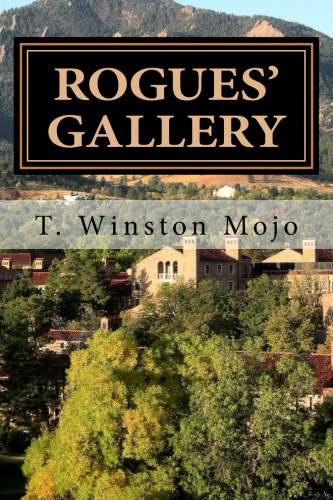
The following is an excerpt from Evan Cantor’s new book, Rogues’ Gallery, which he describes as “an exploration of just how small the stakes can be in campus life.” Written under a pen name, T. Winston Mojo, the book is filled with the author’s “hair-raising experiences in the bureaucracy” at a Colorado university. “It will be of interest to anybody involved with academic life,” Cantor says.
Introduction
I’d like to be clear from the start. This story is based on reality. It all happened. Although my recollections might not concern historical junctures, they are in-and-of-themselves historical. Memories are always moderated, yes, but the things that have been changed are the names and places, to protect the innocent and guilty alike. This is a Kerouackian exercise, relating reality as fiction. No hyperbole was necessary to embellish the story. It may still strike the reader as unbelievable, but believe me, it all happened just as related. Please note that any resemblance to real persons, living or dead, is purely coincidental.
As a memoir, however, this document is no doubt flawed. How flawed is another matter of debate. Memory is a peculiar thing. It gets chopped up and shuffled around in our minds as the years go by. As you repeat stories over the years, those stories can take on lives of their own and grow. I was fortunate, in some respects, that I documented a lot of my experiences as I went along.
No doubt I remember how wonderful I was and how awful everybody else could be. I readily admit that I grew up a lot in those 27 years. I was just a kid when I started working at Rocky Mountain University in 1984, a 28-year-old avant-garde musician leading a performance-art rock band in an underground scene. I didn’t want a job or care much about having a job. I needed an income to pay my bills, but I was focused on the outdoors and my creative projects, living a period of arrested, extended adolescence. So, of course, the tendency is to portray my past self just as I am now, years after the fact. I have made every effort to avoid this pitfall and to look honestly at my own pratfalls along the way. Yes, I have been an idiot on occasion. Who hasn’t? Would you blame me if I failed to dwell on my own shortcomings?
To be fair, it must be said that plenty of people have terrific work experiences on campus. They love their jobs and their bosses. They stay in the same departments for years and years and are apparently treated with respect. Just as many, however, stick around for years without sharing this experience and that is what my story is about. I had some good jobs and some good bosses, but there would be no story without the villains, my “Rogues’ Gallery.”
The incidents and experiences related in this document are fabulously trivial and mundane. It has often been noted that university politics are so vicious because the stakes are so small. Wallace Sayre, Woodrow Wilson and Henry Kissinger were likely thinking of deans, chancellors, committee and faculty members. But if you thought the stakes couldn’t get any smaller, think again. Personal politics amongst university staff can be equally intense …
By writing my story and documenting it, I can set it free. No longer must I carry these memories around in my head and suffer whatever subconscious price they have exacted and may continue to exact. It’s nice to clear the mind and make room for new stories.
I never dreamt that I would work at Rocky Mountain University in Big Rock, Colorado, for 27 years. At the time I was hired, in June 1984, I didn’t even want a job, but I got one anyway. Working at the Campus Recreation Center turned out to be a pretty good gig for about six years. In that seventh year, I grew suspicious of a fellow employee’s activity. I began to question her habits and behavior, especially where influence peddling was concerned.
Lita Patrick had come to the Recreation Center from Personnel and we were friends for a number of years, sharing the main office with our supervisor. Lita proved to be quite a wealthy young lady. While everybody else at Recreation appeared to be very happy with her apparent wealth and generosity, I eventually came to suspect that something fishy was going on.
When Lita realized I was suspicious, she had to get rid of me. In retrospect, it’s quite clear, because Lita was eventually arrested. Before the arrest, it was not so obvious. Embezzling from the Center’s revenue stream made it imperative that she rid her circle of anybody looking at her sideways. She set about making my life miserable and succeeded wildly. This is when I first bounced from one bad situation to another at Rocky Mountain University in Big Rock, Colorado. And that’s what the stories in this book are about.
Chapter 1: The Campus Recreation Center
My first job at the University was handling the student payroll at the Campus Recreation Center. I had recently lost my job at the Bank Trust Company downtown and was collecting unemployment. I thought I could spend all summer eating hot dogs, living in a tent up in the hills, coming down to town once a week to fill out bogus applications. I applied to the University thinking they’d never hire me. I took a typing test and scored 90 words per minute. Then I filled out a “self-evaluation” form. Before I knew it, I was working at the Campus Recreation Center. My primary duties were student employee payroll, answering the telephone and typing up letters for a bunch of recreation people who could hardly spell, much less compose complete sentences. They gave me an IBM Selectric with which to work. All of my friends thought I had scored a plum position, making $12,000 a year. I had never before earned $1000 a month. It was quite the landmark for me then …
These were my early years in Colorado. I had moved from Virginia in 1981 because I had wanted to be “out west,” somewhere close to a lot of mountains. The Pacific Northwest seemed too rainy to me, the desert Southwest too dry. There were no cool towns in Utah or Wyoming. Montana struck me as too cold. Colorado was right in the middle. I knew very little about Colorado except that there were a lot of mountains. Literally, I was besotted with the Rocky Mountains in those years and Big Rock Valley was directly in the shadow of the Continental Divide.
But I was hamstrung by the fact that every time you changed jobs, you were lucky to get two weeks of vacation a year. I would parcel out those vacation days like precious gold. The ’80s were a kind of mythical magic time in Colorado. Development hadn’t yet caught up with the Front Range and industrial tourism was only on its first faltering legs. Trailheads up the road from Big Rock were typically empty and parking was no issue. I used to drive up to a trailhead on a Friday night after work, hike a half-mile with my backpack and camp. Then I could spend the rest of the weekend in the Native Peaks Wilderness Area and be back in town Sunday night, in time for Monday morning at the office …