Pipe Dream
The discordant life of UVA’s open-air organ
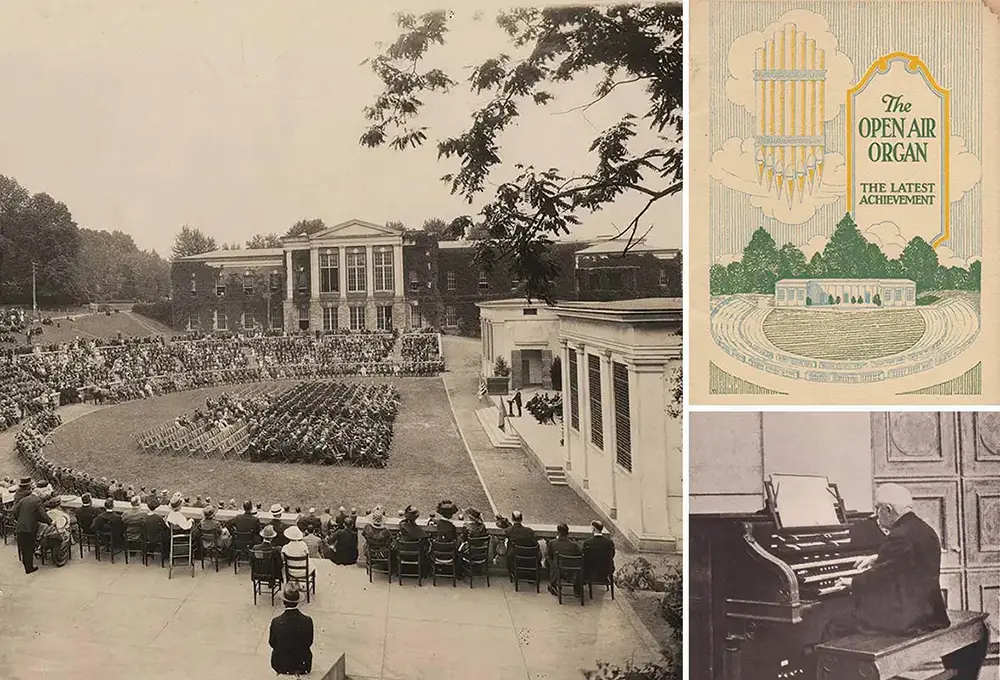
Albert and Shirley Small Special Collections; Wiki; Pipe Organ Database
McIntire Amphitheatre originally came with an outdoor pipe organ reportedly loud enough to carry its melodies a mile away. According to organist and former UVA music professor Paul Walker, it was “doomed from the start.”
Situated in a concrete chamber still visible on the left side of the amphitheater stage, the organ included a movable console and 2,245 pipes, according to the Organ Historical Society’s Pipe Organ Database, a collection of details from organ scholars about organs across North America.
The instrument sat beneath “rolling steel shutters to fully protect the organ from the weather,” according to a pamphlet published by its designer, M. P. Möller, once the largest organ manufacturer in the world.
Photos show the organ being played during Final Exercises in 1921, the same year the amphitheater was built.
“I suspect somebody at the university said, ‘I think it would be really cool to have this organ in the space; we should have some kind of music for commencement,’” Walker says. But he suspects there was simply no real use for it after the university moved Final Exercises to the Lawn in 1953.
Plus, he says, “Oral tradition indicates that it was incredibly loud and could be heard all the way downtown. Nobody particularly liked it.”
And those steel shutters meant to be protective? Over time, they likely just couldn’t stand up to the weather, Walker says. (The pamphlet about the organ even acknowledged that Virginia’s “damp climactic conditions” were less than ideal for such a project.) According to a post on the online forum at the Pipe Organ Database, the shutters were also left open one winter, causing considerable water damage.
With insufficient protection from the elements and nobody to perform the necessary maintenance and upkeep, Walker says, it became clear that keeping the organ on Grounds wasn’t worth the effort. Finally, more than 60 years after its installation, it was removed, according to the Pipe Organ Database post.
Walker says he remembers seeing workers “hauling all the pipes out” sometime in the mid-1980s.
“It probably lived about as long a life as you can expect,” Walker says, “and then it had served its purpose.”