Former student receives five life sentences for 2022 shootings on Grounds
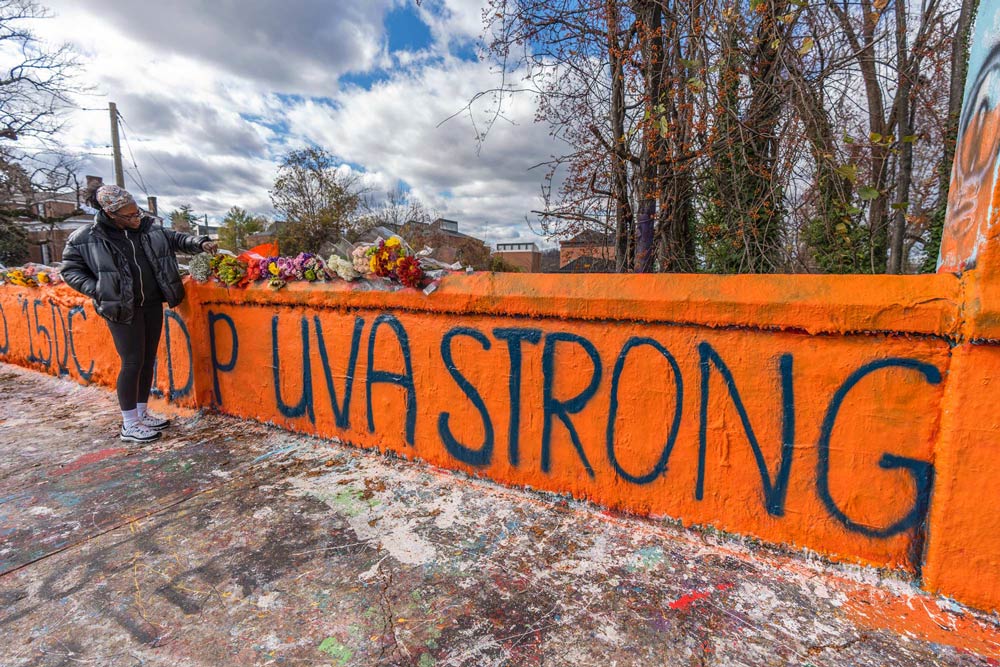
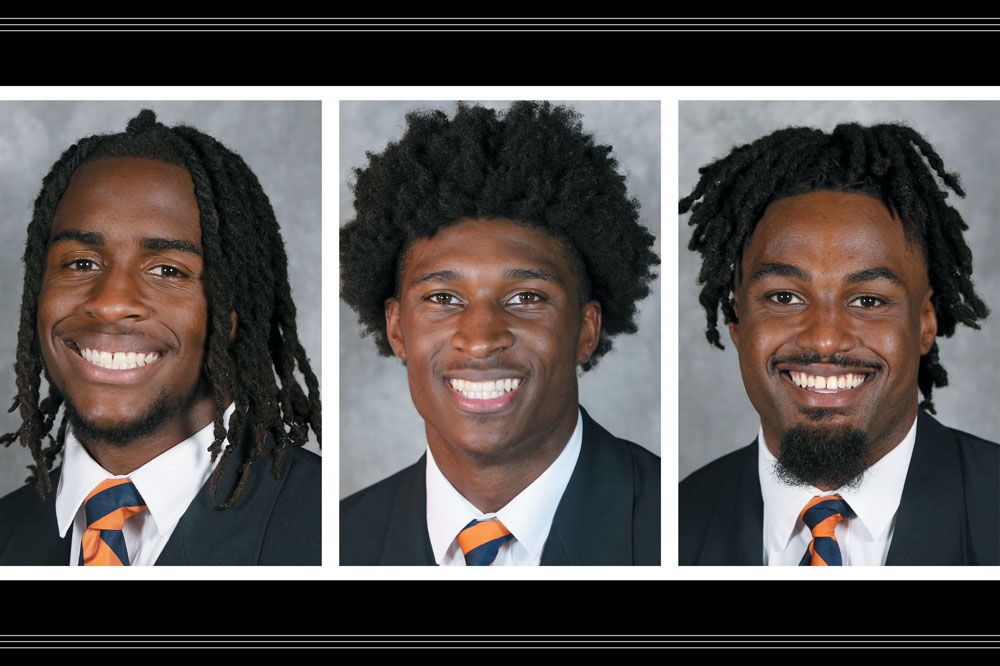
Imposing the maximum penalty for what prosecutors termed “unfathomable acts of harm,” an Albemarle County Circuit Court judge in November sentenced former UVA student Christopher Darnell Jones Jr. to five life sentences for the 2022 murders of football players Devin Chandler (Col class of ’24), Lavel Davis Jr. (Col class of ’24) and D’Sean Perry (Col class of ’23), and the shootings of students Mike Hollins (Col class of ’23, Educ class of ’24) and Marlee Morgan (Com class of ’25) as they all returned from a class trip to Washington, D.C.
Family members of the slain players had waited three years for some measure of justice, as well as for answers about the events leading up to the shootings.
“My question is why? We all want to know why,” Happy Perry, mother of D’Sean Perry, testified.
The facts of that night were not in dispute; Jones confessed to the shootings. A pair of heavily redacted reports related to the events, released in March 2025, did not reveal much new information.
Over five days of often harrowing testimony, however, a more complete picture emerged: details of Jones’ troubled upbringing and his time at UVA, accounts of his actions leading up to and on the day of the shootings, as well as victim and witness accounts of the shootings themselves and of the trauma and anguish still suffered by survivors and relatives.
“This is a life sentence for all of us,” said Brenda Hollins, Mike Hollins’ mother. “It’s a life sentence, and we didn’t ask for that.”
Initially charged with three counts of aggravated murder, which would have carried mandatory sentences of life without parole had he been convicted at trial, Jones in November 2024 pleaded guilty to the lesser charge of first-degree murder, which has a sentencing range of 20 years to life. He also pleaded guilty to two charges of aggravated malicious wounding, which carry the same sentencing range.
Jones was initially set to be sentenced in early February, but the hearing was delayed until November. It began four days after the third anniversary of the shootings.
Family members, survivors and UVA officials filled all seven allotted rows of the courtroom throughout the week. Boxes of tissues were lined up for them each morning on the partition dividing spectators from the main part of the courtroom.
More than 20 witnesses testified, with the defense and prosecution laying out contrasting narratives of what led Jones to shoot five fellow students as the bus carrying them neared the Culbreth Road parking garage around 10:15 p.m. that Sunday night.
Lawyers for Jones argued that he was in the throes of a mental health crisis when he committed the crimes. They asserted repeatedly that Jones was experiencing extreme paranoia and cognitive distortion that made him perceive threats where none existed.
“Christopher was severely mentally ill but not filled with evil intent,” public defender Nick Reppucci (Col class of ’92, Law class of ’96) said in his closing arguments.
A 61-page mitigation narrative submitted by the defense detailed Jones’ impoverished upbringing and the mental and physical abuse and “severe trauma” he suffered as a child. Defense witnesses testified that despite growing up in a home one relative described as “a war zone,” Jones became a star athlete and student leader at Petersburg High School, south of Richmond, and won a partial academic scholarship to UVA, where he was also a member of the football team in 2018. Many of the same witnesses said that by the summer of 2022 Jones had become a completely different person, unrecognizable from the young man they had known.
“It felt like nothing we could have said was getting through to him at that point,” said Antonio Clarke Jr., a cousin who grew up with Jones.
Prosecutors did not dispute that Jones had mental health issues but said he acted rationally in planning and committing the crimes, and when making his escape. They also said Jones lived a “double life”—one in which he was a polite, hardworking high achiever and another in which he used and sold drugs, had violent outbursts, and stockpiled guns in his dorm room.
“This was not a freak psychotic episode,” Albemarle Assistant Commonwealth’s Attorney Richard Farley said in the prosecution’s closing argument. “This was a criminal episode.”
According to the defense, Jones’ downward spiral at UVA began in November 2019, when he was stabbed during a brawl involving football players and local residents outside a restaurant near the Corner. Jones needed 20 stitches and two staples to close the wounds on his face and head. The incident shattered the sense of safety he’d felt at the university, the defense argued in court and in the mitigation report. Jones met with a university dean and then briefly with a UVA police officer but was not interested in pursuing the case, and charges were never filed, according to the report.
Jones also struggled during the pandemic. Forced to move back to Petersburg, Virginia, he took classes online while working a series of low-wage jobs to support himself and his grandmother. Jones also began selling marijuana, according to the report.
When his sister was severely injured in a car accident, Jones’ mental health declined further. He began “taking whatever pills he could get his hands on” and was soon mixing them with alcohol, according to the report.
Jones in August 2020 was charged with felony hit-and-run. Then in February 2021, after a traffic stop, he was charged with carrying a concealed 9 mm pistol without a permit; he had to forfeit the gun. He attempted to buy another gun but couldn’t because of his conviction on the felony hit-and-run charge, the report said. Later, after that conviction was reduced to a misdemeanor on appeal, he bought a rifle and then a Glock 45 9 mm pistol.
A planned semester leave of absence from UVA turned into a year. Jones returned in August 2022.
Back at school, Jones was “all over the place” mentally, testified Alexis Stokes (Col class of ’23, Educ class of ’24), a friend who was on the trip. He was “very paranoid,” believing that people were out to harm him.
According to the mitigation report, Jones focused much of his paranoia on a mutual friend of his and Stokes’, a student with whom he’d had a brief romantic relationship. The three students remained friends after the relationship ended, but Jones became convinced that the student was trying to set him up to be harmed, according to the report.
The prosecution painted a different picture of Jones.
Farley, the assistant commonwealth’s attorney, said Jones’ motive for the shootings was jealousy. The student with whom he’d had a romantic relationship was on the trip and sat with the football players at dinner after the show, he said.
In text messages to a mentor before the shooting, Jones claimed that the football players had bullied him.
“[T]his entire trip these boys have been (messing) wit me… tonight I’m either going to hell or jail. I’m sorry,” he wrote.
Multiple witnesses who were on the bus trip testified that the football players had barely interacted with him.
“The case is truly about anger and sexual jealousy,” Farley said.
Prosecutors also said that after shooting the players, Jones turned to the student and said, “You’re lucky I don’t shoot women.”
Jones cursed out the players as he left the bus and made his escape on foot, prosecutors said.
He ditched his red jacket, red hoodie, phone and gun, and donned a mask. Roughly five minutes after the shooting, when police were looking for an unnamed suspect in a red jacket and hoodie, Jones was stopped by a UVA police officer at the corner of Rugby Road and University Avenue. Body-camera footage played in court showed the officer questioning Jones, who when asked said that he had not heard any shots. Asked whether he was a student, Jones produced his ID card. He also complied when the officer asked him to lift his shirt to show that he didn’t have any weapons.
When information about the shooting came over the police radio, Jones feigned surprise. “Oh my goodness, what?” he said before the officer let him go.
UVA was locked down for just under 12 hours, until Jones was arrested the next morning near his mother’s house in Henrico County, around Richmond.
Prosecutors presented additional evidence that they said showed Jones’ true nature. On the final day of the hearing, over the objection of the defense team, they introduced into evidence a pair of jailhouse phone calls Jones had made earlier in the week. In the recordings, Jones referred to the three murdered players as growing up comfortably in better circumstances than he did. He was also heard laughing about the case.
“That’s the real Chris Jones,” Assistant Commonwealth’s Attorney Susan Baumgartner said.
In his closing argument, defender Reppucci asked Judge Cheryl Higgins to impose a sentence of 40 years of active incarceration, a significant punishment but one “tempered with mercy,” he said. Reppucci said the stabbing at UVA was a turning point and that Jones no longer felt secure there.
The prosecution said UVA had no shortage of support in place, had Jones sought it.
“UVA provided the most nurturing environment that this man will ever exist in,” Farley said. He added: “He could have gotten treatment. Instead he committed mass murder.”
Baumgartner said the mercy the defense requested had been granted in the plea agreement, which allows Jones to apply for geriatric release—conditional release for anyone convicted of a felony who has served at least 10 years of their sentence and is 60 or older.
Dressed in a suit for much of the hearing, with his hair closely cropped, Jones sat impassively for most of the week, with one hand bound by a chain around his waist.
He addressed the court for about 20 minutes before the sentence was handed down. Sobbing heavily, he apologized to family members of the three students killed, and to Hollins and Morgan. Many stood up and left the courtroom as he began speaking.
“I’m so sorry,” he said. “I know that doesn’t change anything.”
Jones said he did not expect forgiveness. “I know y’all don’t forgive me,” he said. “I don’t forgive myself.”
As to the length of his sentence, Jones said: “I never said I wanted anything less than life. I don’t deserve anything like that.”
Trauma from the crime remains fresh, particularly to those directly affected.
Kwamie Green, an aunt of Lavel Davis Jr., spoke for the family and said the past three years have been “a nightmare we cannot wake up from.”
Dalayna Chandler, Devin Chandler’s mother, said, “My heart has been broken in a way that can never be repaired.”
Students who went on the trip testified to being fearful in public places, to being hypervigilant and to having flashbacks, among other lingering effects.
“People say it gets better, but it really doesn’t,” Stokes said. “You just learn to cope with it.”
Family members and survivors assembled again after Higgins completed her deliberations, which took about an hour. In explaining her sentencing decision, Higgins acknowledged that Jones’ psychological function was “severely compromised.”
“But these distortions did not interfere with his ability to complete actions,” she said. “He acted knowing that what was contemplated would lead to dire consequences.”
Higgins also cited the “execution-style” manner of the killings and the vulnerability of the victims. “The court finds these facts do merit a life sentence,” she said.
Relatives of the victims began quietly weeping as she announced the sentences. After Higgins left, many of them applauded and embraced.
Outside the courthouse, as a light rain fell on that Friday evening, Mike Hollins stood in front of a bank of television cameras.
“All the families wanted justice for the lives lost and the long-lasting grief that we’ve all been experiencing,” Hollins said. “To add onto that, we just wanted to look for a little bit of closure out of what happened.”
Hollins said he had “a little bit of peace” knowing that Jones won’t be harming anyone else. He also said he was grateful that the truth of what happened that Nov. 13 had come to light, not just for the families but for the entire community.
“Just to connect the fine nuanced dots that led up to the event,” he said. “I think that definitely helped.”