Alumni Hall prepares for a new era
Construction on the Alumni Association’s new home starts this fall
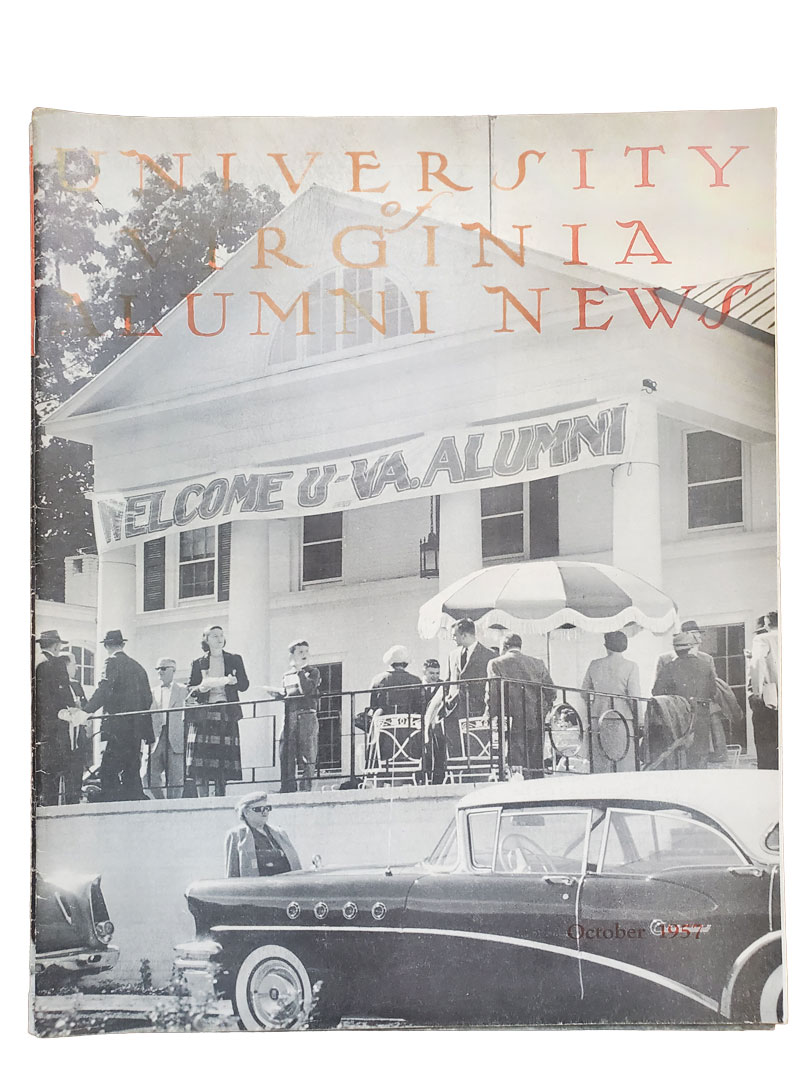
For more than a century, 211 Emmet Street South has taken on all manner of roles. First a home. Then a fraternity house—twice. And, in spring 1936, it stepped into its most enduring identity—Alumni Hall for the University of Virginia Alumni Association.
During Homecoming Weekend in October 1936, hundreds of alumni descended on Charlottesville to christen the space as the football team clashed with Washington and Lee, then dubbed by The Daily Progress as an “ancient football foe” for UVA.
At the time, big changes were happening on Grounds. Thornton Hall had opened down the street the year before and was fueling enrollment growth. By fall 1936, UVA was managing a record-breaking student body of around 2,450. And just up University Avenue, excavation work would soon be underway to prepare for a monumental shift—moving UVA’s library from the Rotunda to a new central library—now Shannon.
In the last 90 years, UVA has continued that evolution—from its football rivals to the size of its student body and main library. In fall 2024, nearly 26,000 students were enrolled, and the alumni network now spans more than 270,000 graduates worldwide. An updated and expanded Shannon Library reopened in 2024.
And in just the past two years, Alumni Hall’s neighbors have undergone their own transformation too—to the south, the new Contemplative Commons building, and to the north, a cluster of new UVA-owned buildings at the intersection of Emmet Street and Ivy Road.
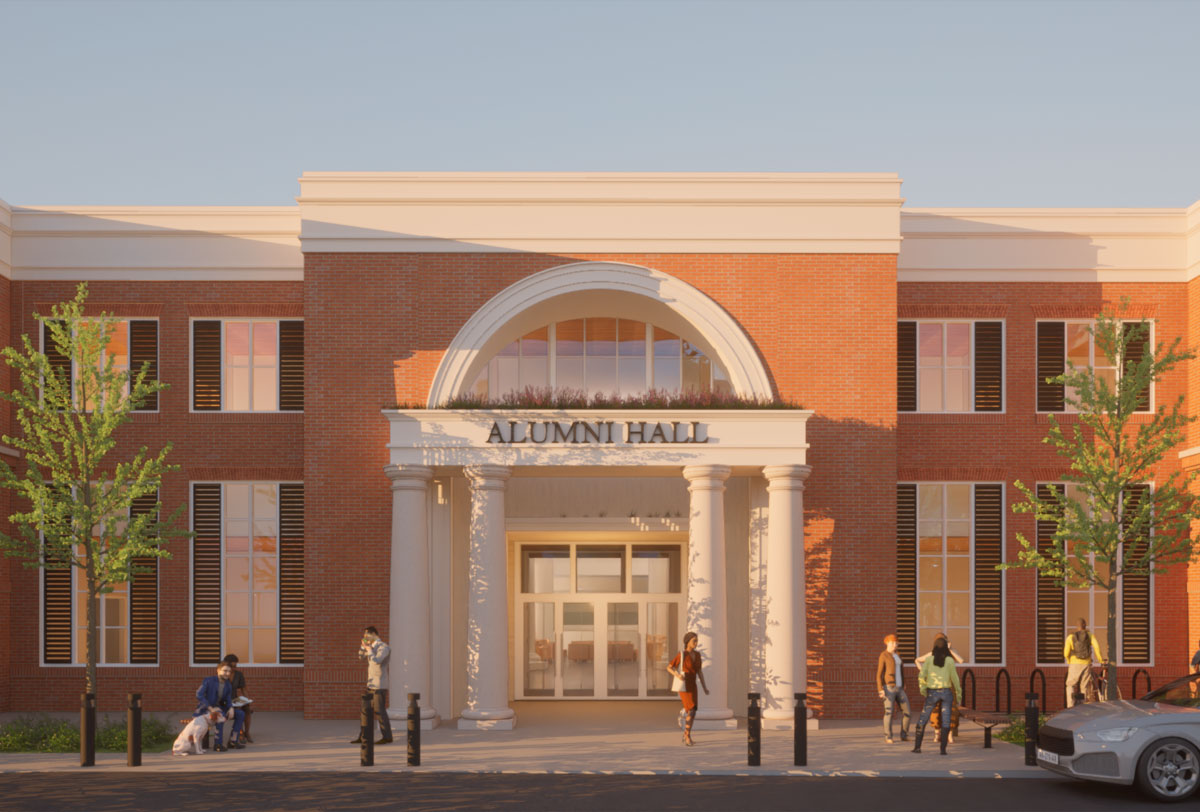
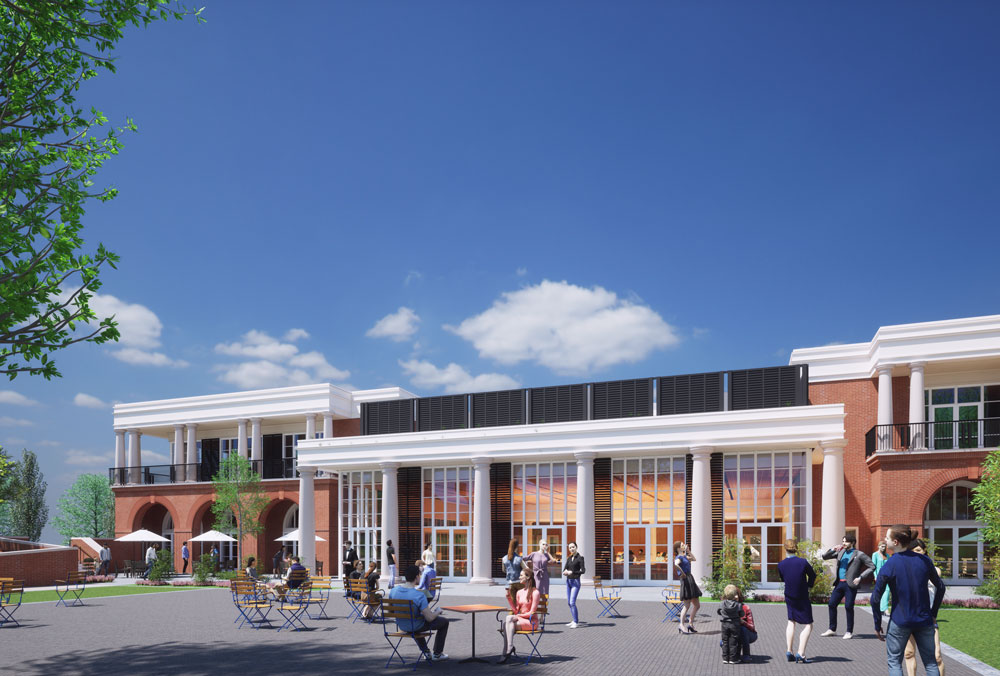
Now, it’s 211 Emmet’s turn. In September, the white brick building will be razed to make way for a new Alumni Hall—an open and airy design with twice as much room for formal and informal alumni gatherings. Elizabeth Hedde (Arch class of ’05), a principal with Centerbrook Architects & Planners, which designed the new building, says it offers nods to Jeffersonian architecture with a modern spin throughout.
Construction will take about 18 months, and the Association’s 60 employees will operate from a space on Old Ivy Road in the interim. Once it reopens in spring 2027, Alumni Association leaders hope the new building becomes a home away from home for returning ’Hoos.
“It’s a once-in-a-lifetime opportunity,” says Tatia Granger (Col class of ’89, Educ class of ’93, class of ’99), former chair of the Alumni Association’s Board of Managers. “It’s a relaunch for the Alumni Association.”
A place for parties
This isn’t the first major shift for the Alumni Association–or the property it’s called home for so long. Before settling into its current address, the Association spent decades on the move.
In 1907, after early plans for an independent alumni facility fell through, the Association partnered with the newly formed Colonnade Club for faculty members. Together, they funded an addition to Pavilion VII on the Lawn that included a reading room, a billiard room and eight bedrooms.
In 1926 the Association moved from the Lawn to the Corner, remaking a former post office into three rooms, including a spot designed for alumni and visiting tourists to gather.
By the 1930s, the Association was ready for a permanent home–and had the funding to make it happen. In 1936, it moved into 211 Emmet St., linking its future to a house that already was a prominent feature in the society pages of the day.
The property is situated on a portion of what was once called the “Towles Addition,” named after William B. Towles (Med 1869), a professor of anatomy at UVA. In late 1911 or early 1912, Arthur M. Taylor and his wife moved into their “new residence” on part of the former Towles property, according to The Daily Progress. It’s not clear if the house was new to them or newly constructed.
The couple regularly hosted gatherings there until 1916 when they moved to Paris, putting the house up for rent and two cows and a heifer for sale. While they were away, their home’s renters kept it lively, holding a benefit and dance for the French war-wounded and a house party for students during finals.
In 1921, Zeta Beta Tau, UVA’s first Jewish fraternity, purchased the property, which a 1923 history of the fraternity’s first 25 years describes as “probably the most beautiful fraternity house on Virginia’s campus.”
With new digs, the chapter was active. It won an award from the national fraternity for having the most campus activities, including a tea for Charlottesville’s Jewish community and a housewarming that drew more than 500, during its first year there.
Through the years, newspaper society pages told of annual house parties, teas and after-dance suppers at the house. Classified ads in 1924 touted the home as “a lovely place,” perfect for “summer school girls” to rent. (In the early 20th century, UVA opened its doors in the summer to women who took classes in teaching, art, home economics and a few other fields.)
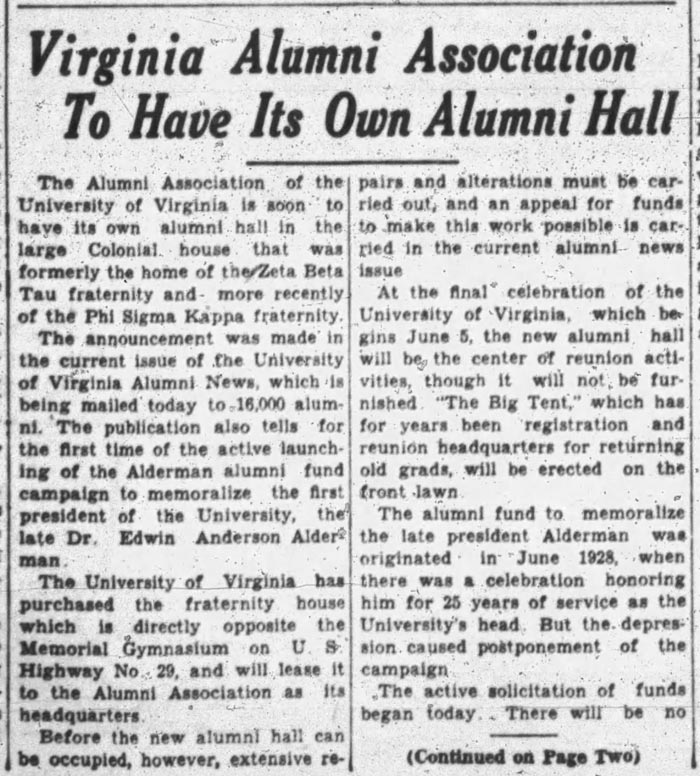
At some point, another fraternity, Phi Sigma Kappa, called it home. By the time the Alumni Association purchased the property in 1936, The Daily Progress reported, it “needed extensive repairs and alterations” before it could be occupied.
About a decade later, the Association had already outgrown the space.
A $150,00 expansion completed in 1950 added two single-story brick wings to the original house and a new room, called the Serpentine Room, for an event space.
A few decades later, the Association was again stretched, serving an alumni population close to 85,000 or so, The Daily Progress reported. In 1981, the Association embarked on a $2 million project to more than double its space with a new ballroom, meeting rooms, boardroom and courtyard. The expanded space opened in 1983.
Staying put
Through decades of football tailgates, reunions, lectures, dances, student and alumni meetings, and weddings and other private events, the building has served alumni well, says Granger, including herself. Her 1999 wedding reception took place in the ballroom. But, as UVA’s alumni base grows, the building has its limits. “We can really only do one event at a time,” Granger says.
The most recent discussion about what to do with Alumni Hall started during the pandemic as part of conversations about how to maximize the Association’s programs and services for alumni, Granger says. Those conversations eventually led to a closer look at the current building.
Many of the building’s current challenges stem from how it has evolved over time, say Granger and Teresa Lockard (Col class of ’84, Grad class of ’93), Alumni Association chief of staff. The additions and renovations have resulted in a patchwork layout.
Accessibility is a concern. A maze of narrow corridors and spaces doesn’t provide easy access for wheelchair users and others with mobility challenges, Lockard says.
The building also has plenty of structural issues. The air-conditioning system is failing, the roof is due for replacement, and water stains—caused by both leaks and the malfunctioning air conditioning—mark walls throughout the facility.
The Alumni Association’s leadership considered relocation, but the building’s proximity to Grounds was too good to pass up. “The value of our building is our location,” Lockard says.
As part of the deliberations, the Association’s Board of Managers commissioned a space study of the existing building, which revealed that about 65 percent of the 50,000-square-foot building was dedicated to offices and back-of-house functions while only 35 percent could be used for alumni programs and events, Lockard says. The report recommended flipping that ratio.
At its October 2024 meeting, the Board of Managers agreed to move forward with the construction of a new building.
The total project cost is about $63 million, and the Alumni Association’s goal is to raise $35 million toward that total cost, Lockard says. The Alumni Association is currently offering naming rights opportunities for the grounds, atrium and smaller spaces inside.
Excitement with a side of nostalgia
For Hedde, the project at her alma mater was a rare opportunity to create a lasting place where UVA students and alumni can gather for the next century. The challenge with the project, she says, was maintaining a careful balance between honoring UVA’s historic architectural language while also reflecting its reputation as a forward-thinking institution.
From her earliest conversations with Alumni Association leadership, she says, a central question was where the building should fall on that spectrum of architectural style—from traditional historic reproduction to modern, contemporary design.
“It can be a dangerous place to be in the middle because you don’t want it to be pastiche, like you’re just recreating something and be cute about it,” Hedde says. “But you also want the forms to be familiar, so it feels embedded in the fabric.”
The result is a design that feels a bit more traditional on the outside with a modern, light-filled interior. Across the design, alumni will recognize architectural references to iconic buildings across Grounds.
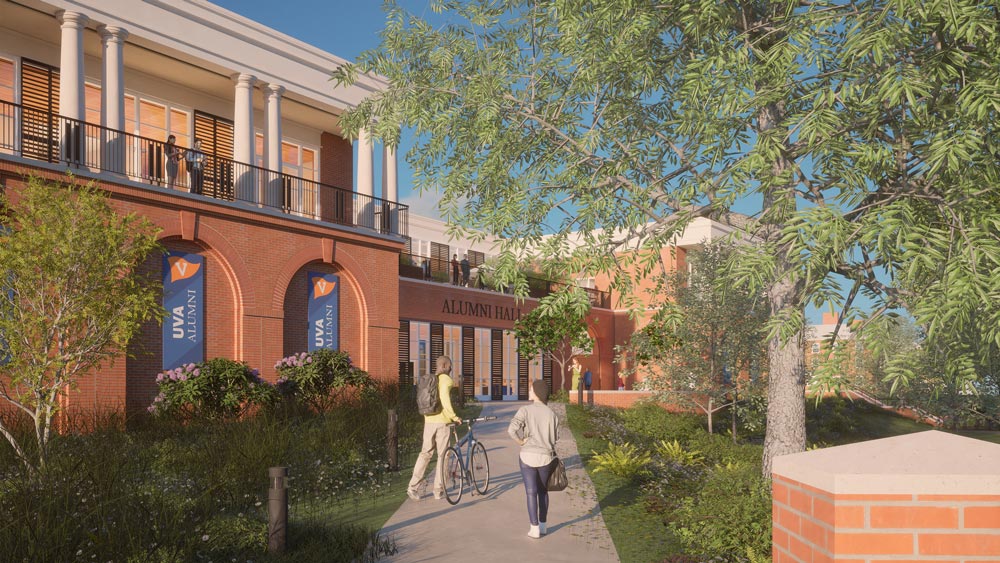
As Hedde describes it, a soaring central atrium, for example, echoes the Rotunda’s dome, with similar proportions and railing design. Blind brick arches on the exterior reflect those found on Memorial Gym’s facade across the street, Hedde says. A second-floor balcony, facing Emmet Street, evokes the Lawn’s pavilions, encouraging activity at multiple levels.
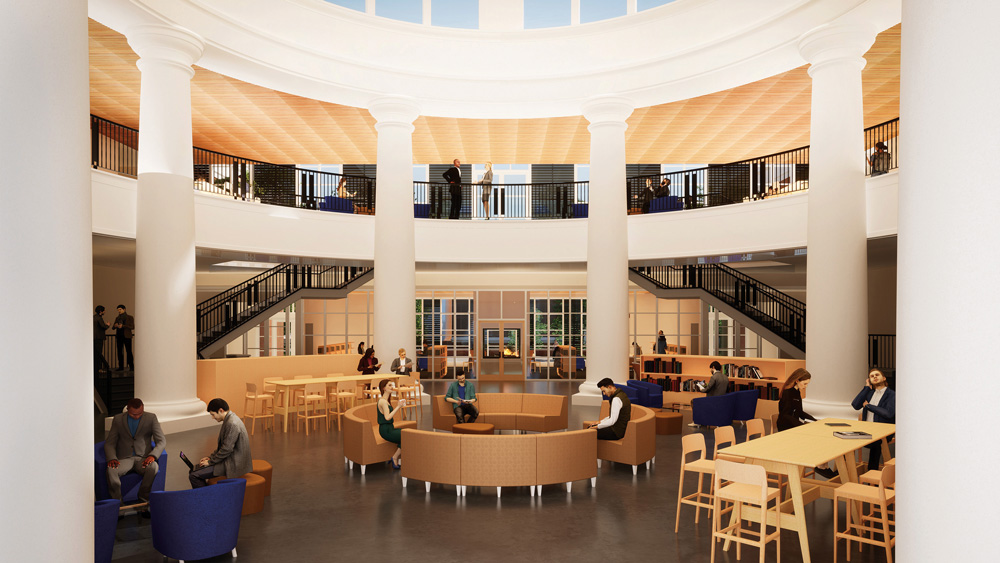
Natural interior light was a priority, she says. The new Alumni Hall will feature expansive windows, skylights and a clerestory around the central Rotunda-like atrium to maximize daylight, Hedde describes. The project also is designed to maximize energy efficiency and preserve an existing serpentine wall and mature trees, including some magnolias, she says.
Pushing the new building closer to Emmet Street will make room for a larger outdoor courtyard in the back for events, Hedde says. Its presence along Emmet also will make the building more inviting to passersby, with the large windows and the second-floor balcony showcasing the people inside and outside its walls, she says.
“We don’t want the building to be the first thing you see,” Hedde says. “You want to see all the beautiful work and community of alumni and students in there.”
After nearly 90 years of service to UVA alumni, the final months of the current Alumni Hall carry a sense of nostalgia. Alumni Association employees have been sorting through decades of memorabilia collected inside. Final alumni group meetings and events are wrapping up.
Granger gets it. She has her own fond memories of her wedding reception and countless other events at Alumni Hall. But what’s changing, she says, isn’t the heart of Alumni Hall—it’s how much room there will be to make memories and celebrate milestones. The redesign flips the current proportions with two-thirds dedicated to events and programs.
When it reopens, Alumni Hall will offer more to alumni, she says. “I believe that all that is good about what has transpired is going to remain, and it is going to become a part of the new space.”