In Memoriam: Amos Leroy “Roy” Willis
First Black College graduate lived his life “to uplift a community”
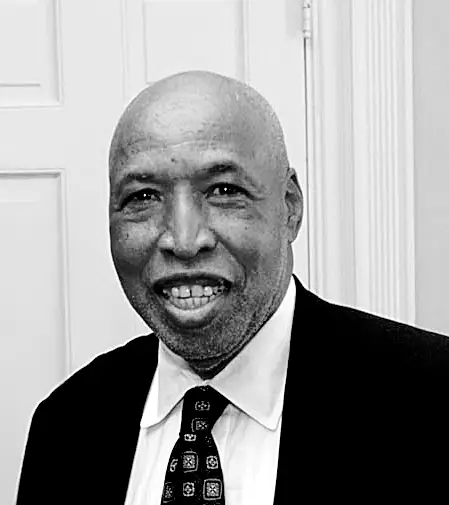
Nia Raymond (Col class of ’93) remembers the 2010 ceremony where UVA honored her father, Amos Leroy “Roy” Willis (Col class of ’62), as a bittersweet moment. Willis, the first Black graduate of the College of Arts & Sciences, received a plaque from then-President John T. Casteen III (Col class of ’65, Grad class of ’66, class of ’70) to be placed outside his former Lawn room.
Raymond remembers thinking, “It’s 2010. This happened [over] 40 years ago. Like, why did this [ceremony] just happen?”
Willis, whom Casteen once called “not just a pioneer, but the pioneer” for civil rights activism at UVA, campaigned alongside other activists to desegregate the Corner. He excelled in his studies despite the challenges he faced as one of the few Black students on Grounds. He went on to a successful career in business and economic development and continued advocating for Black communities throughout his life. He died Oct. 16, 2025.
In 1959, Willis persuaded the UVA administration to let him enroll in the College by quoting Thomas Jefferson’s Declaration of Independence: “All men are created equal.” His impressive academic performance earned him residence on the Lawn and a spot on the Dean’s List. He also received the Distinguished Military Science Award from the Army ROTC.
While at UVA, Willis joined the local chapter of the Virginia Council on Human Relations, a biracial civil rights organization. Along with several other students, including Virginius Thornton, the first African American admitted to the Graduate School of Arts & Sciences, he picketed several segregated Corner businesses, including the University Theater. The chapter then committed itself to a campaign for comprehensive desegregation in Charlottesville.
According to Raymond, Willis had a complicated relationship with the university but was grateful for the education he received.
“It was the best education in the state of Virginia,” Raymond said. “He shouldn’t have had to get it that way; he shouldn’t have had to petition because of segregation.” His time at UVA was marked by discrimination and racism from his classmates. “He would sit down at a lunch table, and people would get up. I think there were maybe one or two white people that he would have considered friends,” Raymond said.
After graduating from UVA and serving in the U.S. Army, Willis headed to Harvard Business School, where he co-founded the Harvard Business School African American Student Union and persuaded the administration to accept more Black students. Despite intense pushback, Black enrollment in the subsequent class more than quadrupled to 27, according to the school’s alumni website.
Willis moved to California, where he embarked on a career in business and economic development. According to his son, Maceo Willis (Col class of ’94), he opened The Dock of the Bay in Berkeley, a community-owned upscale seafood restaurant and jazz club catering to Black intelligentsia. He served as the deputy administrator of the Community Redevelopment Agency in Los Angeles from 1987 to 1999. He was key in developing projects in the downtown area, including the Walt Disney Concert Hall. His son said that after the 1992 Los Angeles riots, Willis dedicated himself to revitalizing the historically Black Watts neighborhood, creating community spaces around the Watts Towers art installation and building a public library.
“He was very concerned about the Black community and Black prosperity, and that was how he lived his life, to uplift a community,” Raymond said.
He is survived by his wife, Dean; three children, including Nia and Maceo; four grandchildren; four siblings; and his former wife.
—Kiki McLaughlin