Virginia’s visionary
Longtime president John Casteen set UVA on its modern course
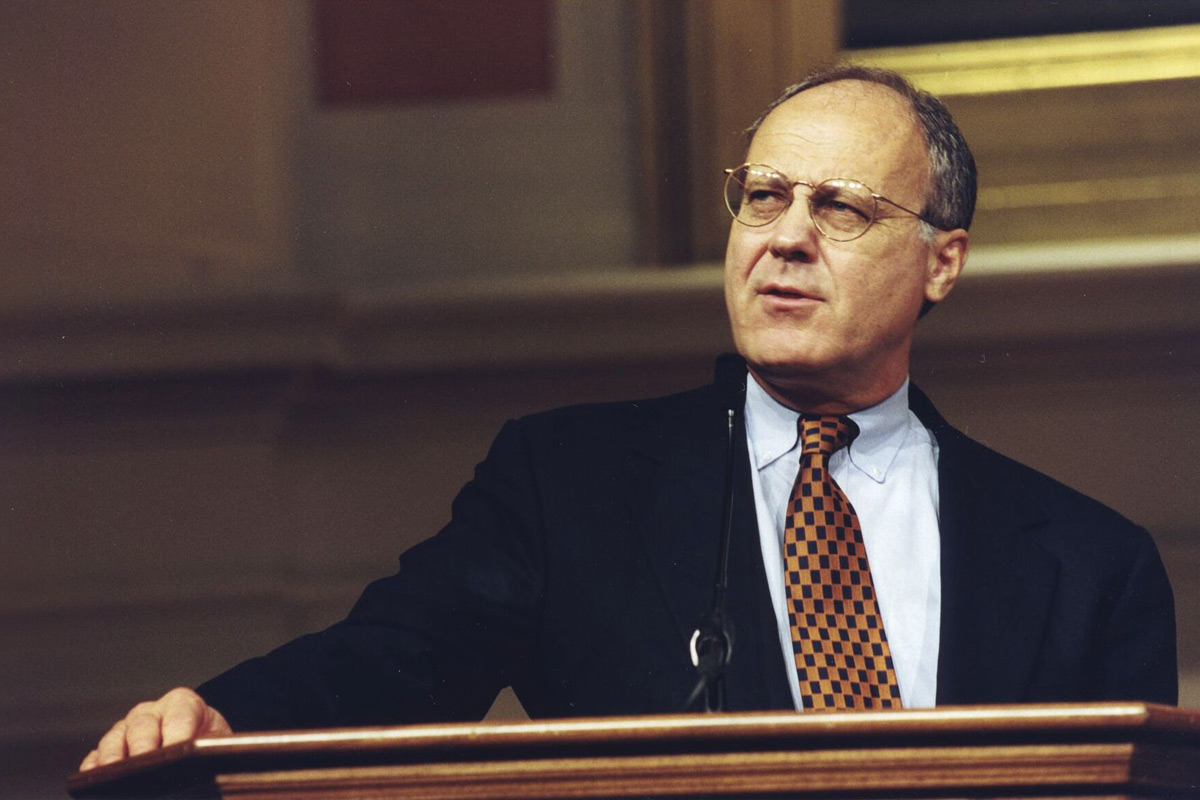
Albert and Shirley Small Special Collections Library / UVA Library
Inaugurated as UVA’s seventh president on Oct. 6, 1990, John T. Casteen III (Col class of ’65, Grad class of ’66, class of ’70) settled into the corner office at Madison Hall largely free to set his own agenda, a privilege also enjoyed by his predecessors.
“The job was not clearly defined,” Casteen said in a 2024 interview with Virginia Magazine. “The job of the president was to be the president.”
Very quickly, however, outside events brought Casteen’s job into sharp focus. Drastic cuts in state funding meant Casteen would soon have to devote much of his time to fundraising, to a degree that previous presidents could not have dreamed of.
Casteen himself had not anticipated how much time he’d spend raising money, he said.
“The board believed when it hired me that it could count on state funding to be fairly stable and therefore the job would not include a major capital funds campaign early on. It was always imagined that there would be one eventually.
“The funding reductions in the fall of 1990 were dramatic. We had a sort of strategy meeting that resulted in the decision to go ahead and move toward a major campaign. Now the scale of what we had to do was not imagined. It was much larger.”
Several years in the planning, the Campaign for the University of Virginia raised $1.43 billion from 1994 to 2000, then the second-largest sum ever by a state university. It was followed by another, larger campaign in the second decade of Casteen’s term.
A presidency that began with fiscal alarms sounding ended two decades later with UVA on firm financial footing, its academic and global profiles raised, financial aid more widely available through AccessUVA, and Grounds brimming with new buildings and populated by a far more diverse university community. For those reasons and more, Casteen, who retired from the presidency in 2010 and died March 18 at age 81 after a brief bout with pancreatic cancer, has often been called “the father of the modern university.”
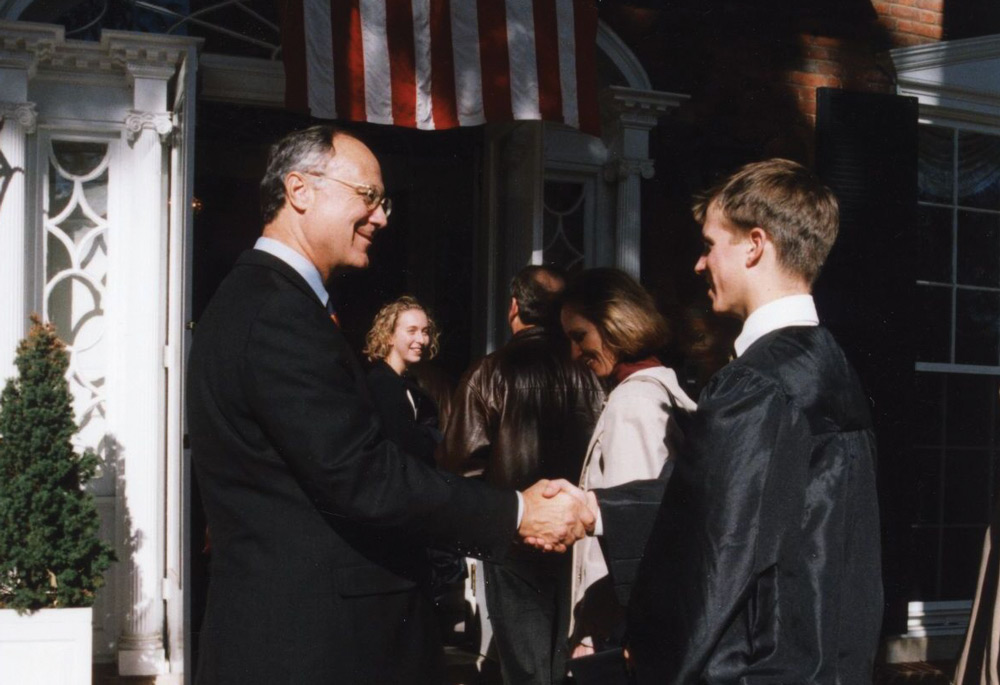
“John Casteen is simply inseparable from the story of UVA,” President James E. Ryan (Law class of ’92) said in a statement upon Casteen’s death. “As president, he transformed UVA into a world-class university. As a teacher, mentor, colleague and friend, he was beloved.”
“John’s legacy is our modern-day UVA—a university that offers undergraduate education second to none, highly ranked graduate and professional programs, a strong and improving research enterprise, and a world-class health system,” Leonard Sandridge (Grad class of ’74), who worked alongside Casteen as executive vice president and chief operating officer, wrote in an email.
Casteen’s 20-year tenure is second in duration only to that of UVA’s first president, Edwin Alderman, who served for 27 years. Casteen seemed born to be president, a 1999 profile of him in The New York Times asserted.
“If ever there was a man placed on this earth for the purpose of being president of the University of Virginia, it is Dr. John Casteen 3d,” the article began, citing his erudition, his love for UVA, his drive, and his ambition—first expressed while he was still in his 20s—to hold the job one day.
Casteen was raised in an unlikely spot for someone supposedly destined to such a lofty station in higher education. He grew up in the blue-collar community of Cradock in Portsmouth, Virginia, which was built by the federal government in 1918 to house workers at the nearby Norfolk Naval Shipyard.
Casteen’s father was a master mechanic at the shipyard. His mother worked at home. Casteen attended public school and was the first in his family to go to college, choosing UVA over Harvard and Princeton, neither of which he could afford.
In 1961, Casteen arrived at what he called the “Old U.” It was “simply a boys’ school,” he said in a 2021 interview with UVA Today. What he saw and experienced there would influence his push to make UVA more inclusive once he became president three decades later.
“Many took pride in being backward, and they didn’t want to change,” he said, referring to resistance to coeducation and racial desegregation.
Casteen earned bachelor’s, master’s and doctorate degrees in English, specializing in Anglo-Saxon poems and Icelandic sagas. Among his advisers was President Edgar F. Shannon Jr., a Rhodes Scholar who also taught in the English department.
Casteen taught at the University of California, Berkeley, for six years before returning to UVA as dean of admission, to help fulfill Shannon’s vision of a fully coeducated and integrated student body.
“Having come of age during the Civil Rights era and attended high school during Massive Resistance, he was determined to transform the undergraduate student body in a manner consistent with the principle and practice of inclusive excellence,” two of his children, John T. Casteen IV (Col class of ’93) and Elizabeth Ingeborg Casteen, wrote in an obituary in the Cavalier Daily.
Casteen left UVA in 1982 to serve as secretary of education under Virginia Gov. Charles “Chuck” Robb (Law class of ’73) and then as president of the University of Connecticut. When he returned to Grounds in 1990, state aid, which accounted for 32 percent of the university’s budget in the mid-1980s, had fallen to 23 percent, with more cuts on the horizon.
In a March 1992 interview with Alumni News (this magazine’s predecessor), then-budget director Colette Capone (now Colette Sheehy, senior vice president for operations and state government relations) said the university would begin the 1992-94 biennium with $58.2 million less in state funding than two years before.
Though the figure represented just 3.3 percent of the total budget, the impact was greater because state funding supported the core academic mission of the university, she said.
Casteen had already been at work planning a campaign, an effort that largely began from scratch. UVA had raised roughly $140 million during a campaign in the mid-1980s but had let its fundraising infrastructure deteriorate.
“Prior to the appointment of Mr. Casteen, the University had undergone a difficult period in managing the relationships among its various decentralized fund-raising operations,” according to a campaign planning document produced by the university in October 1992. “The University Development office had lost credibility, which, in turn led to tremendous personnel turnover. Before the University could even attempt another capital campaign, these situations had to be rectified.”
Casteen rebuilt and scaled up the department, but he would have to take a hands-on approach. In 1993, the Board of Visitors approved an administrative reorganization increasing the number and range of duties assigned to Casteen’s vice presidents and senior staff.
“This is necessary to free you from daily managerial duties and enable you to increase your commitments to travel and other activities related to the campaign,” Rector Hovey S. Dabney (Law class of ’49) wrote Casteen.
Casteen had planned a traditional “academic” presidency that included teaching, as his mentor Shannon had done, he said in 2024. Instead, he was on the road up to four days a week and hosting events at Carr’s Hill when not traveling. He and adviser and fundraiser Gordon Burris (Educ class of ’67) took to the air in a King Air 90 turboprop plane, often accompanied by Alumni Association President Gilbert Sullivan (Com class of ’48). The plane was nothing fancy, but it allowed them to appear at multiple events in a single day, within a reasonable distance, Casteen said in 2024.
“We knew the stakes were high,” Casteen said. “That was always there. We understood from the start that if we failed at this, looking just at the state money available at the time, we were headed toward a long, deep dive.”
The scholar proved to be a tireless and effective fundraiser, able to converse on just about any subject, Burris said. Casteen was deployed both as a setup man and a closer.
“He would sell the vision and ask for the gifts,” Burris said.
“He loved it,” Edward Mitchell (Col class of ’63), one of the co-chairs, said in an interview about the campaign in 2024. “He could turn over the university to Leonard (Sandridge) to run and go to these campaign events as the public face of the campaign.”
Casteen said his approach was not merely to ask potential donors for money, but to get them invested in the success of UVA.
“I ask for their vision of the university, I ask for their political support, I ask for their membership on committees, I ask for their children,” he told The New York Times in 1999.
Casteen took flak for being gone so much. In 1998, the Cavalier Daily nicknamed him “Capital Campaigner Casteen.” Faculty also leveled criticism, but it waned over time, Burris said.
“Once they saw the money coming in, and they saw what the money could do, it was almost like they expected John to go out,” he said.
The effect of the $1.43 billion raised was seen across Grounds in new and renovated buildings, such as the David A. Harrison III Law Grounds and renovations to Scott Stadium. It was also felt in the classroom, with the funding of 154 endowed professorships, 122 fellowships and 616 scholarships, Casteen wrote when the campaign ended.
Rather than take a victory lap, Casteen pivoted immediately to a new initiative: Virginia 2020, a long-range planning process intended to position the university for its third century. It focused on strengthening UVA in science and technology, international activities, public service and outreach, and the fine and performing arts.
Casteen said in 2024 that Virginia 2020 was “a matter of defining what we would be,” as well as how the university would get there.
That included building the endowment. When Casteen retired in 2010, with another capital campaign in full swing, the endowment had grown from $488 million to $5.1 billion.
In Casteen’s 20 years, 134 buildings were erected, UVA Today reported in 2010. Among the high-profile projects completed were the Albert and Shirley Small Special Collections Library, John Paul Jones Arena, the renovation of Old Cabell Hall, and the South Lawn project. The overall square footage of Grounds grew by 42 percent. This happened while state funding continued to drop, from 23 percent of the university budget in 1990 to 6.7 percent of it in 2010.
Casteen’s legacy was not just as “the Builder,” as this magazine called him when he retired in 2010. He was also a champion of inclusion and access.
In 2003, Casteen launched AccessUVA, a program that meets 100 percent of undergraduate students’ demonstrated financial need. Burris said it was personal for Casteen.
“He knew what UVA had meant to him coming out of where he had come out of,” he said. “He’d experienced it firsthand as a student.”
“He had an appreciation of what education could do for you, and he demonstrated that for himself,” Sandridge told UVA Today. “Therefore, he wanted to make sure he did everything he could to make it available to everyone else.”
Casteen said in 2010 that he viewed access as nothing less than what was required of a public university by the Bill of Rights, and particularly the 14th Amendment, which ensures equal protection under the law.
“We don’t, and we ought not be able to, discriminate on the basis of who comes from a privileged background and who doesn’t,” he said.
Similarly, Casteen created the Office of Diversity and Equity in the wake of racial incidents on Grounds in late 2002 and early 2003, which included an assault on a biracial student who was running for student council president, and white students dressing in blackface for a party.
During his administration, the enrollment of women, international students and minority students increased. The percentage of female undergraduates went from 50 to 56 percent, and the minority undergraduate population rose from 17.8 to 25.5 percent. The faculty also became more diverse, with women making up 25 percent and minorities 15 percent.
Angela M. Davis, who was the only Black person and one of just two women in the English department when she joined the faculty in 1975, said at a memorial service for Casteen in April that she soon wanted out of the “chilly environment” she encountered at UVA. She was planning to leave when Casteen convinced her to instead apply for a position in student affairs. Davis, who became a special assistant to the vice president and chief student affairs officer, said it was an example of the forward-thinking Casteen “already intentionally shaping the university into the 21st century.”
“John understood that it wasn’t good enough to just go to Black churches to recruit Black students, and open the door of UVA to women,” Davis said. “It was just as critical to diversify our faculty and administrative leadership.”
Casteen made a habit of remembering names and is remembered for his humility, his children wrote. He was “habitually unsentimental and highly irreverent,” his son, Casteen IV, said at his father’s memorial service.
“He took his work with absolute seriousness but himself not so much,” Casteen IV said.
Casteen was quiet by nature, but several people who worked closely with him, or for him, said he inspired loyalty and dedication and a sense of mission.
“He was caring,” said Louise Dudley, who served as university spokeswoman from 1991 to 2002. “He dealt with people on a personal level.”
After retiring from the presidency, Casteen returned to the classroom for another decade, teaching courses on Icelandic literature; the modern novel; and the art, culture and history of Venice. He studied 12 languages, was an avid boater and, along with his wife, Betsy, was a patron of the arts. UVA’s arts grounds were named for the couple in 2010.
“John Casteen is simply inseparable from the story of UVA.”
Casteen was also a world traveler.
“He’s been everywhere,” said Susan Harris (Law class of ’87), who in addition to serving as secretary to the Board of Visitors is a trustee and secretary to the board of the Leifur Eiríksson Foundation, an organization that provides funding for graduate student exchanges between the United States and Iceland. Casteen raised money to get the venture off the ground, she said. In 2022, he was awarded the Order of the Falcon, the highest honor bestowed by the Icelandic government.
Casteen made several trips to Iceland on behalf of the foundation, Harris said. As board members traveled by minibus between Icelandic universities, Casteen entertained them by giving lectures on Icelandic sagas, she said.
Casteen was disappointed about being unable to make the most recent trip this past fall, Harris said. He was looking forward to returning to Iceland and talked of taking trips to Newfoundland and the Faroe Islands, she said.
Casteen had a very brief period of diagnosis and treatment of pancreatic cancer before he died, according to his obituary.
Above all, Casteen was motivated by what was best for the university, Sandridge said. His relentless focus was on positioning UVA as one of the nation’s top universities, public or private.
“Over his two decades as president, he successfully realized this vision,” Sandridge wrote.
Casteen is survived by his wife, Betsy, and, according to his obituary, a “large and blended” family that includes UVA alumni Casteen IV, who is an associate professor at UVA and director of studies at Brown College; stepdaughters Alexandra Foote (Col class of ’04) and Elizabeth Robinson (Col class of ’07, Educ class of ’07); and 12 grandchildren.