UVA’s external review of 2022 shooting released
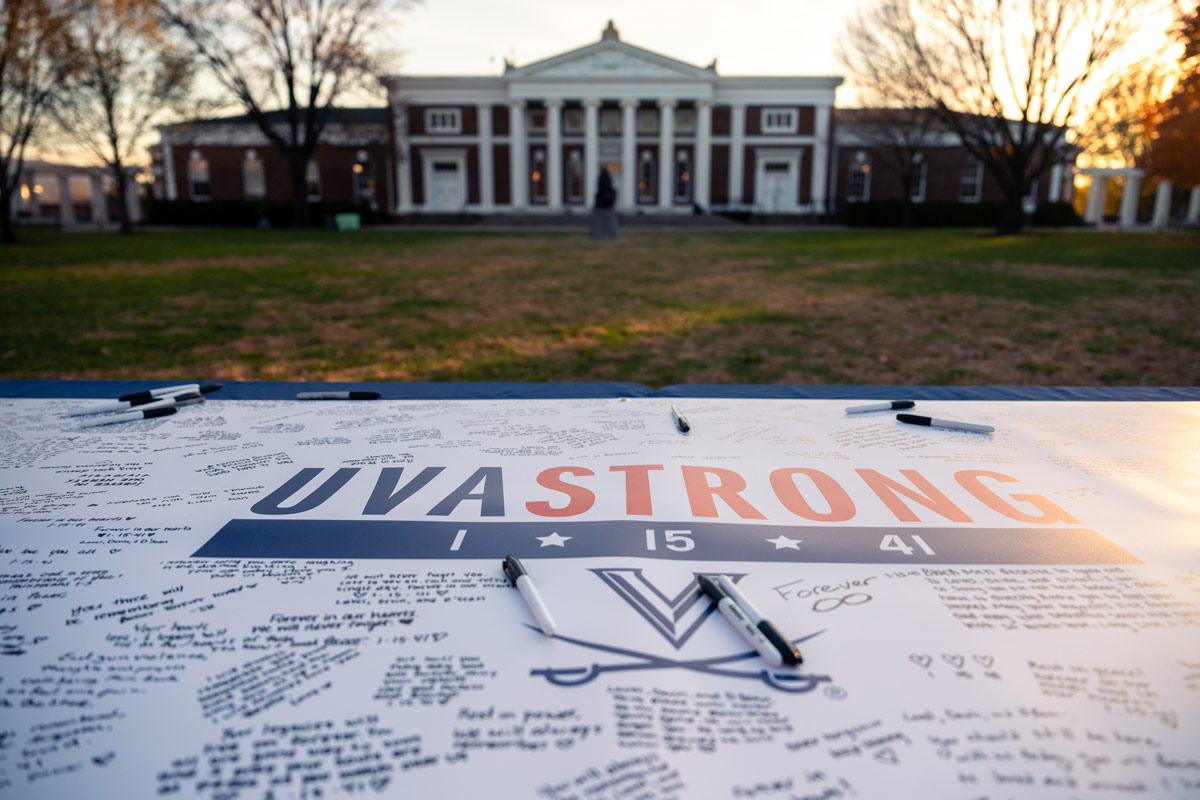
While reports stemming from the external review of the 2022 shooting on Grounds shed little new light on the events leading up to the tragedy, they say UVA and law enforcement’s response was “swift” and “multi-faceted,” and emergency responders and officials “performed admirably.” They also suggest a range of security enhancements, many of which UVA has already deployed.
The long-awaited reports, which were sought by UVA and authorized by the Virginia attorney general just after the shooting, were released March 21.
Of the nearly 200 pages contained within the two reports written by law firms Quinn Emanuel Urquhart & Sullivan in Los Angeles and Vinson & Elkins in Washington, D.C., more than half are redacted. The redactions cite the federal Family Educational Rights and Privacy Act, as well as state code that exempts education records and certain records related to public safety from the Freedom of Information Act.
“Although I hope this update brings a measure of solace, I know that this information will not provide answers to all of your questions, nor does it answer all of mine,” UVA President James E. Ryan (Law class of ’92) said in a statement accompanying the reports.
One outstanding question is what university officials knew about the shooter, then-student Christopher Darnell Jones Jr., who has pleaded guilty. While the reports do not contain specific unredacted information to answer that question, the Quinn Emanuel report, which analyzed the events preceding the shooting, does not conclude that the information the threat assessment team had “would have put a reasonable person on notice that [Jones] would commit the types of acts for which [he] is now criminally charged.”
The shooting took place around 10:15 p.m. Nov. 13, 2022, near the Culbreth Road parking garage, after a class field trip to Washington, D.C. As the bus parked near the garage, Jones opened fire and then fled. The incident prompted a 12-hour lockdown across Grounds as law enforcement searched for Jones. He was arrested near Richmond, about 80 miles from UVA.
“Although I hope this update brings a measure of solace, I know that this information will not provide answers to all of your questions, nor does it answer all of mine.”
Three students were murdered—football players Devin Chandler (Col class of ’24), Lavel Davis Jr. (Col class of ’24) and D’Sean Perry (Col class of ’23). Two students were injured—football player Michael Hollins Jr. (Col class of ’23) and Marlee Morgan (Col class of ’25).
Days after the shooting, Ryan and then-Rector Whittington W. Clement (Col class of ’70, Law class of ’74) asked Jason S. Miyares, the state AG, to appoint special counsel to review what happened.
In December 2022, Miyares appointed the two law firms to conduct the reviews. Two partners from Quinn Emanuel studied what happened before the shooting, and Vinson & Elkins partner G. Zachary Terwilliger (Col class of ’03), a former Virginia U.S. attorney, looked at related law enforcement issues. They completed their work in October 2023. According to an executive summary released with the redacted reports, the Board of Visitors then reviewed the report with representatives from the firms. Final, amended reports were finished in January 2024.
UVA delayed the release of the analyses for more than a year, first citing attorney-client privilege and, later, the criminal proceedings against Jones. However, last November, Jones pleaded guilty to three charges of first-degree murder, two charges of aggravated malicious wounding and five firearms charges in a court hearing in Albemarle County Circuit Court.
Jones was initially set to be sentenced in early February, but the hearing was delayed until November. In mid-February, UVA announced that Albemarle County Commonwealth’s Attorney James M. Hingeley (Law class of ’76) had withdrawn his concern that releasing the report would influence the criminal proceedings.
Both reports make recommendations for how UVA can bolster its safety policies and practices.
The Quinn Emanuel report identified areas of “vulnerability and potential improvement” to UVA’s threat assessment team and safety and support structure. The report found that, unlike many peer institutions, UVA did not have a dedicated body to address incidents of student distress that might not rise to a level of immediate threat, but where there was still cause for concern.
It also flagged student self-governance as a potential obstacle, finding that the long-standing tradition could “impede” UVA administrators’ ability to enforce public safety rules and recommended that UVA increase administrative involvement in public safety and discipline.
“Because virtually all non-criminal student conduct matters are processed through the Honor or [University Judiciary Committee] systems, the University administration appears to lack meaningful processes to enforce its policies,” the report said. “These student-run bodies can be slow-moving and there is a sense that the UJC may not be taken seriously by the student body as a tool to ensure discipline and safety.”
The Vinson & Elkins report generally praised the response of UVA law enforcement, emergency responders, and officials. But the firm also concluded that a “quicker information flow and sharing” between law enforcement, the university and the public would have been better. It found that UVA waited too long—about 16 minutes after the first 911 call—to issue the first alert warning the community about the shooter because the division of the University Police Department was having trouble contacting a shift supervisor for approval.
UVA has implemented recommendations from both reports, devoting new personnel and resources to more nimbly and effectively respond to students who are potentially in crisis and to assess other possible threats.
That includes establishing an Office of Threat Assessment and hiring full- and part-time staff to support it. UVA expanded its threat assessment team to include representatives from University Police and Housing & Residence Life and modified its operating procedures to more rapidly respond if a firearm is reported on Grounds.
And in January 2024, it established the Policy, Accountability and Critical Events unit to support UVA’s processes associated with student conduct, including interim suspensions, arrest disclosures and related matters. The unit now advises and supports the Honor and Judiciary committees.
“As president, my most important responsibility is the safety of every individual in our community and ensuring that we have the processes in place to provide for that protection,” Ryan said in the statement.
A month before the reports were released to the public, the two injured students were able to review them, as were the families of the three deceased students. Victims also have received or are seeking compensation.
In May 2024, UVA agreed in mediation to a $9 million settlement, allocating $2 million each to the families of Chandler, Davis and Perry and a total of $3 million to Hollins and Morgan, which is the maximum permitted under the commonwealth’s risk management plan.
And in April 2025 , Virginia federal judge Jasmine Yoon (Col class of ’03, Law class of ’06) ruled that two students on the bus, Ryan Lynch (Col class of ’25) and Kimberley Castano (Col class of ’23), can move forward with some civil claims—false imprisonment, willful and wanton negligence and intentional infliction of emotional distress—against the bus driver and its owner and operator, Charles Howard and A and A Executive Transportation Services.
According to the court filing , when the shooting began, Lynch saw Howard exit the bus and close the door behind him, trapping students on the bus. Both Lynch and Castano, the filing says, dropped to the floor and heard other students “yell that they could not get off the bus and call out for someone to open the door as gunshots continued to ring out.”
The bus’s internal lights were off during the shooting, making it difficult to see what was happening, the court filing says. Students were eventually able to escape when another student succeeded in opening the doors. Both students say in the court filing that they have suffered emotional trauma since the incident, including post-traumatic stress disorder.