Cooling down electronics
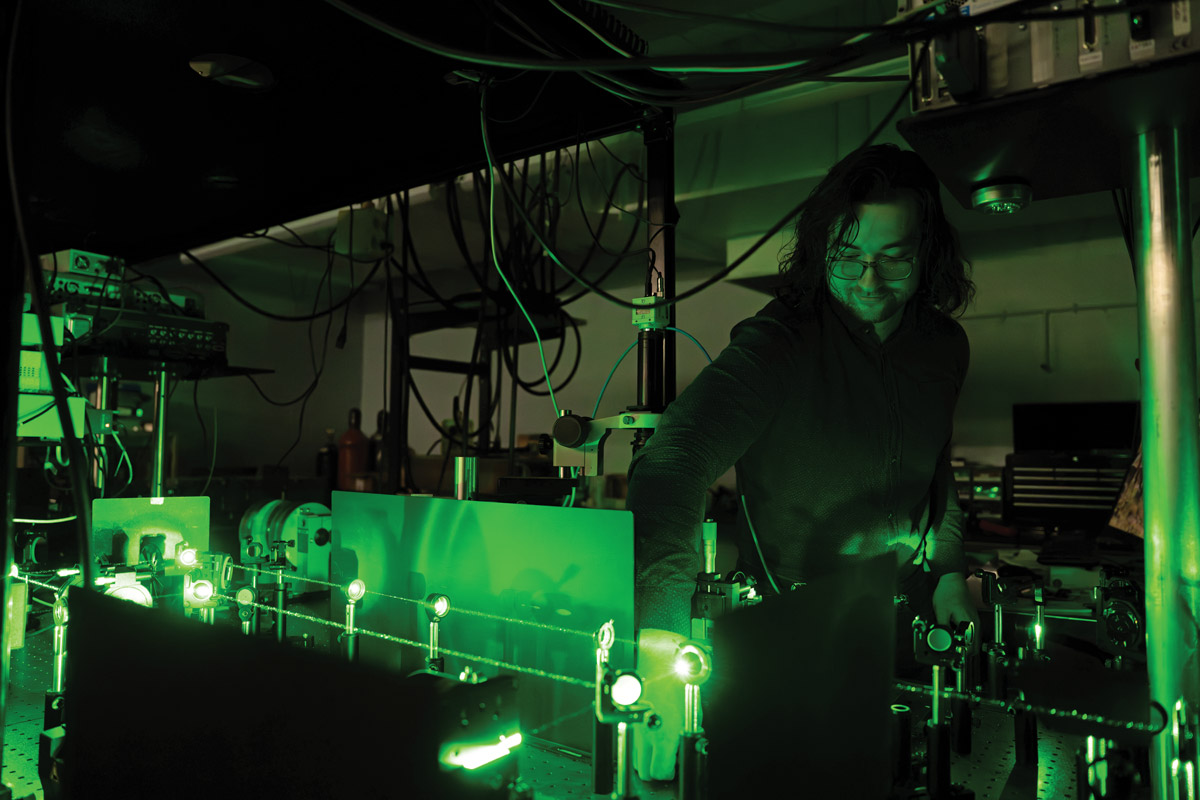
Overheated cellphones could become a thing of the past with a new mechanism developed by a team at UVA Engineering. Testing showed that with the right materials and design, the mechanism moves heat away from hot spots about 10 times faster than current setups.
In today’s devices, electronic components can get hot when operated for long periods, reducing their efficiency. Heat makes atoms in the components wiggle, and when many atoms are wiggling together, they become phonons that dissipate heat. The problem is that phonons move slowly, so heat can build up in the component. But photons (with a “t”) move much faster—at the speed of light.
“We thought, ‘Why can’t we use photons?’” said Patrick Hopkins (Engr class of ’04, class of ’08), a professor of mechanical and aerospace engineering.
The team used a laser to heat a tiny piece of gold atop a flake of hexagonal boron nitride. This allowed phonons to hitch a ride on faster-moving photons, rapidly blasting heat away from the hot spot before it could accumulate. “This mechanism was never thought to exist before,” Hopkins said. The team is now collaborating with other researchers to build devices that take advantage of this mechanism, which could make much faster, more efficient devices a reality.