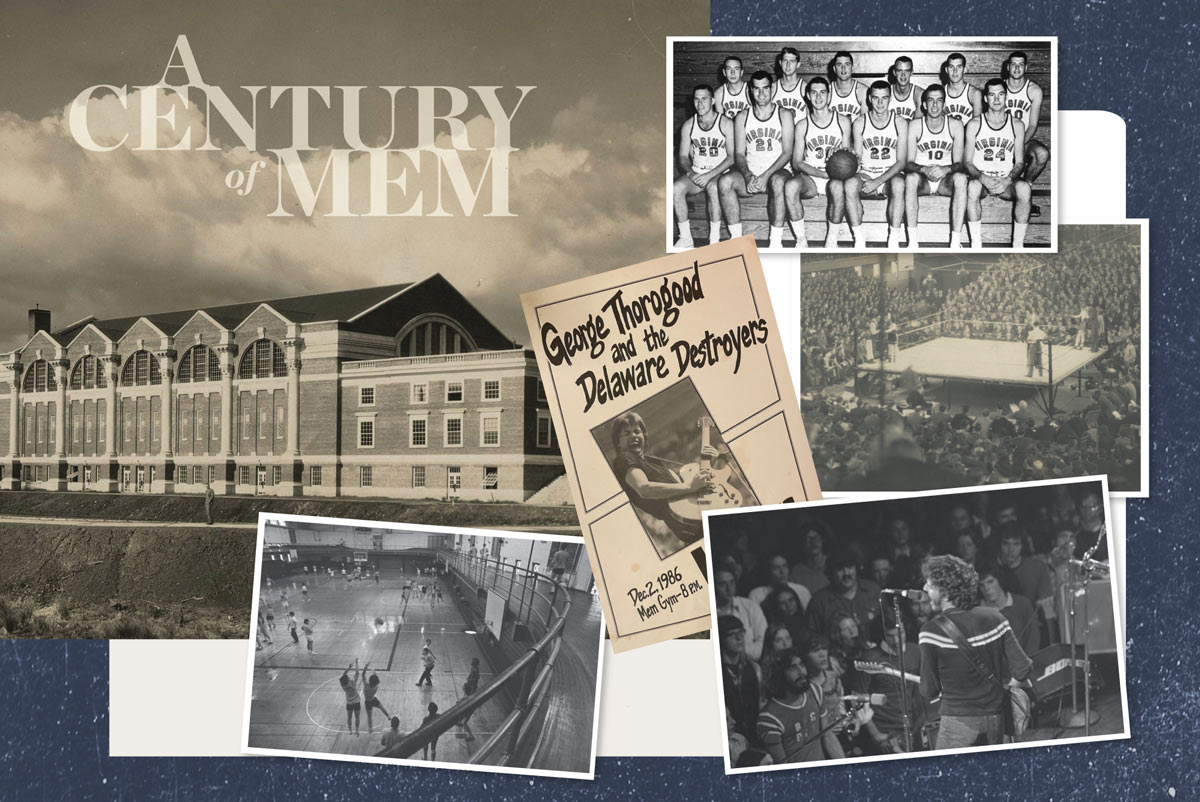
There was no ceremony to mark the opening of Memorial Gym on Jan. 14, 1924. The performance of the Virginia men’s basketball team, well drilled under veteran coach Henry H. “Pop” Lannigan, would have to be entertainment enough.
The Cavaliers did not disappoint, whipping Randolph-Macon 41-14 in front of a crowd of 700, The Daily Progress reported. Even with no formal festivities to mark the occasion, however, the story of the night was not the game but the sheer scale and spectacle of the new arena, completed at a cost of $300,000 and named in memory of the 80 students and alumni who lost their lives in World War I.
“It is impossible to describe its huge dimensions,” wrote Alumni News, this magazine’s predecessor.
With a gross square footage of 77,065 feet, Mem Gym was the third largest gym on the East Coast. The two “most comparable in size and character,” at Princeton and West Point, were 20 years older and lacked the “architectural treatment and completeness” of UVA’s new facility, Alumni News boasted when plans for the gym were finalized in 1921.
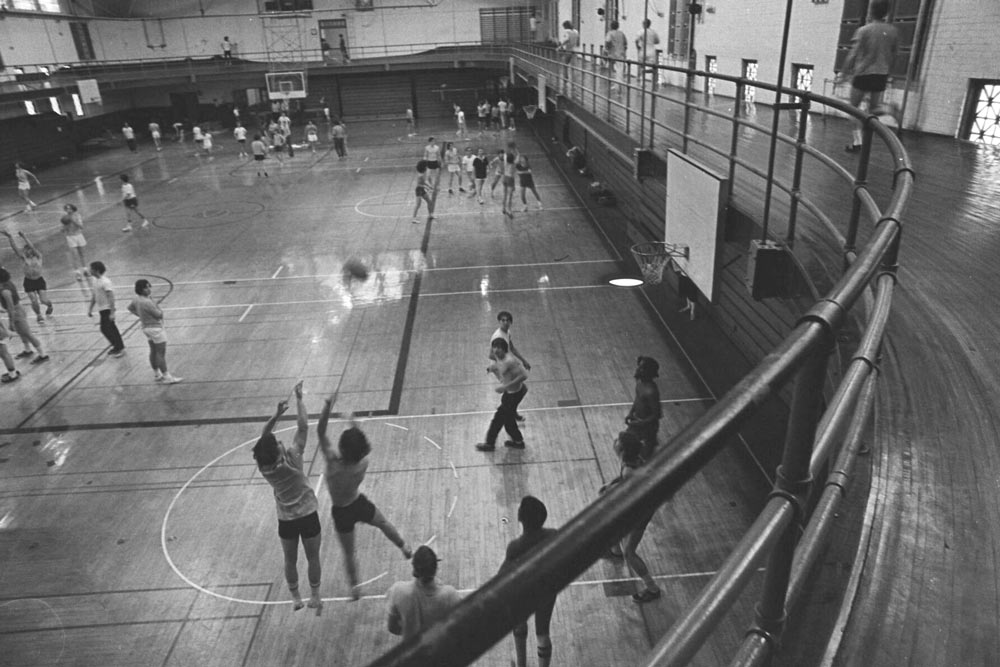
Students at the gym in the 1970s
Albert and Shirley Small Special Collections Library/UVA Library
“All told, then, it is no exaggeration to say that this will be the finest gymnasium in the country.”
It was a fitting beginning for a structure that would serve for decades as a hub of UVA athletic and social life. Over the years, fans crowded in to watch sporting events and musicians, and even one commencement address of national significance. Some queued for class registration there; some graduated there. And while it’s grown small compared to other athletic facilities on Grounds, it has lasted a century and is being prepped for its next.
From the earliest days of the university, people wanted a dedicated space to exercise.
Corks & Curls
The minutes of the July 6, 1835, meeting of the Board of Visitors recount that a Mr. A. Penci sought “permission to erect a building suitable for a gymnasium.”
The board turned him down.
“Resolved, That the condition of the Funds of the University will not, at this time permit an appropriation for the building desired,” it concluded.
It wasn’t until 1857 that UVA built its first indoor gym: Squibb. It was in Hotel F on the East Range, in what is now called Levering Hall, says Brian Hogg (Col class of ’83), senior historic preservation planner with the Office of the Architect. By all reports, there was not much to Squibb. As Alumni News reported: “Except for the label nobody could recognize what the place was. The equipment consisted largely of three boxing gloves. The padding in these weapons was a trifle softer than a brick.”
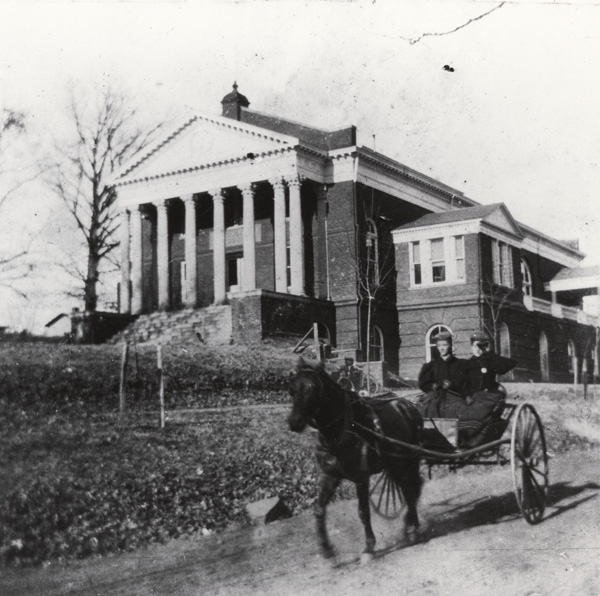
In 1893 came UVA’s first substantial gym: Fayerweather Hall. Though considered architecturally significant—it marked a return to the classicism that had been abandoned with the construction of Brooks Hall and the University Chapel, a pair of Victorian Gothic bookends—Fayerweather was from the beginning a dud as a gym.
Fayerweather Hall in 1897
Albert and Shirley Small Special Collections Library/UVA Library
“Fayerweather Hall quickly became outdated,” according to the UVA Library exhibit “From Village to Grounds: Architecture After Jefferson at the University of Virginia.”
Fayerweather’s many shortcomings were lampooned in “A Gym Forevermore,” published in Alumni News in March 1921. It was a send-up of “The Raven” by Edgar Allan Poe (Col 1826).
In 54 lines of doggerel, “A Gym Forevermore” skewered Fayerweather’s ancient showers and shallow pool and asked whether Virginia’s athletes should continue to have their “feet torn up with splinters” on the “cramped and quite restricted bumpy Fayerweather floor.”
“Quoth old Edgar: ‘Nevermore!’”
The poem served as a call for donations to fund a new gym. Early in 1921, the student members of the General Athletic Association board and the V Club, a booster organization, had passed a resolution calling on students to raise “as their birthday gift to Alma Mater, sums necessary for the building of a new gymnasium and the completion of the athletic field house,” Alumni News reported.
A week after the campaign kicked off, with posters and handbills plastered across the Corner, students pledged nearly $150,000. President Edwin Alderman raised $100,000, and $50,000 came from the Commonwealth of Virginia.
An architectural commission recommended to Alderman and the Board of Visitors a location on the western edge of Grounds, some 1,200 feet from the Rotunda, a site considered remote at the time. The gym’s porticoed main entrance would face north. Its comparatively unadorned west side would back up to Emmet Street, which was still a dirt road south of University Avenue, Hogg says. The showier east side, fronted by a reflecting pool and with Corinthian columns framing its five bays, was intended to be the major facade, Hogg says.
The gym’s design took Jefferson’s Roman Revival architecture a step further, Hogg says.
Designed by a group of architects led by Fiske Kimball, the first head of UVA’s School of Architecture, it was built in the Beaux Arts Classicism style and modeled on grand Roman baths.
“Jefferson used Roman models as the inspiration for the Lawn,” Hogg says. “Kimball is going back to a Roman model for a gymnasium. In some ways it’s more literal than what Jefferson did. [Kimball] is taking the Roman baths, which were places for exercises as well as for bathing, and turning it into a gymnasium.”
Plans called for the gym to be part of a quad developed around Nameless Field, as a sort of westward projection of the Lawn, Hogg says. Those plans were never realized, but as UVA grew around it, Mem Gym came to occupy a central place on Grounds.
Lannigan’s basketball team played opening night, but the top draw in the building’s early years was the boxing team, which went unbeaten from 1932 to 1936 and regularly filled the gym “to the roof,” recalled former boxer Mortimer Caplin (Col class of ’37, Law class of ’40) in a 2017 Virginia Magazine article.
Boxing began to fade in the early 1950s, about the same time the pond on the east side was drained and filled. Mem continued to host concerts, dinners and other celebrations, and was the rain location for major university events.
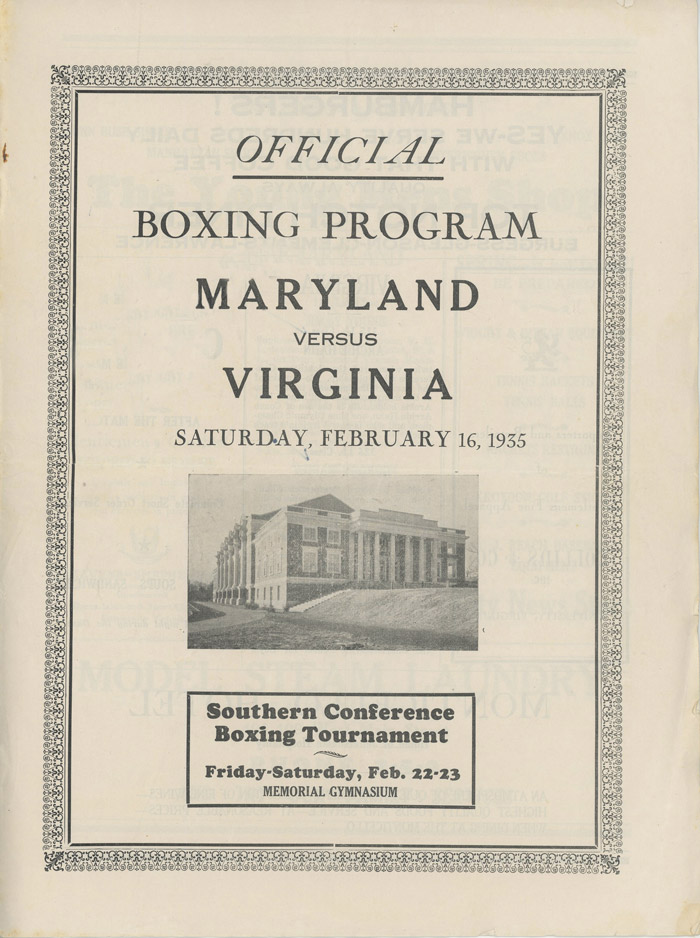
A program from the annual Southern Conference tournament held at Mem Gym in 1935
Albert and Shirley Small Special Collections Library/UVA Library
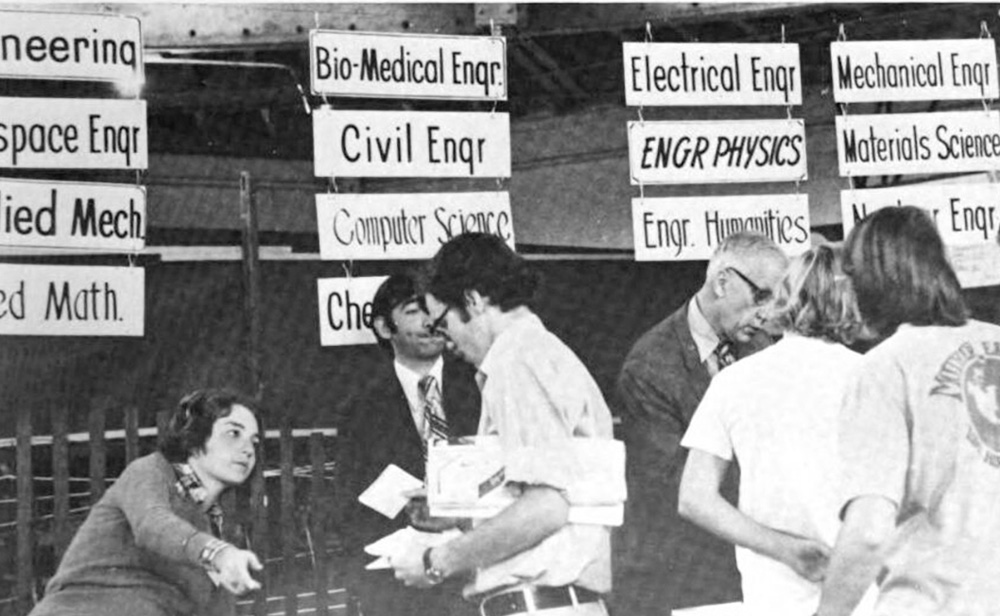
“It was probably the largest enclosed space at the school for years,” Hogg says. “When they needed to get most or all of the student body in one place, that was where they could go.”
The basketball team moved out in 1965, when University Hall was completed. Mem Gym got the last laugh, however: U-Hall was imploded in 2019. Mem is being spruced up for future generations.
In recent decades it has served as home of the wrestling and volleyball programs, as a venue for intramural sports, and as the preferred rec center for those partial to its old-school vibe.
At the end of the fall semester, it closed for upgrades to its plumbing and HVAC systems. The building’s accessibility will be enhanced with the installation of a permanent ramp at the main entrance and improvements to the nearby sidewalks. The project is expected to be completed in the fall of 2026 and will prep Mem for its second century.
“You’ve got 100-year-old pipes, you’ve got old wiring,” says Amy Mays, a senior project manager who is overseeing the renovation for UVA’s Facilities Management Division. “The building doesn’t have sprinklers. It doesn’t have central air and heat right now.”
“I always say there’s been 100 years of Band-Aids put on this building,” Mays says. “We’re trying to rip all the Band-Aids off and do it the right way and put it back together so hopefully nobody else will have to do this for another 100 years.”