In Bricks and Bits
From Minecraft to Legos to The Sims, here are three creative (and time-consuming!) ways that ’Hoos have paid homage to Grounds.
Minecraft Grounds by Alec Husted (Col class of ’20)
Estimated hours spent: 80 to 120
After graduating from UVA in May 2020, Alec Husted (Col class of ’20) found himself facing two problems: He missed Grounds and, thanks to COVID, he had too much time on his hands.
The solution? Recreate the University in Minecraft, the popular video game that allows users to build three-dimensional worlds with virtual blocks. Over the course of a year and a half, Husted ended up with a wildly detailed, almost eerily accurate version of Grounds.
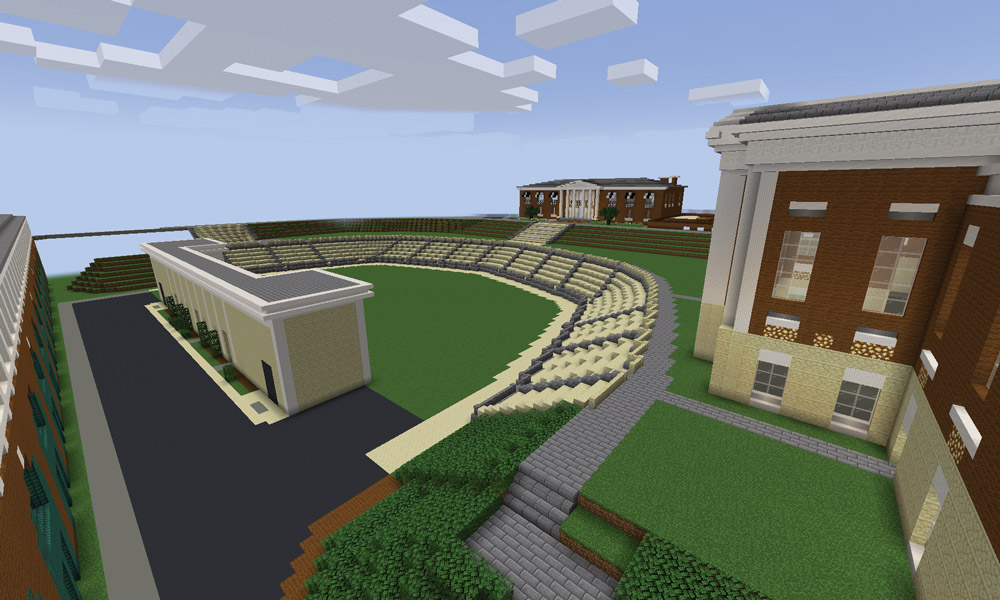
When you open the world, which Husted completed in May 2021, you’re instantly immersed. As you stroll down each path and round each corner, you keep finding new details: the illuminated seating area outside Clemons Library, a serpentine wall lining a pavilion garden, a narrow passageway separating the Lawn and the Range, even the McIntire Amphitheatre. And everything, somehow, feels totally proportional.

“The way I went about it was a combination of Google Maps and my memories of walking around Grounds during my undergrad … and tours of Grounds on YouTube as well,” says Husted, who’s now serving as an officer in the U.S. Air Force. “I’d look at pictures of, say, the Rotunda or one of the libraries, and just look at the proportions between different pieces, like, ‘This window looks to be about two blocks by three blocks.’”
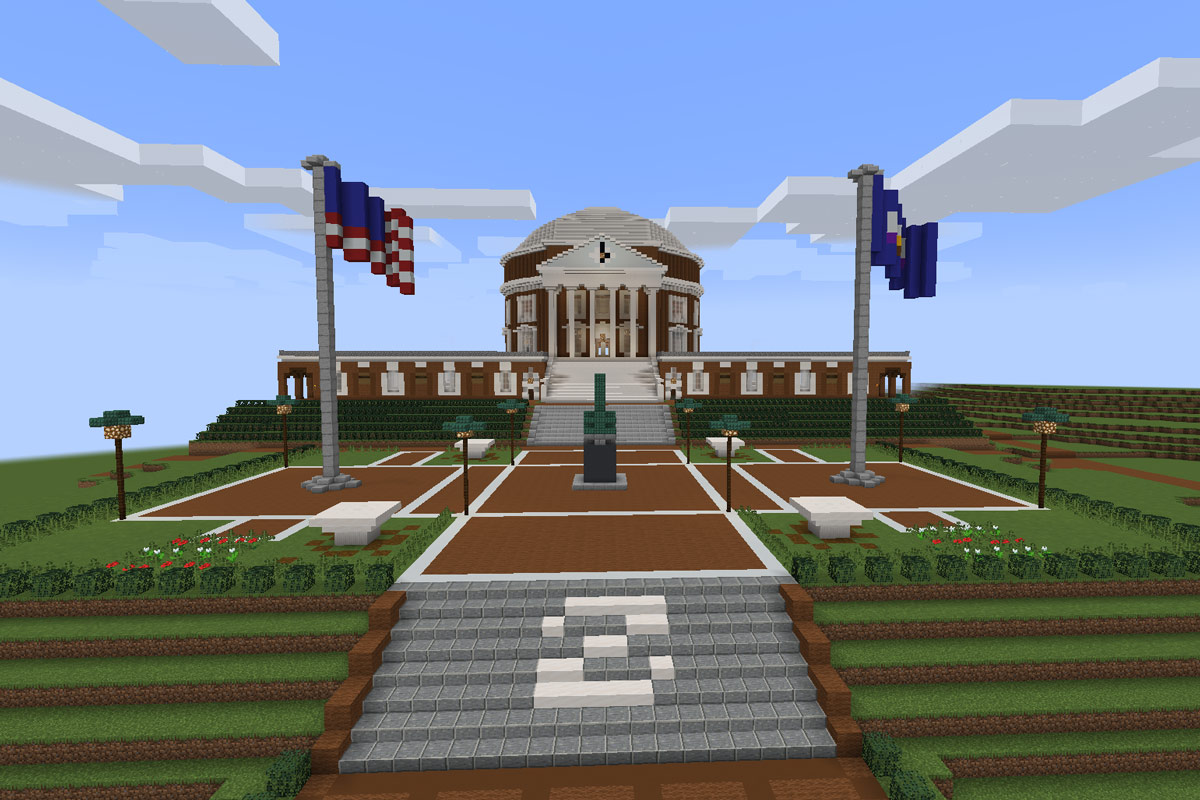
The most elaborate and impressive part of the world is the Rotunda—and it was also the trickiest to complete.
“A lot of the buildings on Grounds are fairly standard: rectangular with a triangular roof,” Husted says. “At first, it was difficult to find a compromise between the Rotunda’s curvature and Minecraft’s angular building blocks. That took a matter, honestly, of just proportions more than anything, just sizing relative to other objects next to it.”
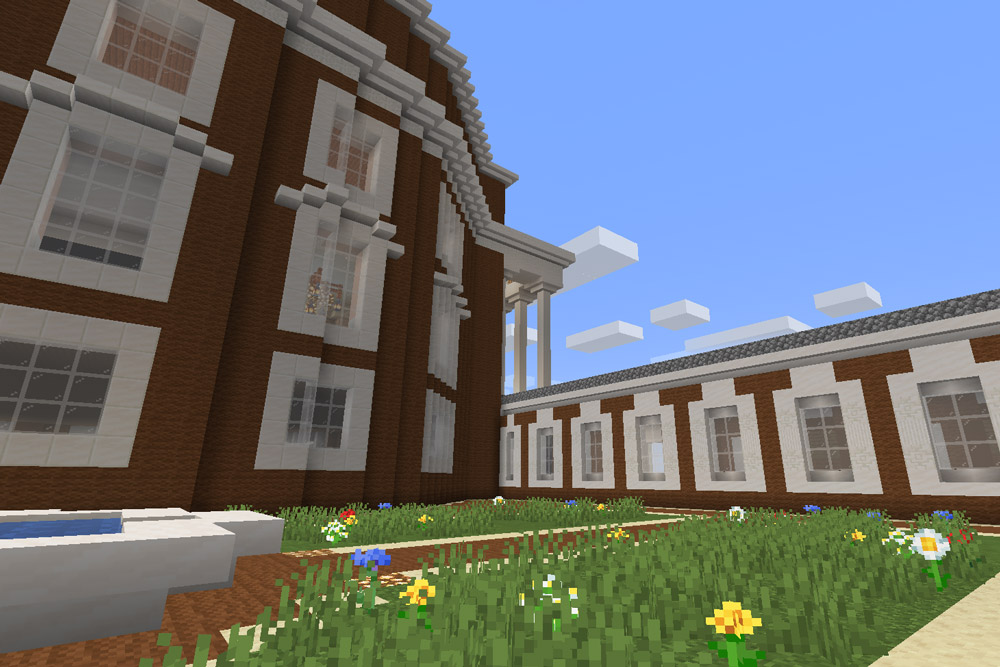
It took many attempts to get the Rotunda just right. “And that’s one of the reasons why I was so proud of it in the end,” he says, “because I got it to a point where it looked really, really good.”
When you climb the steps and enter the main doors of the Rotunda, you’ll notice that, unlike the other structures that Husted built, it features a complete multilevel interior that you can walk through—and up.
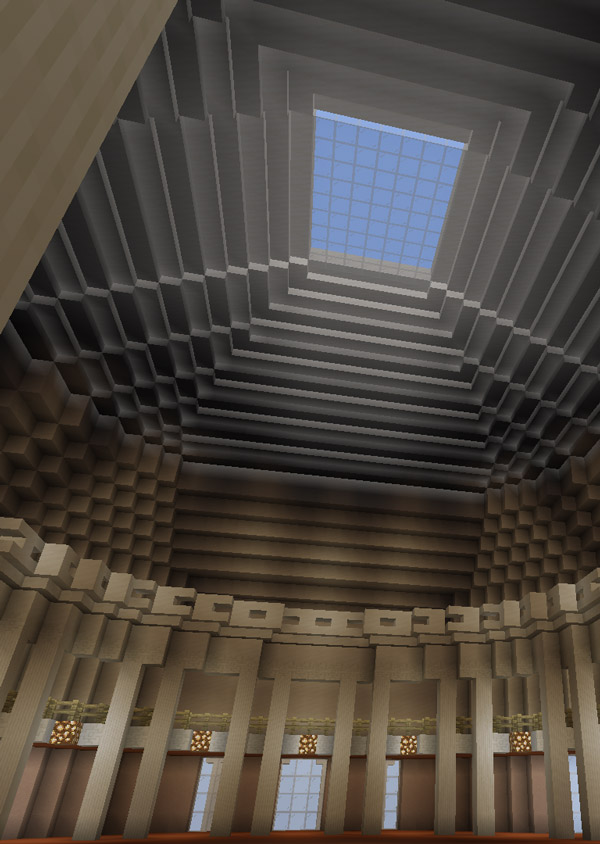
Once he completed the Rotunda, he worked his way outward, building the rest of the Lawn and moving south to Old Cabell Hall.
Husted’s homage to Grounds is almost perfect, but there was one detail he found impossible to get right with Minecraft’s limited resources: statues. They’re simply too small and too detailed to build with Minecraft’s cubes. He decided to represent the Homer statue in front of Old Cabell Hall and the Jefferson statue in front of the Rotunda with rudimentary, “low-resolution” versions.
In addition to the Rotunda, Husted’s world features the Lawn (pavilions I–IX and pavilions II–X), the West Range (dining hall, Lawn rooms, and hotels), the Chapel, Shannon Library, Clemons Library, Special Collections, Peabody Hall, Monroe Hall, Garrett Hall, Cocke Hall, Old Cabell Hall, New Cabell Hall, Rouss Hall, Bryan Hall, and the McIntire Amphitheatre.
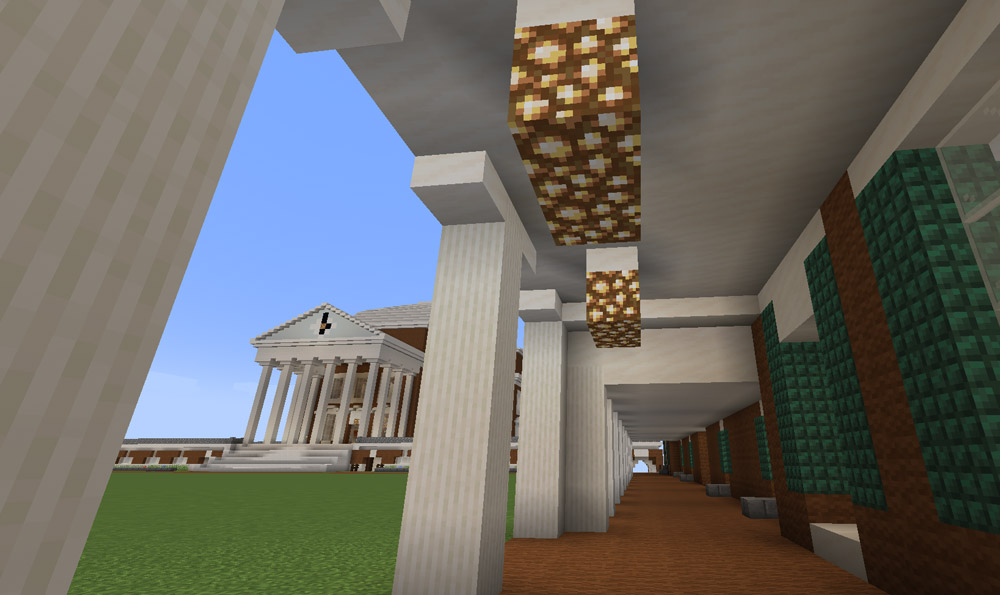
When he shared the project with the UVA community on Reddit back in 2021, Husted says, he was “blown away by the response that people had to it.” Users called it “legendary,” “insanely well done” and “the most beautiful thing I’ve ever seen.” One said, “It’s amazing how this could bring me so much nostalgia. It’s as if I’m right there again.” Another asked to download the file to “show my kids UVA through their favorite game.”
His post is now the third most upvoted of all time on the UVA subreddit.
For other ’Hoos interested in tackling a project of this magnitude, “definitely take it a day at a time or in chunks,” Husted suggests. “With dedication and passion, you never know what you can create when you set your mind to it.”
Lego Rotunda by Benjamin Edlavitch (Arch class of ’25)
Estimated hours spent: 40 to 50
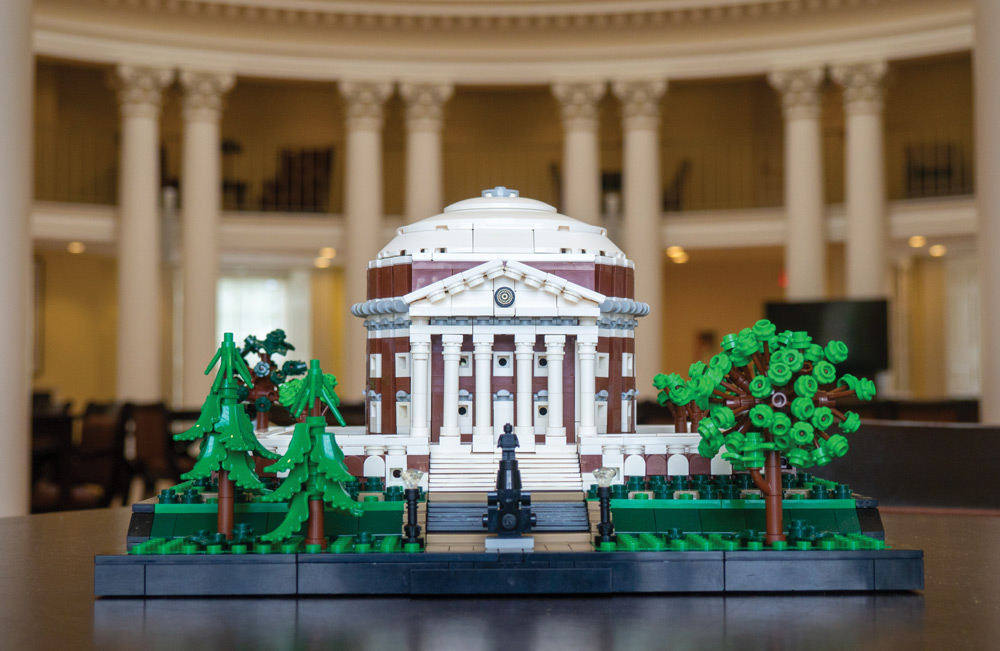

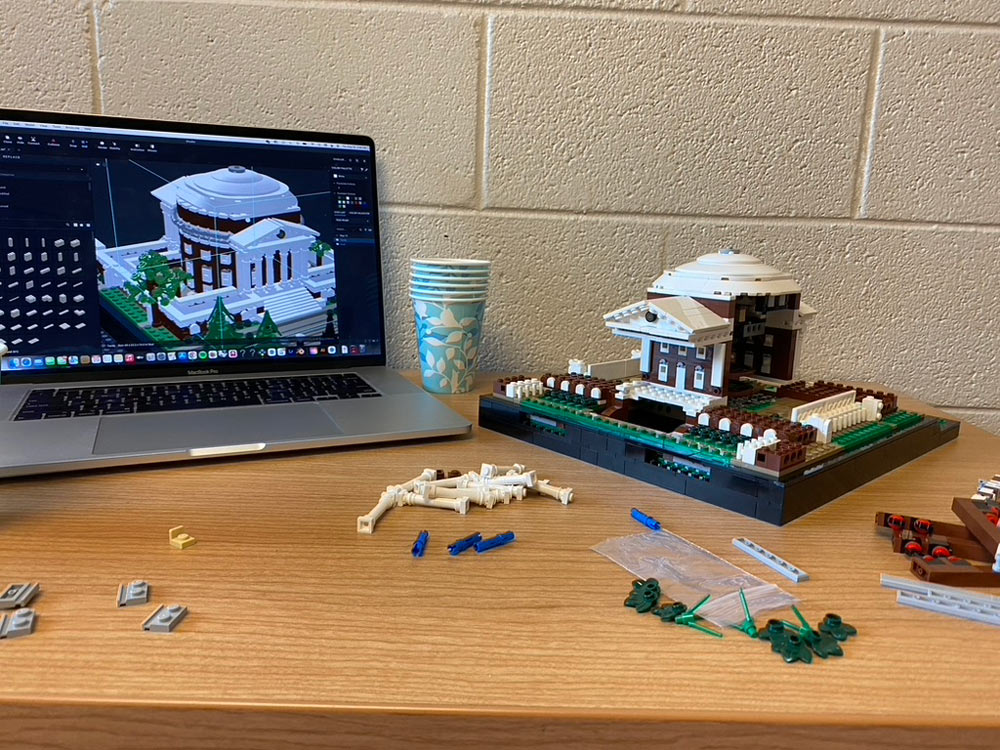
Benjamin Edlavitch (Arch class of ’25) started designing a Lego model of the Rotunda before he’d even been accepted to UVA.
“When you apply to architecture schools, you have to have a portfolio. A couple of the projects I had in mind were Lego-related, so I started working on the Rotunda,” says Edlavitch, who competed on Season 4 of Fox’s LEGO Masters reality game show in 2023. “It was meant to be a little bit of pandering, maybe, to help me get into the program here.”
Using what he describes as “CAD for Legos,” he finished the rendering during his first year but says it “sat around as a digital file for the next couple of years” as he focused on his schoolwork. Now, in his final year of the architecture program, he has finally built the physical model to be featured in a Lego exhibit at the Virginia Museum of History and Culture in Richmond.
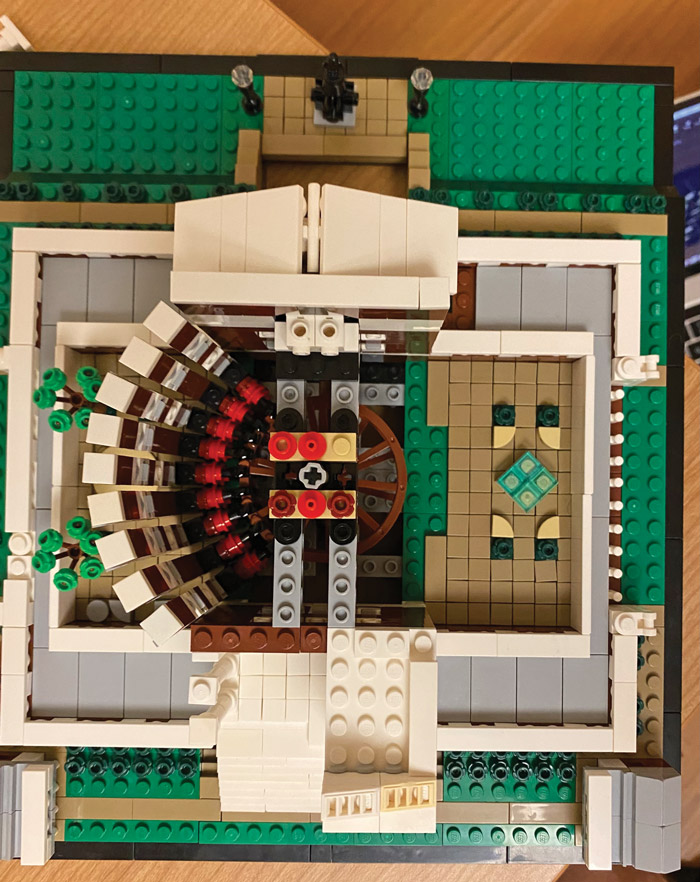
Tasked with constructing a famously round structure using square bricks, Edlavitch had to experiment. He found a round wheel piece—“meant to be used on the outside of a wagon or a stagecoach or something”—and then laid it flat and used clips to attach pieces.
He also had to shop around until he found just the right materials for the building’s iconic columns: candlestick pieces stacked on top of one another and then, at the top, round circular studs and flower pieces. “That gives the detail of the big Italian Corinthian columns,” he says.
The final creation—which includes trees, terraces and the Jefferson statue below the Rotunda’s northern steps—measures about 12 by 15 inches and contains around 3,000 pieces.
“I really enjoy having this creative outlet that’s very playful,” he says. “I think playfulness is a very important part of architecture, and creating things that people really identify with and enjoy interacting with.”
The Sim Rotunda by Ali Butcher (Engr class of ’24)
Estimated hours spent: 5
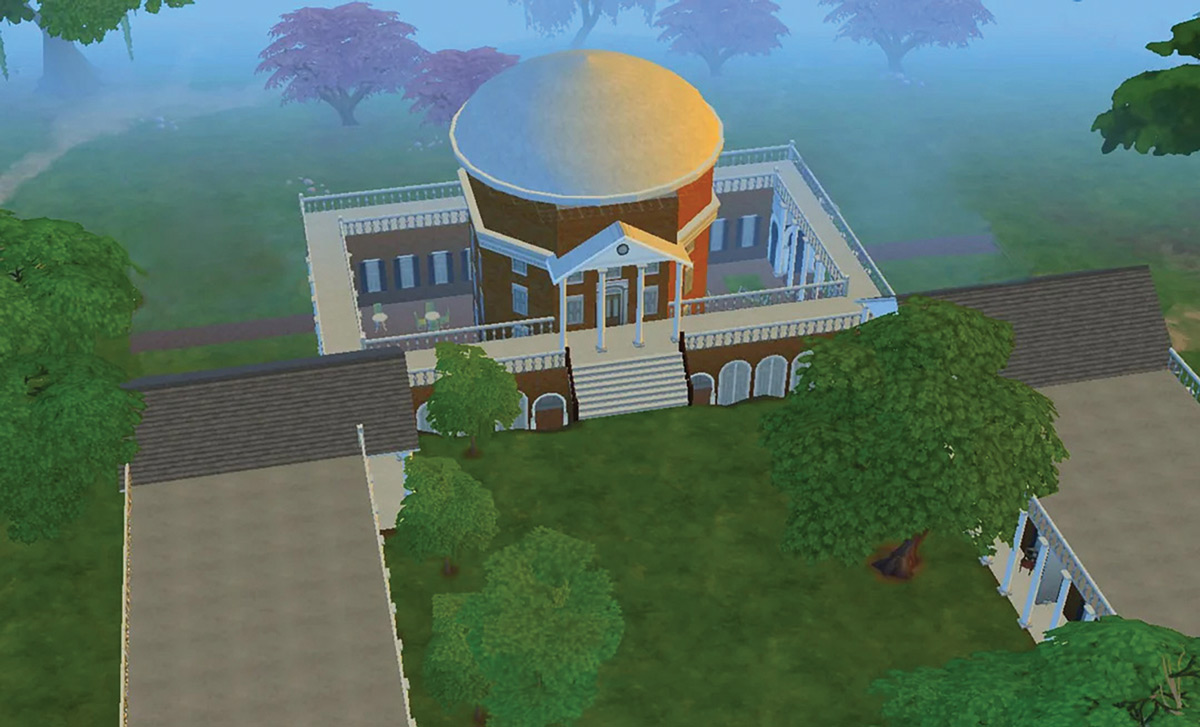
When Ali Butcher (Engr class of ’24) arrived at UVA for her first in-person semester in the spring of 2021, COVID restrictions forced her to get creative to familiarize herself with Grounds. She and her dormmates turned to The Sims, the popular video game that lets users build homes for virtual characters.
She started by building Lile-Maupin. “First year I was in my dorm pretty much all the time because of COVID, so that was kind of my little world,” says Butcher, who now works as a technical solutions engineer in Madison, Wisconsin. “My friends and I had little Sims, and then we decided we needed the Lawn for them to also walk around.”
In what she calls “a single night of boredom,” Butcher spent about five hours building the Rotunda from scratch by referencing photos of the Lawn from different angles.
“I had a photo on my phone of the Lawn from a few different angles, and I was really taking close looks at the architecture.”
“I was really taking close looks at the architecture, and it was kind of cool because it actually made me really think deeply about the architectural decisions they made, because I was trying to replicate it as closely as I could.”
The trickiest part? The proportions. “I don’t think The Sims is really meant to be on a giant-building scale,” she says. “It’s designed for more of a house scale.” Take, for example, the clock situated in the building’s Lawn-facing portico that, in real life, measures 5 feet, 6 inches, across. Butcher’s only option was a regular decorative house clock, but she managed to use a cheat code to scale it up until it fit seamlessly.
Another detail she’s proud of are the tables and chairs in the courtyard—she tinkered with several options until they looked just right.
“I had also seen the Minecraft version of Grounds, and it’s made me think about, as UVA students, how much our beautiful architecture on our Grounds means to us,” Butcher says. “And I think it’s really cool that a lot of different people have felt the need to create little digital monuments to it.”