30 years on from the first time UVA squashed FSU
UVA Athletics
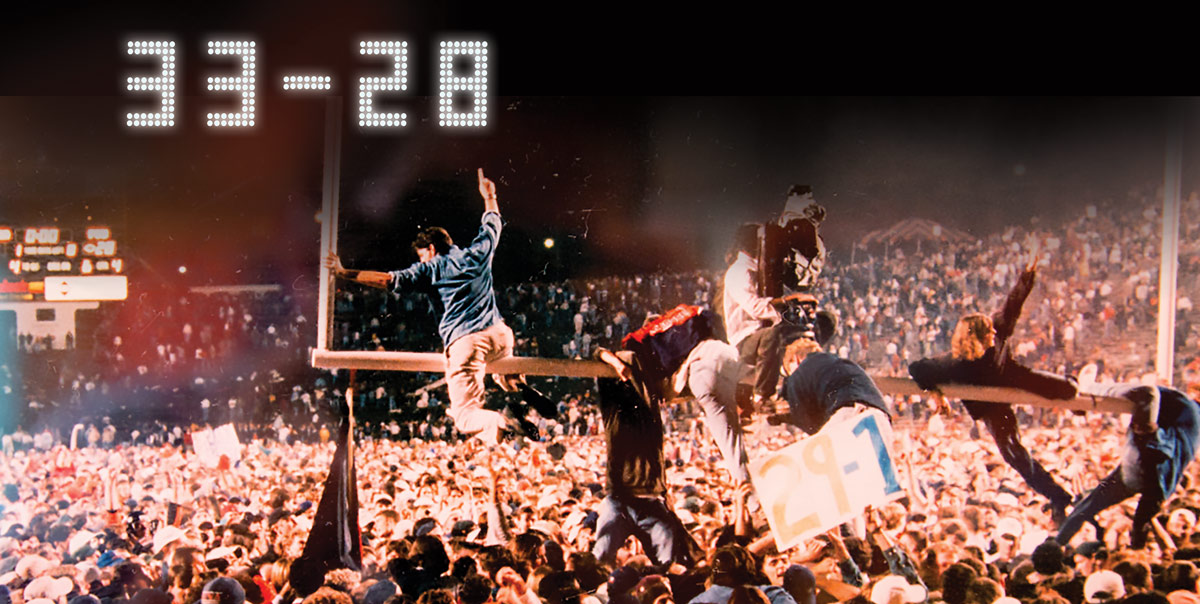
The atmosphere inside Scott Stadium was electric, as fans and players describe it 30 years later. The sellout crowd of 44,300 on Nov. 2, 1995, packed the stands. Students had claimed every ticket reserved for them—twice as many as the typical UVA football game.
They were gathered there to watch No. 24 UVA take on No. 2 Florida State, a powerhouse riding a winning streak under legendary coach Bobby Bowden. The Seminoles’ star running back, Warrick Dunn, was a Heisman contender.
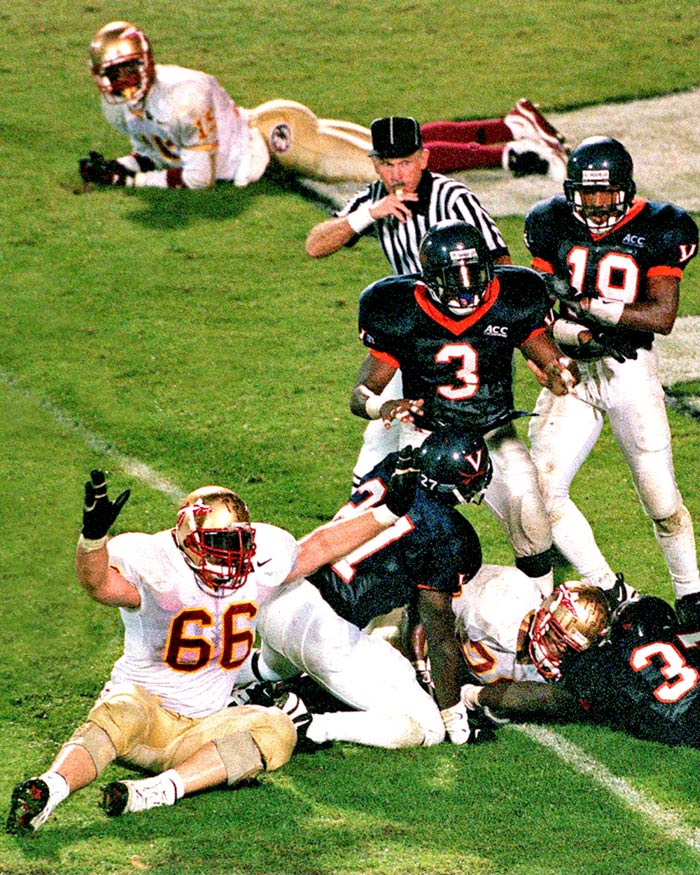
Big plays dotted the four quarters, but it’s the final four seconds that are remembered most vividly. UVA led 33-28, but FSU had the ball on the Cavaliers’ 6-yard line. And instead of throwing, as many expected, Dunn ran it up the middle.
“You could touch the air and get static shock,” remembers then first-year John Flowers (Col class of ’99).
Fans and players remember the moment that play exploded into action. Sitting higher up in the stands, then third-year Jennifer Newsom Csontos (Col class of ’97) shielded her eyes. Next to her, then third-year Arnie Mason (Col class of ’97) wondered: Did we win?
On the field, the Cavaliers were locked in. As Dunn waited for what would be a direct snap, UVA defensive captain Skeet Jones (Col class of ’95) spotted his eyes shifting from the ball to the route he’d take toward the end zone, prompting Jones to point out the path and forecast the play to his teammates.
Safety Percy Ellsworth (Col class of ’96) watched it unfold with what he calls the “absolute best view.” On the field, yards away, he saw Dunn run the ball and safety
Adrian Burnim (Col class of ’99) dive to push it out of Dunn’s hands just before it reached the goal line.
What are you even doing? Ellsworth wondered in the moment. Usually defensive players are trying to tackle the runner, not poking at the ball. Burnim remembers thinking: We’re not losing.
As the clock ticked to zero, Burnim had knocked the ball out of Dunn’s hands—just a few inches from the goal line. The crowd erupted. UVA had overcome a football powerhouse, and the night would go down in the record books.
This past September, UVA beat No. 8 FSU in double overtime, 46-38, and fans stormed the field. It was the fourth time the Seminoles have fallen to the Cavaliers since the 1995 game. UVA football also bested FSU on the field in 2005, 2011 and 2019.
But the 1995 game was different. On that night, UVA dealt FSU its first loss in ACC history, ending the team’s 29-game conference winning streak. It featured the most future NFL players of any ACC game—62 players on both teams’ rosters went on to play professionally, including 30 ’Hoos. That season ended with a win over Georgia in the Peach Bowl and UVA coach George Welsh, who died in 2019, being named ACC coach of the year.
Ellsworth, who went on to play six seasons in the NFL, recalls the on-field celebration. “I took it all in,” he says. “That was such pure joy. I remember, even when I went to sleep like at 5 or 6 [in the morning], the campus was still buzzing. It was buzzing the whole time.”
Losses in final seconds
In that 1995 football season, UVA had come heartbreakingly close to major wins. It opened with an 18-17 loss at No. 14 Michigan in front of a crowd of 101,444, decided by a final play that began with just four seconds left. The New York Times dubbed it the “greatest comeback in Michigan history.”
Despite racking up conference wins after that game, UVA entered the Florida State matchup stinging from a loss to No. 16 Texas two weeks earlier. Once again, in front of a massive crowd and in the final seconds of the game, UVA, then ranked No. 14, lost in crushing fashion, 17-16.
“I remember Coach Welsh in the coach’s locker room at Texas when the game was over,” says Art Markos (Educ class of ’08), then an assistant coach for UVA who was responsible for defensive backs and punters. “He was staring at the ground, and he was talking, thinking out loud, and he said, ‘It’s got to turn. It’s just got to turn somewhere.’ And they were prophetic words.”
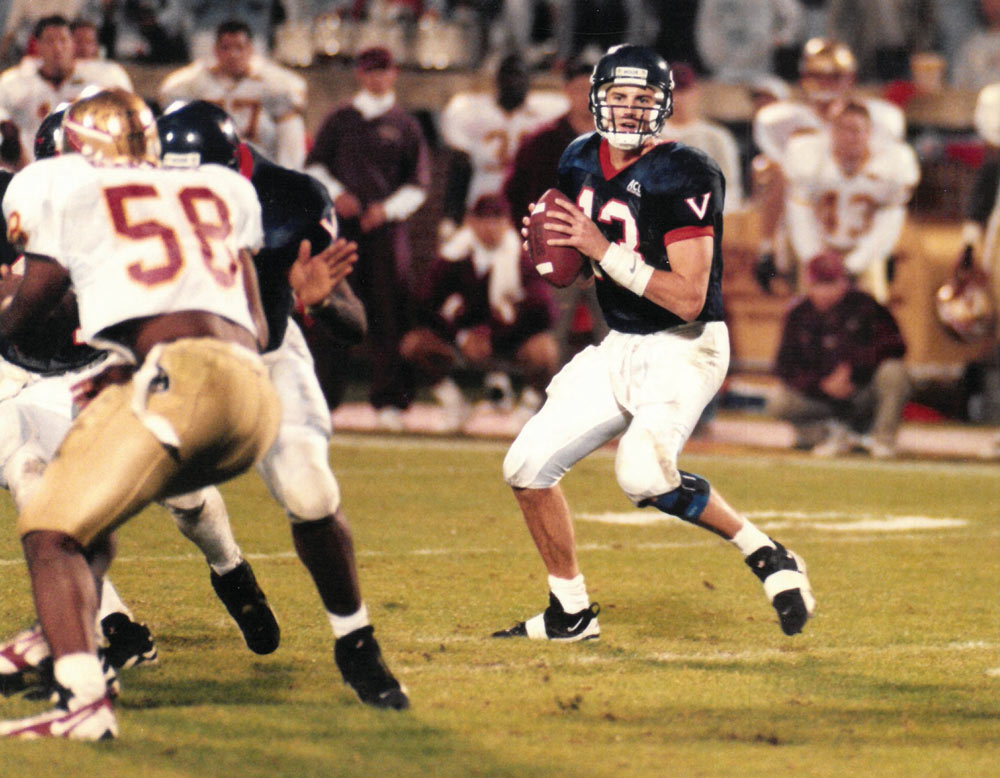
Those losses were painful, but they also proved something to the players and coaches: UVA could hang with college football’s elite, and maybe even beat them.
In many ways, the culture and competitive spirit of the 1995 team were rooted in UVA’s record-breaking 1989 season—when the program won a school-record 10 games and claimed a share of the ACC championship for the first time, Jones says. In 1995, Jones and other upperclassmen had played alongside veterans of that historic run; some were Welsh’s first recruits. Players were eager to carry that legacy forward.
“Even though none of them were playing in that ’95 game, they had a big influence,” Jones says. “That was the accountability piece for us.”
The team also was primed for intense competition. Recent recruiting classes had drawn multi-sport stars, including Burnim, from high schools across Virginia, North Carolina and elsewhere. And they all had perfected their positioning, plays and strength through intense practices in the spring and summer. Conditioning coach Eric Fears (Educ class of ’84), in particular, took their strength and conditioning to new levels, players say.
They knew how to win, and they loved to compete on and off the field. “There was not a moment that the team wasn’t competing with each other, whether it was who had the best ability to remember a rap lyric or who had the best polo shirt collection,” says Burnim, who also was a high school basketball point guard known for racking up steals. “So that made practices intense. And games were fun.”
An open week between the Texas and FSU games meant the Cavaliers had more time to prepare for Florida State and get recentered, Markos says. The team even practiced versions of the very play that would unfold in the final seconds of the game.
The night before the game, Welsh did something he’d never done before and took the team to the stadium. Markos says: “George was not a big ‘rah-rah’ kind of coach. When he talked, you listened, because he had something to tell you.” That night, Welsh pointed to different players and different spots on the field and had them envision hypothetical plays. One of the spots was near where the game-ending play took place.
“It was emotional,” Markos says. “It was the kind of thing that got the kids fired up.”
A win manifested
On the morning of game day, the team woke up at the Omni Hotel in downtown Charlottesville, just as they usually did. Burnim and Anthony Poindexter (Col class of ’99), the two players who would be instrumental in that final play, were roommates. Burnim had a vivid memory of a dream. “I remember waking up and I said, ‘Dex, we’re going to win the game,’” Burnim says. “I’m going to make a last-second play at the end to win the game.”
The Thursday night game, televised nationally on ESPN, was at an unusual time and on a misty day. But it didn’t slow down the pregame celebrations. Students came early, lining up at 4:30 p.m. to get the best seats when the gates opened at 6, the Cavalier Daily reported. The game featured fireworks.
Then a first-year, Naveen “Vinnie” Kwatra (Col class of ’99) remembers feeling pumped. A high school football player, he was eager for a great game and to see some college football greats, including Bowden, on the field. “I felt like the whole campus was pre-partying and getting ready,” says Kwatra, who visited a couple of fraternities along Rugby Road before the 8 p.m. kickoff.
Ellsworth clearly remembers feeling the energy inside the stadium, particularly in the student section, when he and the rest of the team got to the field.
“They were really the 12th man,” he says. “It was a wild crowd, and it was exactly what we needed.”
At the time, UVA set aside 8,000 tickets for students for football games, though typical attendance hovered around 4,000, The Daily Progress reported then. But this matchup drew 8,500 students.
“If anybody was in that crowd that night, we appreciate every cheer, yell, cuss word, whatever you did—we appreciated it as a team,” Jones says. “It was the first time that I had been at a game and we walked in and the student section was damn near full.”
‘Ready to fight’
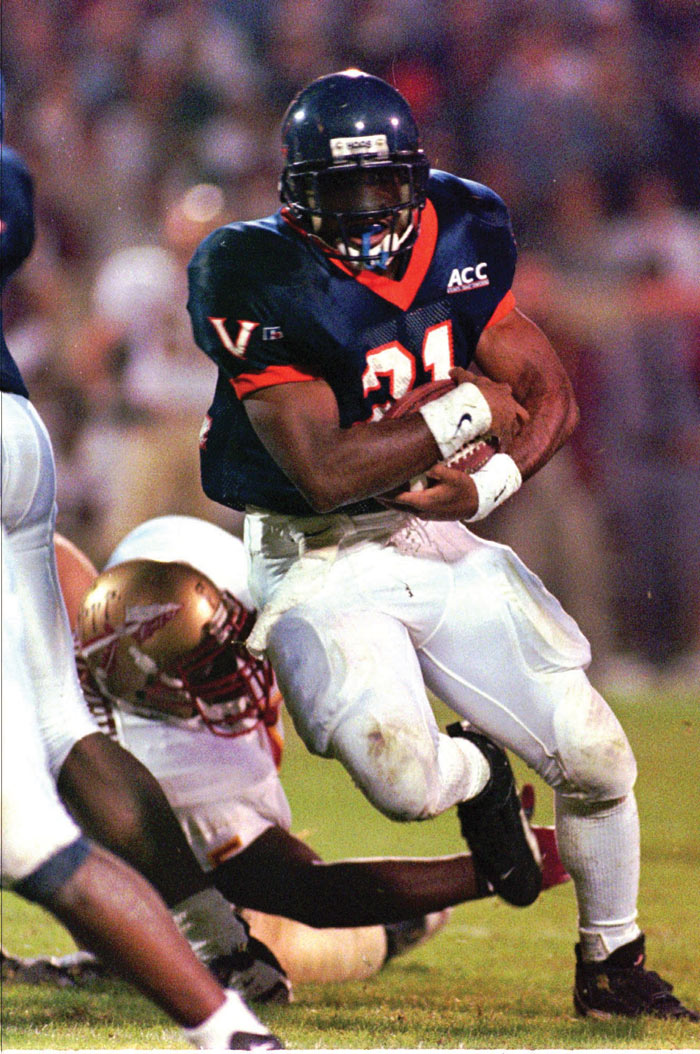
Like most great football games, this one had its ups and downs for the ’Hoos, including an early FSU touchdown, which left players rattled. But then Tiki Barber (Com class of ’97), who would go on to a career in the NFL, tied the game with a 64-yard touchdown run. “It reassured my confidence. Everybody is ready to fight,” says Ellsworth, whose interception with just a couple of minutes left in the game was another critical play.
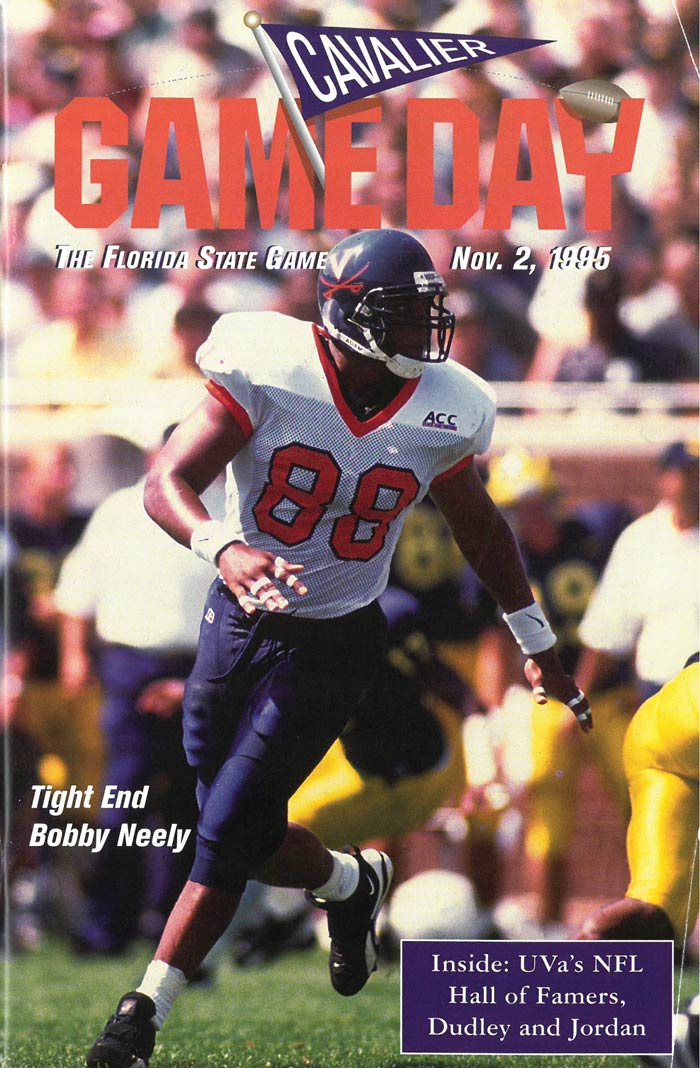
The final moments unfolded in slow motion. With nine seconds left, FSU’s quarterback, Danny Kanell, threw the ball out of bounds, and UVA fans, thinking the game was over, rushed the field. Players pushed them back.
In the stands, Flowers remembers, the energy built to intensity. As the end was coming, “you could feel like this was happening,” he says. “They’ve got the ball at the very end, they’ve got to make that goal line stand. You didn’t know what was going to happen, until finally you did.”
On the field, the players lined up for one last time. And everything played out just as they had prepared for in practices and conditioning. “It was awesome to watch,” Burnim says. “Poindexter, James Farrior [Col ’97], Jamie Sharper [Col ’96] … all of us moved in concert as a defensive unit. It was a tremendous play.”
As Dunn inched closer to the goal line, Burnim saw him getting ready to lunge to score. In response, Burnim did two box jumps to the left, a move he’d fine-tuned with Fears in the weight room. Then he stretched his left arm out in anticipation of Dunn reaching his hand out with the ball to cross it over the goal line.
Falling back on his point guard skills, Burnim knocked the ball out of his hand as Dunn fell to the ground before the goal line. Poindexter, now a co-defensive coordinator and safeties coach at Penn State, was there too, helping to keep Dunn from scoring.
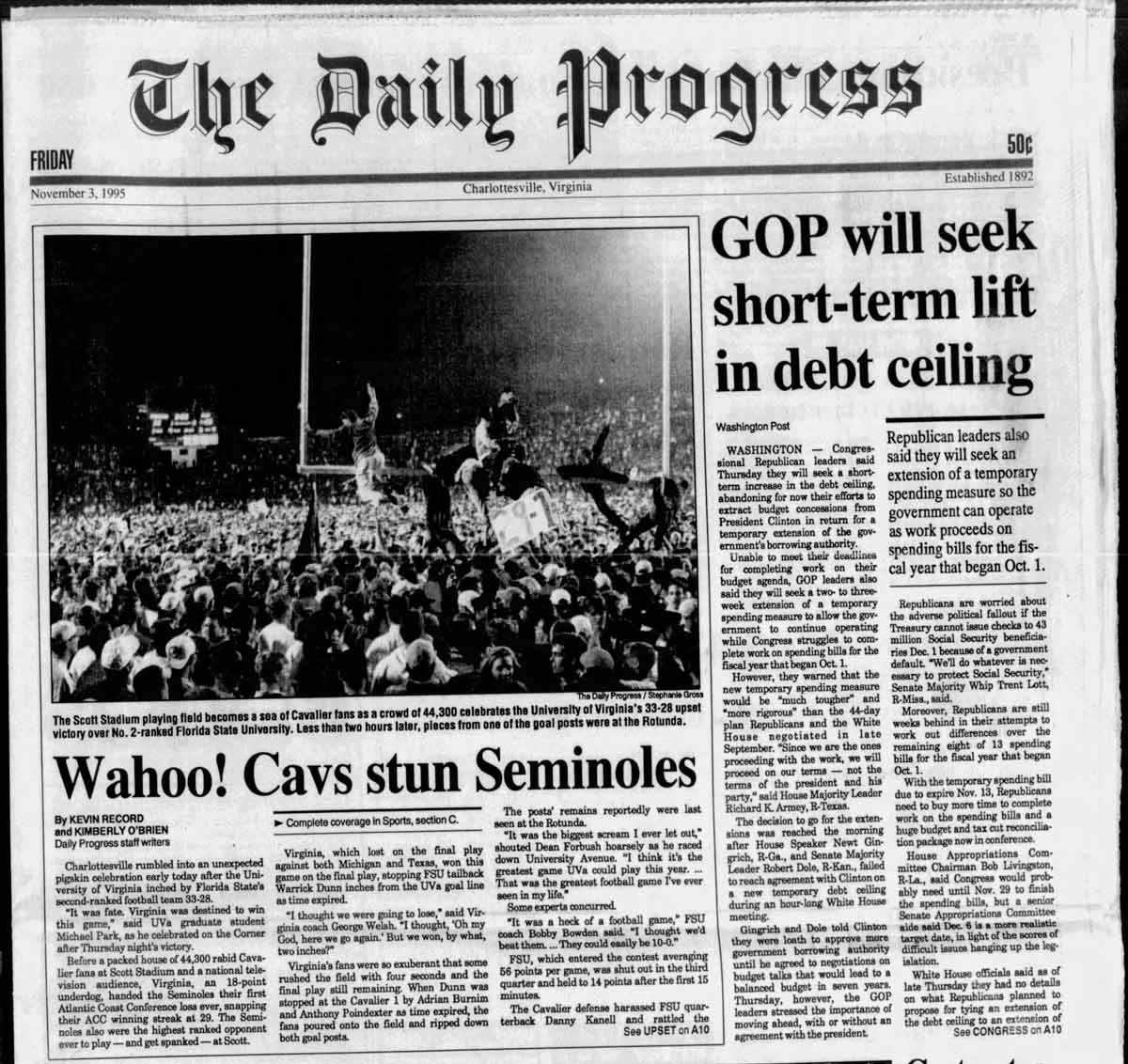
“For good measure, I hit the ball away from the goal line so it couldn’t be received in the end zone either,” Burnim says.
Waiting to get the ruling from the referee, the local play-by-play announcer and former UVA star running back Frank Quayle (Educ class of ’69) was in disbelief. “They’re gonna say no. They’re gonna say no,” he shouted as the final call was made.
But they didn’t. UVA won the football game.
The student section spilled out onto the field again. One fan swiped the ball from Burnim’s hands as he was on the ground, suffering from a cramp. Others, including Kwatra, got to work tearing down the goalposts. Kwatra followed a portion of them to Delta Sigma fraternity, where a brother got out a saw and carved up pieces as souvenirs, he says.
Recent graduate Kevin Edds (Col class of ’95) had spent the game working inside an ESPN production truck, handling the on-screen down-and-distance graphics. He’d had to sit quietly throughout the game and do his job, but before the very last play, he got permission from the executive producer to run out onto the field to celebrate if UVA won.
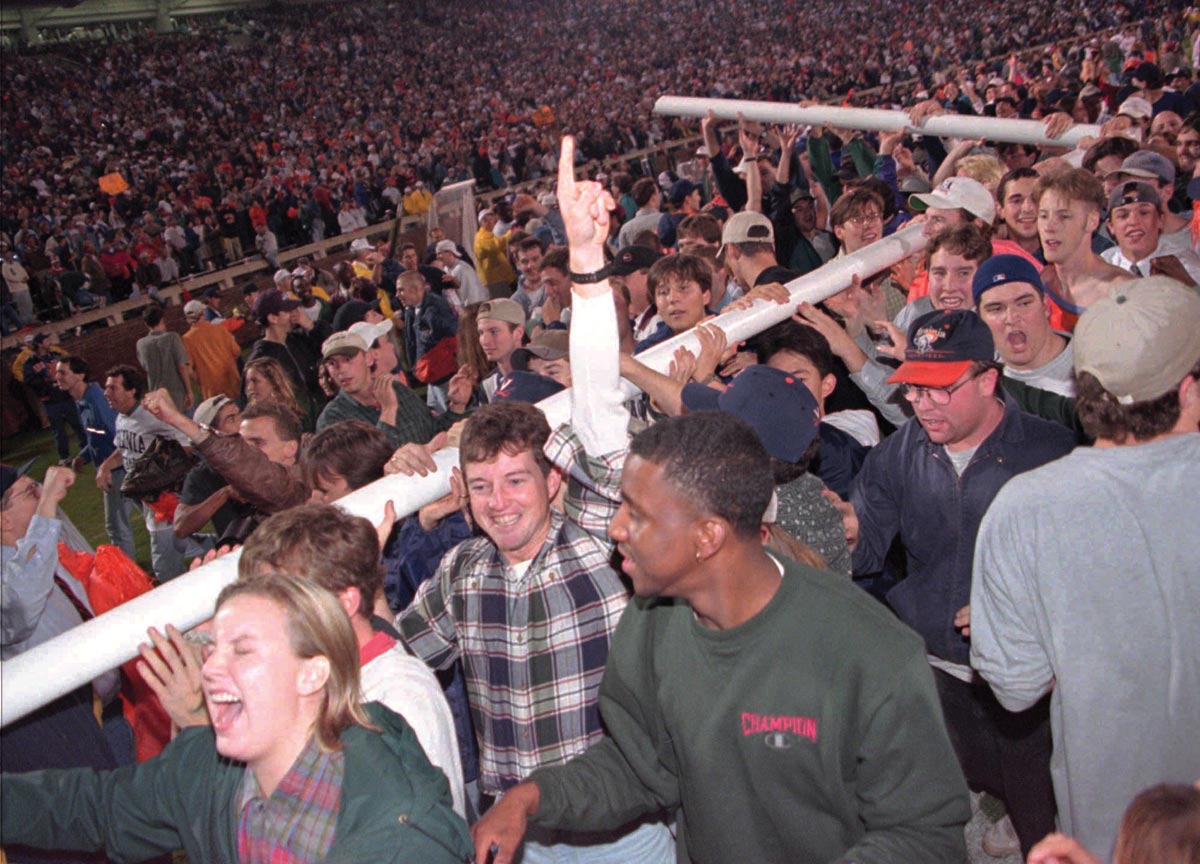
It was madness, says Edds, who was inspired that night to produce a documentary on UVA football, 2010’s Wahoowa: The History of Virginia Cavalier Football.
“You’re trying not to get trampled,” he says. “You don’t know where you’re going. You see a player, but you want to respect their space, and yet people are grabbing them and trying to pick them up in the air. … It was just so celebratory and just so much fun, and just this weight lifted off of the fans’ shoulders.”
Flowers, then a senior writer for the Cavalier Daily, started reporting. As staffers in the Newcomb Hall newsroom scrambled to redesign the paper’s front page, Flowers interviewed students in the stadium and eventually followed a section of goalpost to the Lawn, where a group placed it on the steps of the Rotunda as a sacrifice to Thomas Jefferson.
“They laid it down on the steps very gently too,” Flowers says. “They were very drunk, as I’m sure everyone was. But they were actually very considerate with it being a national historical site, very carefully laying it down there. It was very serious business at that point.”
Inside the locker room, there were celebrations too—and, by chance, a large number of high school recruits who were there to check out all that UVA had to offer. They included linebacker Byron Thweatt (Col class of ’00). “I grabbed him and bear-hugged him and was like, ‘Now who are you going to commit to?’” Jones remembers. Thweatt went on to become a two-year captain for UVA and play in the NFL.
The party continued long into the weekend and across the country. The Cavalier Daily sold posters of the next day’s front page, featuring the final score in big, bold font, with some bought up by alumni far from Charlottesville. Mincer’s printed souvenir T-shirts, The Daily Progress reported, that read, “And we ruled every inch … including the last one.”
FSU fans took the loss poorly. Ellsworth says Dunn was still questioning that final call when they saw each other years later. “No one here gave Virginia a shot at winning,” said a Tallahassee radio host at the time.
Thirty years later, it remains among the most iconic moments for UVA football. Alumni remember where they were—whether inside Scott Stadium or across the country.
For the players, it was about more than the win. It was validation of their hard work and the culture they built together. Even now, that connection holds strong, and Jones is the connector, keeping the far-flung brotherhood together.
“That season was life: ups, downs, highs, lows,” Jones says. “The true definition of grit.”